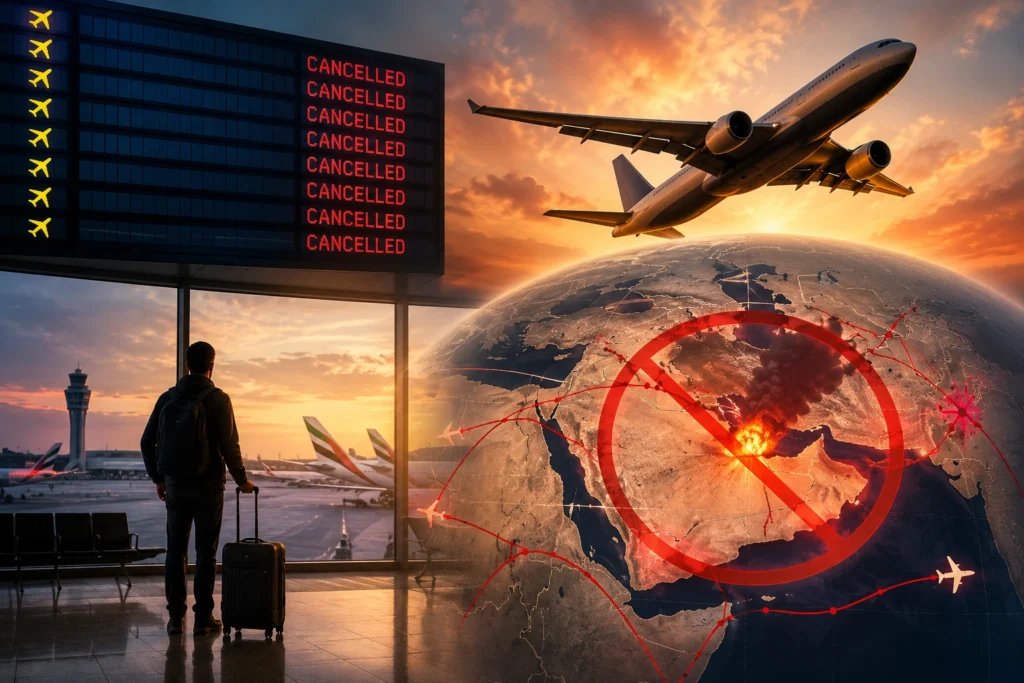
Germany, France, the United Kingdom, the United States, Italy, India and several other countries are facing escalating aviation disruption as major global airlines suspend flights to Dubai, Doha, Tel Aviv and key Gulf destinations amid intensifying Middle East airspace tensions.
Airlines including Lufthansa, Air France-KLM, British Airways, Delta Air Lines, United Airlines and Air India have either halted or significantly reduced operations across parts of the Middle East and Gulf region, citing safety concerns, operational instability and mounting costs linked to rerouting aircraft around restricted airspace corridors.
The coordinated airline response reflects growing pressure on global aviation networks as regulators across Europe, the United States and India issue advisories urging carriers to avoid high-risk airspace sectors involving Iran, Iraq, Israel and surrounding regions.
The result is a rapidly evolving travel landscape marked by longer flight times, reduced capacity, higher fares and widespread disruption to international connectivity between Europe, Asia, the Middle East and North America.
Lufthansa Group Adopts Longest Gulf Route Suspensions
Germany’s Lufthansa Group has emerged as one of the most cautious major airline groups responding to the crisis, implementing some of the aviation industry’s longest route suspension periods.
The group, which includes Lufthansa, SWISS, Austrian Airlines, Brussels Airlines and Eurowings, has suspended flights across multiple Middle Eastern destinations while introducing phased and delayed return strategies for selected routes.
Lufthansa and SWISS have suspended Dubai services through at least mid-September 2026, significantly longer than many competing carriers. Additional services involving Abu Dhabi, Amman, Riyadh, Muscat, Tehran and Erbil remain suspended through at least October 24, covering most of the core summer travel season.
Brussels Airlines has also suspended Tel Aviv and other regional services for the duration of summer operations, while Eurowings extended suspensions affecting Dubai, Abu Dhabi and Amman.
The Lufthansa Group’s strategy reflects a broader focus on risk mitigation, schedule stability and compliance with European aviation safety advisories rather than frequent short-term operational adjustments.
British Airways Cuts Dubai, Doha and Tel Aviv Operations
British Airways has also significantly reduced its Middle East network following escalating regional instability and increasing operational challenges associated with rerouted flight paths.
The airline officially extended suspensions affecting Dubai, Doha and Tel Aviv until August 1, 2026, while simultaneously reducing planned service frequencies upon eventual resumption.
Under the revised schedule, London to Dubai flights will restart with only one daily service instead of multiple frequencies. Doha and Tel Aviv routes are similarly being reduced to one daily flight each.
British Airways has additionally suspended Abu Dhabi indefinitely for the summer season and permanently discontinued flights to Jeddah following an operational review focused on airspace risks, financial viability and network priorities.
The carrier acknowledged that longer rerouting requirements and fuel-intensive alternative corridors are creating major challenges for schedule reliability, crew deployment and operational efficiency.
Air France-KLM and European Airlines Reroute Operations
Air France-KLM has also adjusted Gulf and Middle East operations amid heightened concerns regarding regional airspace safety.
KLM suspended or reduced services affecting Dammam, Riyadh and Dubai while avoiding airspace corridors crossing Iran, Iraq and Israel. Air France similarly introduced route reductions, schedule adjustments and rerouting strategies involving Gulf and East African services.
European carriers are increasingly relying on alternative flight paths over North Africa and southern corridors, often adding one to two hours or more to journey times.
The operational consequences are substantial, increasing fuel consumption, crew scheduling complexity and overall flight costs. These additional expenses are now affecting fare pricing, network planning and route profitability throughout the global aviation market.
US Airlines Scale Back Gulf and Tel Aviv Services
Major US carriers including Delta Air Lines, United Airlines and American Airlines have also sharply reduced Middle East exposure.
United and Delta suspended Tel Aviv operations indefinitely during the peak summer season, effectively eliminating direct transatlantic connectivity between several major US gateways and Israel.
US airlines are additionally avoiding Iranian and Iraqi airspace following Federal Aviation Administration safety advisories, forcing aircraft onto longer southern and northern routing patterns.
Rather than maintaining unstable Gulf operations, many US carriers are redirecting aircraft capacity toward transpacific and domestic markets less exposed to geopolitical disruption.
Although American carriers have not issued extensive public advisories comparable to European airlines, their operational schedules clearly reflect heightened caution and prolonged uncertainty.
Air India Adjusts International Routes Amid DGCA Advisories
India’s aviation sector has also experienced major disruption due to its strategic location connecting Europe, Asia and the Middle East.
Air India confirmed temporary reductions affecting long-haul routes to North America and Europe while rerouting Gulf-bound services around restricted airspace sectors.
Flights connecting Delhi, Mumbai and major European and North American cities have experienced frequency cuts and operational adjustments between June and August 2026.
India’s Directorate General of Civil Aviation (DGCA) has issued advisories recommending avoidance of multiple West Asian airspace corridors, strongly influencing operational decisions by Air India and other regional carriers.
The airline continues operating Gulf services including Doha and Dubai but with modified schedules, extended block times and higher operating costs caused by rerouted flight paths.
Global Airlines Face Rising Costs and Reduced Capacity
The prolonged airspace crisis is creating significant operational and financial strain throughout the aviation industry.
Airlines rerouting around restricted Gulf corridors are experiencing sharply higher fuel consumption, longer crew duty periods and increased maintenance complexity due to extended flying times.
At the same time, widespread flight suspensions are reducing overall seat capacity between Europe, Asia, the Middle East and North America. The resulting supply constraints are placing upward pressure on fares, particularly during the peak summer travel season.
Industry analysts note that passengers should expect longer travel durations, reduced nonstop options and increasingly flexible routing arrangements as airlines continue adapting to rapidly changing geopolitical conditions.
Airlines Expand Flexible Booking Policies
In response to ongoing uncertainty, many carriers have introduced expanded customer flexibility measures.
Passengers across affected routes are being offered full refunds, fee-free rebookings and alternative routing options regardless of whether flights remain technically scheduled.
Airline mobile applications and reservation systems are also increasingly being used to deliver real-time notifications regarding delays, cancellations and route changes.
Travel experts advise passengers to closely monitor airline updates and remain prepared for last-minute schedule adjustments as conditions continue evolving.
Middle East Airspace Crisis Reshapes Global Aviation
The current wave of Middle East flight suspensions highlights how geopolitical instability can rapidly reshape global aviation networks and international tourism flows.
Long-established air corridors connecting Europe, the Gulf, Asia and North America are now being temporarily abandoned not because of weak demand but due to operational safety considerations and regulatory guidance.
Airlines are balancing commercial viability with risk management while governments and regulators continue monitoring airspace security conditions across the region.
Aviation Industry Faces Prolonged Uncertainty
Germany, France, the United Kingdom, the United States, Italy and India now find themselves at the center of one of the most significant aviation disruptions affecting Middle East connectivity in recent years.
With Lufthansa, British Airways, Air France-KLM, Delta, United, Air India and other global carriers suspending or reducing Gulf operations, international travelers are entering a period of prolonged uncertainty defined by rerouted journeys, volatile schedules and shifting global aviation patterns.
The evolving crisis is expected to continue influencing airline strategy, tourism flows and international connectivity well beyond the immediate summer travel season as carriers prioritize operational safety and network resilience amid an increasingly unstable geopolitical environment.
For more travel news like this, keep reading Global Travel Wire