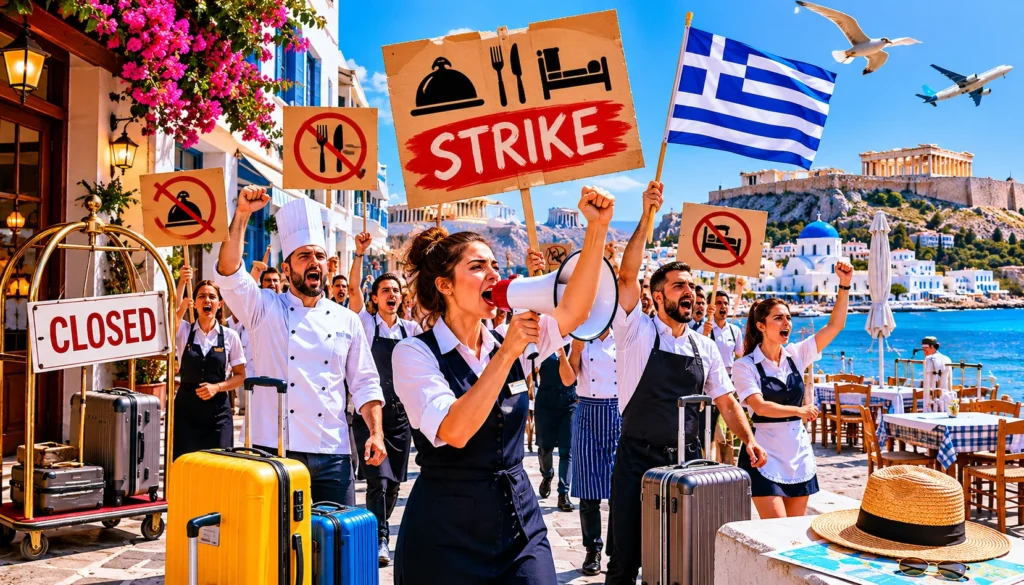
Greece’s tourism industry is facing mounting uncertainty after hospitality and food service workers announced plans for a nationwide 24-hour strike that could disrupt hotels, restaurants, resorts, and visitor services during one of the country’s busiest travel periods. The industrial action, scheduled for June 24, 2026, has intensified concerns across the tourism sector as labor tensions escalate over wages, working conditions, and employment protections.
The strike has been organized by the Panhellenic Federation of Food and Tourism Workers, which represents employees across hotels, catering businesses, restaurants, and tourism-related operations throughout Greece. The planned shutdown is being presented as a response to long-standing labor grievances that workers argue have remained unresolved despite ongoing negotiations with government authorities.
With Greece preparing for peak summer tourism demand, the dispute threatens to impact visitor experiences, transportation services, hospitality operations, and broader tourism activity across the country’s most popular destinations.
Hotels, Restaurants, and Tourist Services Prepare for Disruptions
The planned industrial action is expected to affect a wide range of tourism services, including hotels, restaurants, cafes, resorts, catering providers, and entertainment venues that depend heavily on seasonal labor during the summer months.
Tourism operators are closely monitoring developments as concerns grow that large-scale participation could disrupt accommodation services, food operations, and visitor logistics across key tourist destinations such as Athens, Santorini, Mykonos, Crete, Rhodes, and Thessaloniki.
Industry stakeholders fear the timing of the strike could create operational difficulties for businesses already managing high visitor volumes during the summer travel season. International tourists arriving during the planned strike period may encounter delays, reduced staffing, or temporary service interruptions in parts of the hospitality sector.
Travel advisors are increasingly encouraging visitors to remain informed about local conditions and maintain flexibility with itineraries as negotiations continue between workers and government officials.
Seasonal Workers Demand Greater Employment Security
At the center of the dispute is growing dissatisfaction among seasonal workers who rely heavily on tourism-related employment for income during the peak travel season.
Employees in hotels, restaurants, and tourism services have argued that current unemployment support systems fail to provide adequate financial protection during off-season periods when tourism activity slows significantly. Workers say the seasonal structure of the industry leaves many employees vulnerable to long stretches without stable income.
Labor representatives are calling for stronger unemployment benefit programs, improved contract protections, and more reliable enforcement of employment rights across the tourism sector.
Workers also argue that despite tourism generating substantial national revenue for Greece, labor conditions have not improved sufficiently to reflect the industry’s economic importance or the increasing demands placed on hospitality employees.
Wage Pressures and Cost of Living Concerns Intensify
The planned strike also reflects growing frustration over wages and rising living expenses in major tourism regions across Greece.
Employees have argued that hospitality wages have not kept pace with inflation, housing costs, and increasing day-to-day expenses, particularly in popular island destinations and high-demand tourist cities where accommodation prices have surged.
Labor organizations are demanding wage increases, fairer collective bargaining agreements, and adjustments to taxation policies that workers claim disproportionately affect low and middle-income employees within the tourism sector.
Many workers say the physically demanding nature of hospitality jobs, combined with long working hours and seasonal uncertainty, requires stronger financial protections and improved compensation structures.
The wage debate has become increasingly prominent as Greece experiences continued tourism growth while parts of the workforce struggle with affordability pressures in key tourist regions.
Digital Work Card System Sparks Further Disputes
Another major issue fueling tensions is the implementation of Greece’s Digital Work Card system, which was introduced to improve labor law compliance and monitor employee working hours.
Workers have raised concerns about inconsistent enforcement and technical challenges associated with the system, arguing that some employers have not applied it uniformly across workplaces. Labor representatives claim discrepancies in recorded working hours have made it difficult to guarantee proper overtime compensation and workplace transparency.
The Digital Work Card initiative was designed to strengthen labor protections, but disagreements over implementation have become another source of friction between workers, employers, and government authorities.
Discussions regarding operational improvements and compliance measures remain ongoing, although no final resolution has yet been reached.
Greek Tourism Economy Faces High-Stakes Labor Showdown
Tourism remains one of Greece’s most important economic sectors, generating significant employment and supporting hotels, transportation networks, restaurants, cruise operations, and local businesses across the country.
The possibility of widespread hospitality disruptions during peak travel season has raised concerns among tourism operators who fear reputational impacts and operational instability if negotiations fail to produce an agreement before the strike date.
However, labor unions argue that addressing employment concerns is essential for the long-term sustainability of the tourism industry itself. Worker representatives insist that stronger protections, fair wages, and improved conditions are necessary to maintain a stable workforce capable of supporting Greece’s expanding tourism economy.
The Greek Ministry of Labor continues discussions with union representatives as both sides attempt to resolve differences surrounding wage reforms, unemployment protections, and labor enforcement standards.
Travelers Advised to Monitor Conditions Ahead of Summer Travel
As the June 24 strike date approaches, international visitors planning trips to Greece are being advised to monitor official travel updates, hotel communications, and transportation schedules closely.
Hotels, airlines, ferry operators, and tour companies may issue revised operational guidance if strike participation expands across multiple tourism sectors. Some businesses are also preparing contingency plans aimed at minimizing disruptions for visitors during the busy summer season.
The outcome of ongoing negotiations could significantly shape labor relations within Greece’s hospitality industry moving forward, particularly as the country continues relying heavily on tourism growth to support economic recovery and regional development.
For now, uncertainty remains across the tourism sector as workers and authorities continue efforts to prevent a broader disruption that could affect travelers, businesses, and hospitality services nationwide.
For more travel news like this, keep reading Global Travel Wire