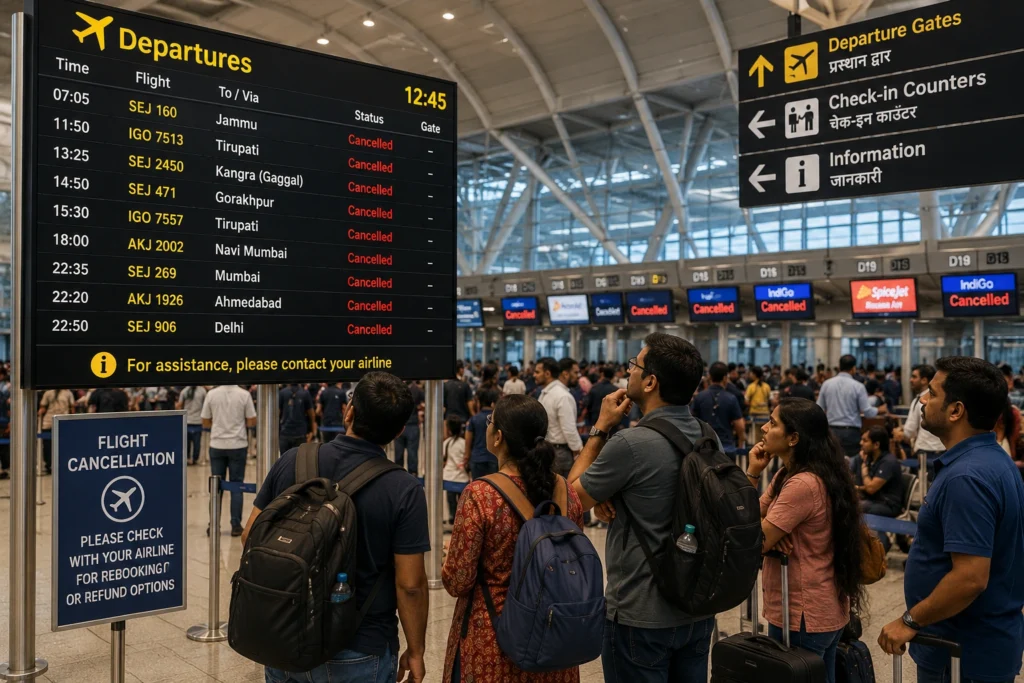
Fresh travel disruptions swept across India after SpiceJet, IndiGo, and Akasa Air cancelled multiple domestic flights affecting passengers traveling through New Delhi, Bengaluru, Hyderabad, and Kolkata. The latest operational setbacks impacted routes linking Delhi, Mumbai, Jammu, Ahmedabad, Tirupati, Gorakhpur, Kangra, and Navi Mumbai, leaving business travelers, tourists, pilgrims, and regional passengers struggling with delays and rescheduling complications.
A total of nine domestic departures were suspended across some of India’s busiest aviation hubs, placing additional pressure on an airline network already managing rising passenger volumes, aircraft rotations, airport congestion, and tight operational schedules.
The cancellations affected operations at Indira Gandhi International Airport in Delhi, Kempegowda International Airport in Bengaluru, Rajiv Gandhi International Airport in Hyderabad, and Netaji Subhash Chandra Bose International Airport in Kolkata.
Industry observers say the latest disruptions once again highlight the growing operational strain facing India’s rapidly expanding aviation sector.
Delhi Airport Records Multiple SpiceJet Cancellations
Indira Gandhi International Airport experienced several cancellations involving SpiceJet services connecting Delhi with important regional destinations across northern India.
Among the affected departures was SpiceJet flight SEJ471 to Gorakhpur Air Force Base, operated by a Boeing 737 and scheduled for Monday afternoon. Another suspended service involved SpiceJet flight SEJ160 to Jammu, while SpiceJet flight SEJ2450 to Kangra’s Gaggal Airport was also cancelled.
The disruptions affected travelers heading toward religious destinations, hill tourism regions, and smaller regional markets where passengers often have limited alternative transportation options.
Routes connecting Delhi with Jammu and Kangra remain particularly important for tourism and pilgrimage traffic, especially during peak travel periods when travelers seek quicker access to mountain destinations and religious sites.
Airport operations teams worked to manage passenger movement as affected travelers searched for alternative flights and revised itineraries.
Bengaluru-Mumbai Corridor Faces Evening Disruption
Kempegowda International Airport in Bengaluru also reported operational interruptions involving key business and commercial routes.
SpiceJet cancelled flight SEJ269 to Mumbai, one of India’s busiest and most heavily traveled domestic aviation corridors. The suspended Boeing 738 service was scheduled to depart Monday night, affecting corporate travelers and connecting passengers.
Akasa Air also cancelled flight AKJ2002 from Bengaluru to Navi Mumbai International Airport, adding pressure to travel demand on routes linked to India’s expanding airport infrastructure network.
The Bengaluru-Mumbai corridor plays a critical role in India’s corporate travel ecosystem, and disruptions along the route often create wider scheduling complications for passengers connecting onward through major hubs.
Aviation analysts note that even isolated cancellations on metro routes can quickly affect aircraft utilization, crew scheduling, and airport slot management nationwide.
IndiGo Suspends Hyderabad-Tirupati Services
Hyderabad’s Rajiv Gandhi International Airport experienced disruptions primarily involving Tirupati-bound services operated by IndiGo.
The airline cancelled two ATR-operated flights to Tirupati, including flights IGO7557 and IGO7513, both scheduled on Sunday.
The route is particularly important for pilgrimage tourism, as Tirupati attracts millions of religious visitors annually traveling to one of India’s most visited temple destinations.
The cancellations likely created challenges for passengers managing temple bookings, hotel reservations, local transportation, and time-sensitive pilgrimage itineraries.
Repeated disruptions on the Hyderabad-Tirupati sector also highlighted the operational challenges airlines face on busy regional routes with consistently strong passenger demand.
Kolkata Flights to Delhi and Ahmedabad Cancelled
Eastern India also experienced travel disruption after Kolkata’s Netaji Subhash Chandra Bose International Airport reported cancelled departures involving major domestic routes.
SpiceJet suspended flight SEJ906 to New Delhi, while Akasa Air cancelled flight AKJ1926 to Ahmedabad.
The Kolkata-Delhi route remains one of eastern India’s most important trunk sectors, serving both government and business travelers as well as connecting international passengers.
Meanwhile, the Ahmedabad route supports growing leisure and commercial traffic between eastern and western India.
The cancellations forced passengers to seek alternative flights during a period of continued strong domestic travel demand across India.
India’s Aviation Sector Faces Rising Operational Pressure
The latest India flight cancellations demonstrate the increasing complexity of managing one of the world’s fastest-growing domestic aviation markets.
Indian airlines continue balancing rising passenger demand with operational realities involving aircraft maintenance schedules, fleet utilization, airport congestion, crew availability, and route efficiency.
Industry experts note that regional sectors often face the greatest disruption because passengers traveling on these routes typically have fewer daily departures and limited backup options compared to larger metro corridors.
The interconnected nature of India’s aviation network also means operational problems in one city can quickly trigger delays and scheduling adjustments elsewhere.
Airlines including SpiceJet, IndiGo, and Akasa Air have expanded aggressively in recent years to capture growing domestic demand, but rapid expansion has also increased operational complexity across the industry.
Travelers Increasingly Depend on Real-Time Flight Updates
Passengers across India are now relying more heavily on airline alerts, mobile notifications, and flexible booking systems to navigate recurring operational changes.
Travel experts advise passengers to monitor flight status regularly, arrive earlier at airports, and maintain contingency plans during periods of schedule instability.
Despite the latest disruptions, domestic travel demand across India remains exceptionally strong, driven by tourism growth, business mobility, pilgrimage traffic, and expanding regional air connectivity.
However, repeated operational interruptions continue placing pressure on airlines to improve reliability, fleet efficiency, and passenger communication systems as India’s aviation sector enters another phase of rapid growth.
The latest cancellations involving SpiceJet, IndiGo, and Akasa Air underscore how quickly disruptions can affect passenger movement across India’s tightly connected airline network, particularly during periods of elevated travel demand.
For more travel news like this, keep reading Global Travel Wire