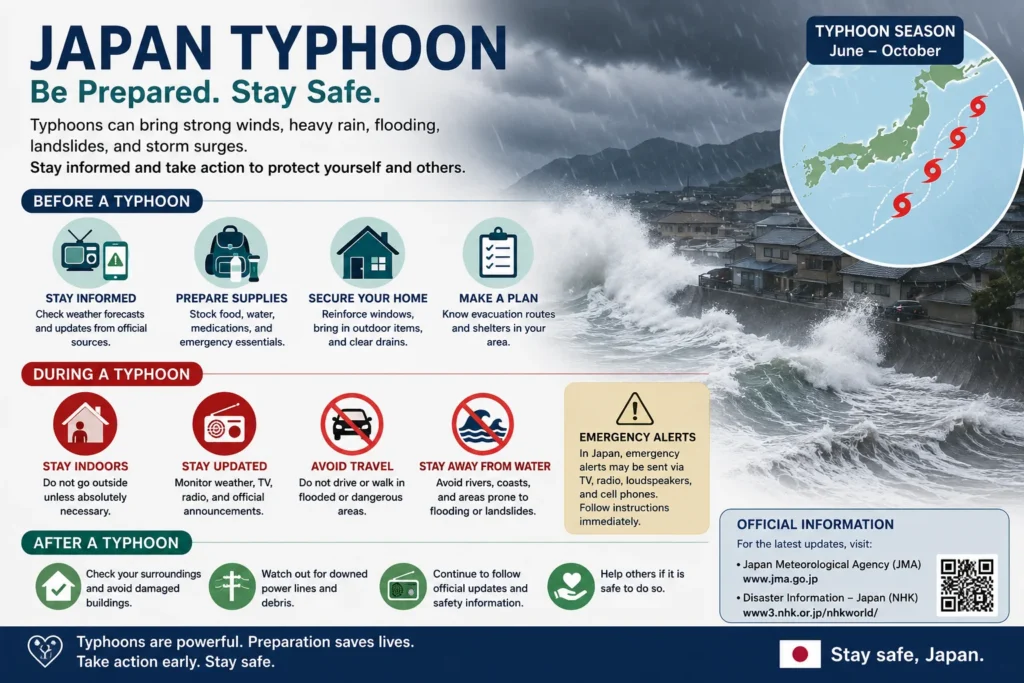
The Ministry of Land, Infrastructure, Transport and Tourism, in coordination with major domestic transit operators, has confirmed that a comprehensive Japan transport recovery phase is active following the passage of Typhoon Jangmi. The severe weather system, designated locally as Typhoon Number 6, skirted the Pacific coastline of eastern Japan, unleashing severe wind gusts and localized torrential downpours that systematically paralyzed national aviation, rail networks, and toll expressways.
Public safety updates from the Japan Meteorological Agency reveal that the storm made landfall along the southern coast before shifting its trajectory northeastward into the open waters of the Pacific Ocean. While the atmospheric core has moved away from the Kanto region, emergency management ministries continue to urge international tourists and domestic commuters to maintain heightened situational awareness regarding secondary scheduling adjustments.
Extensive Aviation Adjustments Liquidate Backlogs at Major Gateways
The aviation sector experienced significant administrative challenges as international and domestic carriers enacted preventative flight adjustments to safeguard assets and passengers. Official operational bulletins from Tokyo International Airport (Haneda) and Narita International Airport document that approximately 900 commercial flights were systematically grounded during the apex of the weather emergency, directly impacting the itineraries of roughly 90,000 travelers.
Statistical disclosures from Japan’s principal flag carriers outline the precise parameters of the flight restructuring:
Japan Airlines: Enacted the immediate suspension of 292 domestic operations alongside critical international connections, modifying transport windows for approximately 32,500 ticketed passengers.
All Nippon Airways: Disrupted standard services for 31,000 travelers by canceling 232 domestic routes, while coordinating an additional 92 international groundings in tandem with partnering regional operators.
By late evening, formal statements from the airline syndicates indicated that standard flight envelopes for the Kanto, Tokai, and Kansai regions would feature no further typhoon-induced climate restrictions. However, management boards cautioned that residual delays could persist into subsequent operating windows due to aircraft rotation cycles, strategic crew repositioning, and lingering visibility impairments at peripheral terminals in Hokkaido and Kagoshima Prefecture. To accommodate affected tourists, ticket-change penalties and cancellation fee waivers remain active for all affected passage windows.
Comprehensive Rail Infrastructure Inspections and Service Resumptions
Surface transit operators, led by the East Japan Railway Company (JR East), have executed meticulous structural inspections across thousands of kilometers of track to clear debris, assess mudslide points, and safely reactivate passenger lines. Official network status briefings confirmed that primary arterial commuter frameworks inside the Tokyo metropolitan area—including the Tokaido Line, Shonan-Shinjuku Line, and Chuo Line rapid service—successfully returned to normal operations late in the evening.
In contrast, several specialized regional lines and scenic rural tourism rail sectors required prolonged safety holds due to saturated soil conditions and track obstructions. Maintenance crews on the Joban Line worked to extract heavy debris obstructing the line between Katsuta and Sawa stations before restoring partial late-evening connections.
Concurrently, complete service suspensions remained enforced across rural networks, including the Suigun Line and the Koumi Line, where localized geographic vulnerabilities prevented the immediate deployment of substitute bus bridge transport. Representatives from the Central Japan Railway Company (JR Central) reported that while the high-speed Tokaido Shinkansen maintained continuous operations under strict speed limits, conventional routes such as the Minobu and Gotemba lines faced selective regulatory halts to protect rolling stock from high winds.
Public Infrastructure Impacts and Municipal Safety Protocols
The Fire and Disaster Management Agency, alongside regional prefectural bureaus in Tokyo, Kanagawa, and Chiba, monitored extreme water level fluctuations across major municipal river basins, including the Nogawa and Meguro rivers. At the height of the storm, emergency broadcast systems distributed evacuation advisories to more than 1.6 million residents as regional precipitation metrics rapidly escalated.
The severe weather conditions temporarily severed regional utility lines, resulting in power outages across approximately 60,000 independent residential and commercial structures. Furthermore, localized flash flooding inside western Tokyo’s Ome City compromised municipal water-supply networks, requiring civil engineering departments to implement emergency pressure reductions and alternative water distribution measures for nearly 1,800 impacted households.
Strategic Guidance for International Tour Operators and Visitors
As weather patterns trend toward stabilization and the meteorological center characterizes Typhoon Jangmi as an transitioning extratropical depression, the Ministry of Land, Infrastructure, Transport and Tourism emphasizes that travelers must not mistake clearing skies for absolute stability. Structural engineers caution that heavily saturated hillsides along prominent historical corridors and coastal passes retain high baseline risks for sudden landslides.
International vacationers currently navigating the Japanese archipelago are strongly advised to consult the automated Multilingual Disaster Information portals managed by official tourism bureaus. Commuters should confirm active seat reservations and terminal status configurations directly via carrier applications prior to vacating hotel properties, ensuring that localized aircraft positioning delays or minor rolling rail maintenance windows do not compromise their long-distance transit logistics.
For more travel news like this, keep reading Global Travel Wire