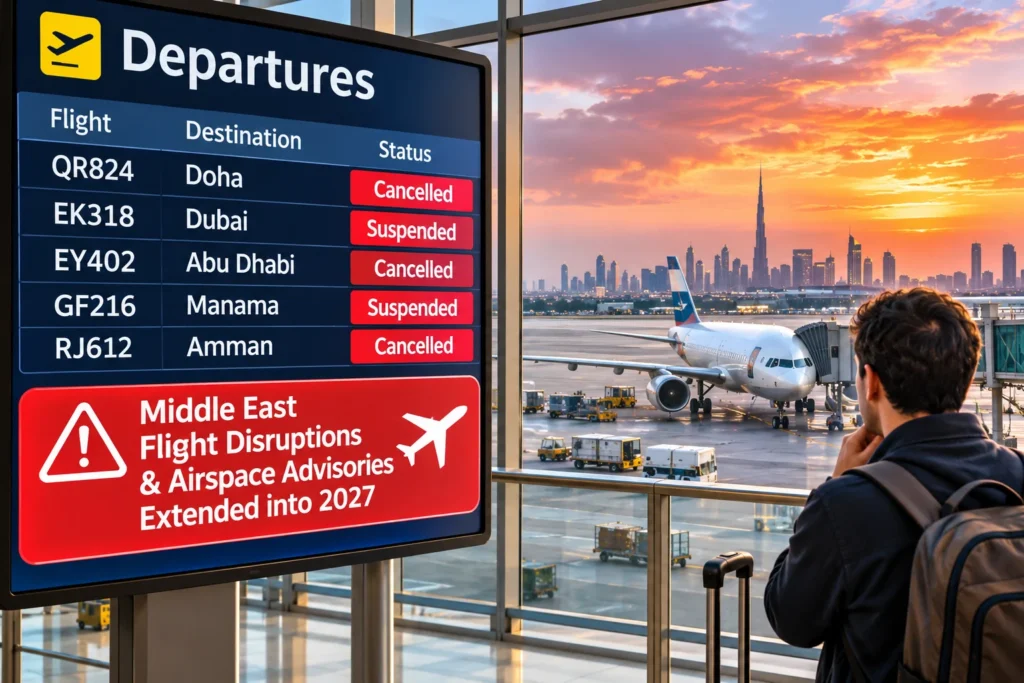
International air travel across the Persian Gulf faces renewed operational pressure in November 2026 following fresh security incidents and aerial threats affecting Bahrain, Kuwait, and Saudi Arabia. While civil aviation authorities across the region have kept major commercial gateways open, the heightened risk environment has triggered extended route suspensions by regional and international carriers, alongside formal airspace advisories extending into early 2027. For global travellers and tourism operators, ongoing Gulf aviation disruption underscores the need for flexible routing and continuous schedule monitoring across key Middle Eastern transit corridors.
Regulatory Airspace Advisories Extended Through January 2027
In response to persistent regional security developments, the European Union Aviation Safety Agency (EASA) formally extended its Conflict Zone Information Bulletins covering the Persian Gulf, the Gulf of Oman, and parts of Saudi Arabian airspace through January 31, 2027. The updated regulatory guidance applies across the Flight Information Regions of Bahrain, Kuwait, Qatar, the United Arab Emirates, and Oman.
Under the official safety bulletin, aviation authorities advise commercial operators to avoid flying over the waters of the Persian Gulf and the Gulf of Oman within the designated airspace zones at all altitudes, permitting flight paths only when strictly necessary for scheduled arrivals and departures at regional airports. Regulators emphasized that military and air-defense activity can occur with minimal notice, requiring airlines to integrate real-time security intelligence into daily flight planning and alternative routing strategies.
Operational Status Across Major Gulf Airports
Despite heightened security alerts, national civil aviation authorities have not implemented a blanket shutdown of commercial airports across the Gulf. Instead, terminal capacity and flight schedules vary significantly depending on local infrastructure status and carrier risk assessments.
| Country | Airport | Current Operational Status |
| Bahrain | Bahrain International Airport (BAH) | Open and handling international flights, though delays and schedule adjustments occur. |
| Kuwait | Kuwait International Airport (KWI) | Partially operational with reduced direct flights via Terminals 4 and 5; Terminal 1 and passenger transit remain restricted. |
| Saudi Arabia | King Khalid International Airport, Riyadh (RUH) | Partially reopened with limited domestic and international schedules under ongoing operational restrictions. |
| Saudi Arabia | King Fahd International Airport, Dammam (DMM) | Open for commercial traffic, though affected by widespread carrier cancellations and reduced connectivity. |
| Saudi Arabia | King Abdulaziz International Airport, Jeddah (JED) | Operational as the primary international gateway, experiencing intermittent delays and cancellations. |
| Saudi Arabia | Abha International Airport (AHB) | Subject to repeated temporary closures and significant flight disruptions. |
| Saudi Arabia | Jazan and Najran Airports | Experiencing recurring operational interruptions and schedule changes. |
In Bahrain, air-defense interceptions near military sites prompted public safety alerts, yet Bahrain International Airport sustained no structural damage and continues to process international arrivals and departures. In Kuwait, security alerts following drone threats near Ali Al Salem Air Base have kept airport operations constrained, with transit restrictions limiting Kuwait International Airport’s role as a connecting hub. Meanwhile, Saudi Arabia continues to experience the sharpest schedule reductions, with Jeddah maintaining the most consistent international connectivity while Riyadh and Dammam operate under reduced capacity.
Major regional transit hubs in Dubai, Abu Dhabi, and Doha remain fully operational and continue to serve as vital connecting points between Europe, Asia, and the Middle East. However, aviation advisories note that carriers operating through these hubs maintain active contingency protocols for sudden airspace rerouting and schedule adjustments.
International and Regional Airlines Extend Route Suspensions
The prolonged security advisories have prompted numerous Gulf, Asian, and European airlines to extend route suspensions into late November 2026 and January 2027:
Middle Eastern Carriers: Etihad Airways has extended cancellations between Abu Dhabi and both Riyadh and Dammam through November 30, while maintaining operations to Jeddah. flydubai has prolonged suspensions to Riyadh and Abha through November 27 while restoring reduced frequencies to Dammam. Qatar Airways has resumed daily services to Riyadh and Dammam, though routes to Abha and Taif remain suspended, and Gulf Air continues to operate a scaled-back international schedule.
Asian Carriers: Indian carriers Air India and IndiGo have extended flight suspensions impacting key Saudi Arabian gateways, particularly Riyadh and Dammam, affecting high-volume business and religious travel corridors.
European Carriers: Lufthansa Group has extended suspensions to Riyadh and Dammam, with select services deferred until January 2027. Air France has delayed its resumption of Riyadh flights until December 12, while British Airways has pushed its Riyadh restart date to January 11, 2027.
Navigating Regional Travel Amid Evolving Schedules
With civil aviation regulators maintaining conflict-zone advisories through the end of January 2027, airline schedules across the Gulf remain fluid. Passengers travelling to or transiting through the Middle East are advised by aviation authorities and national carriers to verify flight statuses directly through official airline channels prior to departure, allow additional transit buffers, and review rebooking policies as airlines adapt routes to comply with international airspace safety guidance.
For more travel news like this, keep reading Global Travel Wire