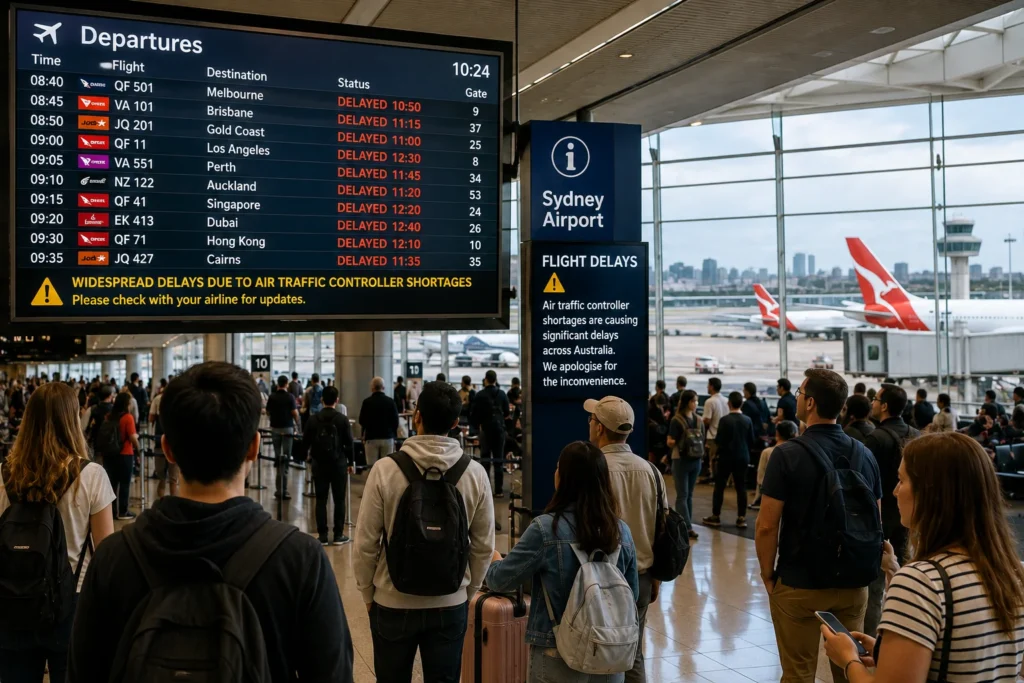
International and domestic passengers traveling through Australia’s busiest aviation hub are facing major schedule disruptions following severe air traffic control constraints at Sydney Kingsford Smith Airport. Airservices Australia, the government-owned organization responsible for managing national airspace and air traffic management, confirmed that air traffic flow management protocols were enacted due to temporary air traffic controller staffing and rostering limitations.
The operational bottleneck has affected more than 150 flights passing through the gateway city, creating domino-effect delays across major carriers including Qantas, QantasLink, and Virgin Australia. With Sydney serving as the primary international gateway to the country, flight holding patterns and tarmac holds are generating widespread delays across regional domestic networks and international long-haul connections.
Airservices Australia Implements Traffic Flow Measures to Maintain Airspace Safety
In an official public announcement, Airservices Australia explained that temporary roster constraints within control tower operations required spacing out departure intervals and capping total aircraft movements through Sydney airspace. The government agency confirmed that while these air traffic flow management procedures temporarily reduce airport capacity, they are strictly necessary to guarantee safety standards across the national aviation network.
Official statements from Airservices Australia emphasize that ground and tower controllers manage highly demanding, safety-critical operations. To address persistent operational pressures, the agency confirmed it is actively expanding its training pipeline to recruit additional air traffic controllers, increase roster depth, and resolve structural rostering restrictions that limit workforce flexibility during peak travel periods.
An official spokesperson for Sydney Airport advised departing and arriving passengers to monitor their flight status directly through airline mobile applications and airport information channels before traveling to terminals. Airport operational updates confirm that ground management teams are working alongside national aviation authorities to support affected travelers and minimize congestion throughout passenger terminals.
Federal Transport Minister Requests Action Plan from Airservices Australia
Addressing the widespread travel disruption, Federal Minister for Infrastructure, Transport, Regional Development and Local Government Catherine King issued an official statement confirming that her office has formally requested an explanation and a clear service recovery plan from Airservices Australia management.
Minister King noted that while mandatory safety procedures were properly enforced to maintain secure flight conditions, Airservices Australia must significantly improve its management of controller rosters and operational contingencies. The minister highlighted that unexpected airport delays create substantial operational strain for airline crews, terminal staff, and domestic and international travelers reliant on timely connections.
Government transportation oversight bodies have requested a comprehensive outline detailing how Airservices Australia intends to bolster workforce resiliency and prevent recurring staffing shortages at Australia’s central international gateway.
Aviation Industry Representatives Call for Long-Term Roster Solutions
Industry leadership representing major regional and international carriers has raised concerns over the broader economic and travel impacts caused by air traffic control constraints. In official public remarks, Stephen Beckett, Chief Executive of Airlines for Australia and New Zealand, emphasized that consecutive days of air traffic control roster shortfalls create compounding operational impacts across the entire South Pacific flight network.
Industry representatives noted that holding patterns and delayed departures at Sydney Airport ripple rapidly into regional centers and international transit hubs, causing missed passenger connections and scheduling realignment for aircraft fleets. While acknowledging that flight safety remains uncompromised, industry leaders urged government aviation agencies to accelerate human resource deployment and ensure towers and en-route control centers maintain sufficient operational depth year-round.
Guidance and Practical Advice for Affected Airline Travelers
Travelers scheduled to fly into or out of Sydney over coming travel periods should prepare for potential schedule adjustments and follow established travel recommendations issued by aviation authorities:
Verify real-time flight status and departure times via airline digital portals or mobile apps prior to commuting to the airport.
Ensure contact information on airline reservations is fully updated to receive automated SMS and email notifications regarding gate changes or delay estimates.
Allow additional buffer time when organizing ground transportation, airport check-in, and international transit connections.
Reach out directly to airline customer support desks or airport passenger information counters for assistance with rebooking missed domestic or international connections.
As Airservices Australia and regional airlines work collaboratively to clear flight backlogs and restore standard departure frequencies, federal authorities reaffirm their commitment to maintaining top-tier airspace safety while restoring reliable operational capacity across Australian airline travel networks.
For more travel news like this, keep reading Global Travel Wire