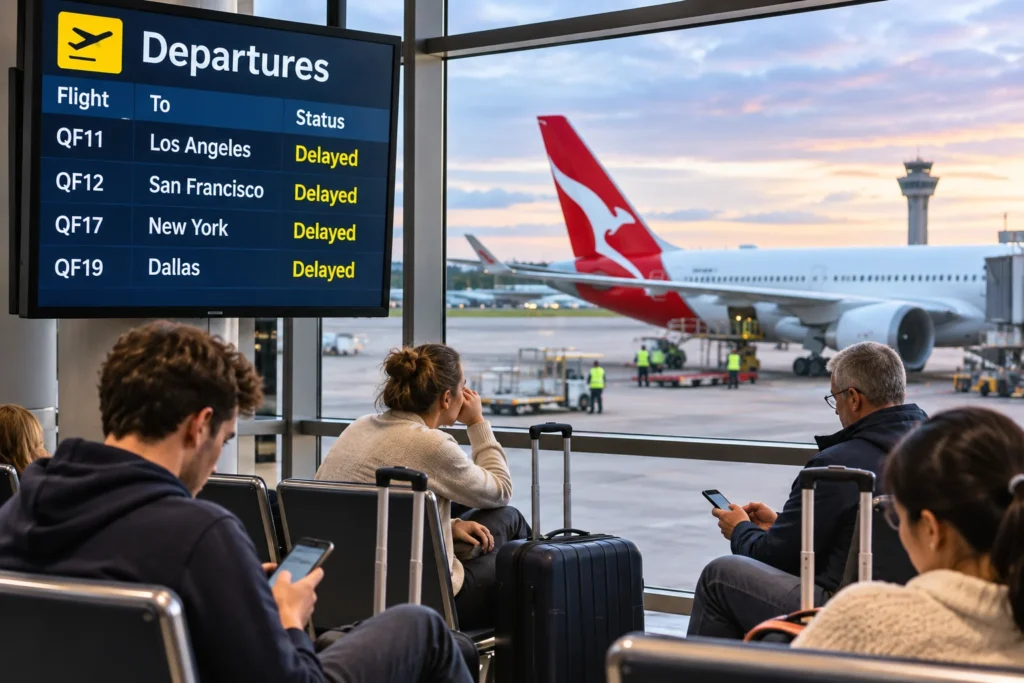
International air travel between Australia and the United States experienced significant weekend schedule disruptions on Saturday, November 14, 2026, after a nationwide grounding directive issued by the United States Federal Aviation Administration rippled across major Australian departure hubs. Holidaymakers, business flyers, and connecting international passengers at Sydney, Melbourne, and Brisbane airports encountered multi-hour departure delays as aviation authorities worked to stabilize North American air traffic operations following a temporary telecommunications outage.
According to official statements issued by the Federal Aviation Administration, the nationwide pause on departures and regulated management of incoming traffic were implemented as a safety precaution in response to a temporary telecommunications outage affecting American air traffic control systems. While federal aviation regulators subsequently lifted the grounding order and launched a formal investigation into the technical root cause, the timing of the restriction coincided directly with the peak morning departure bank for long-haul trans-Pacific services leaving Australia’s east coast.
Multi-Hour Delays Across Sydney, Melbourne, and Brisbane Hubs
Sydney Kingsford Smith Airport, Australia’s busiest international gateway for North American routes, confirmed that several morning services bound for the United States were held on the ground while the American restriction remained active. In an official operational advisory, a Sydney Airport spokesperson confirmed that airport teams were monitoring the Federal Aviation Administration directive closely and urged all passengers traveling to or transiting through the United States to check directly with their respective airlines for real-time schedule updates.
For passengers already boarded on early morning departures out of Sydney, the pause resulted in extended waits on the tarmac lasting up to three hours before air traffic clearance was granted. On at least one long-haul aircraft, extended operation of cabin air-conditioning systems while awaiting departure clearance required ground crews to conduct supplementary refueling before takeoff could proceed safely. Sydney Airport later confirmed that the American restriction on incoming arrivals was lifted shortly before 1:00 p.m. local time, allowing delayed services to progressively clear the tarmac.
At Melbourne Tullamarine Airport, long-haul travelers faced comparable schedule adjustments throughout Saturday morning and early afternoon. Passengers booked on a morning departure to Los Angeles scheduled shortly after 10:00 a.m. experienced delays approaching three hours, while a 10:00 a.m. service bound for Dallas departed at approximately 1:00 p.m., immediately following the lifting of the United States arrival hold. Two additional midday departures from Melbourne scheduled for 12:00 p.m. and 12:45 p.m. were similarly delayed before normal departure flows resumed. Airport operations confirmed that all delayed United States-bound services had successfully departed Melbourne by 3:00 p.m. Saturday.
Further north at Brisbane Airport, four scheduled services bound for North America were held back during the morning window. Two of those delayed flights had departed by 3:00 p.m. Saturday as airspace capacity normalized. A Brisbane Airport spokesperson echoed national aviation guidance, advising travelers heading to North America to remain in direct contact with their carriers for updated boarding and connection details.
Airline Recovery and Guidance for Trans-Pacific Travelers
Flagship carrier Qantas issued an operational notice thanking affected passengers for their patience during the airspace hold and advising travelers holding bookings for upcoming flights to the United States to monitor official airline channels for updated departure times and onward domestic connection adjustments. Because trans-Pacific flights rely on tightly coordinated crew duty schedules and hub connections at major gateways such as Los Angeles, San Francisco, and Dallas Fort Worth, even a three-hour departure hold requires careful schedule recalibration across both sides of the Pacific.
For the broader Asia-Pacific and North American tourism sectors, the incident highlights the intricate operational interdependence of long-haul international aviation networks. Australia and the United States share one of the world’s busiest long-haul tourism corridors, supported by steady leisure demand, family visits, and corporate travel ahead of the busy December holiday season.
Aviation and airport authorities across both nations continue to emphasize proactive passenger communication during infrastructure-related disruptions. Travelers scheduled to fly between Australia and North America over the remainder of the weekend are advised to confirm flight statuses prior to arriving at the terminal, allow generous buffer times for onward domestic United States connections, and utilize official airline digital platforms for real-time gate and schedule notifications as carriers complete their recovery schedules.
For more travel news like this, keep reading Global Travel Wire