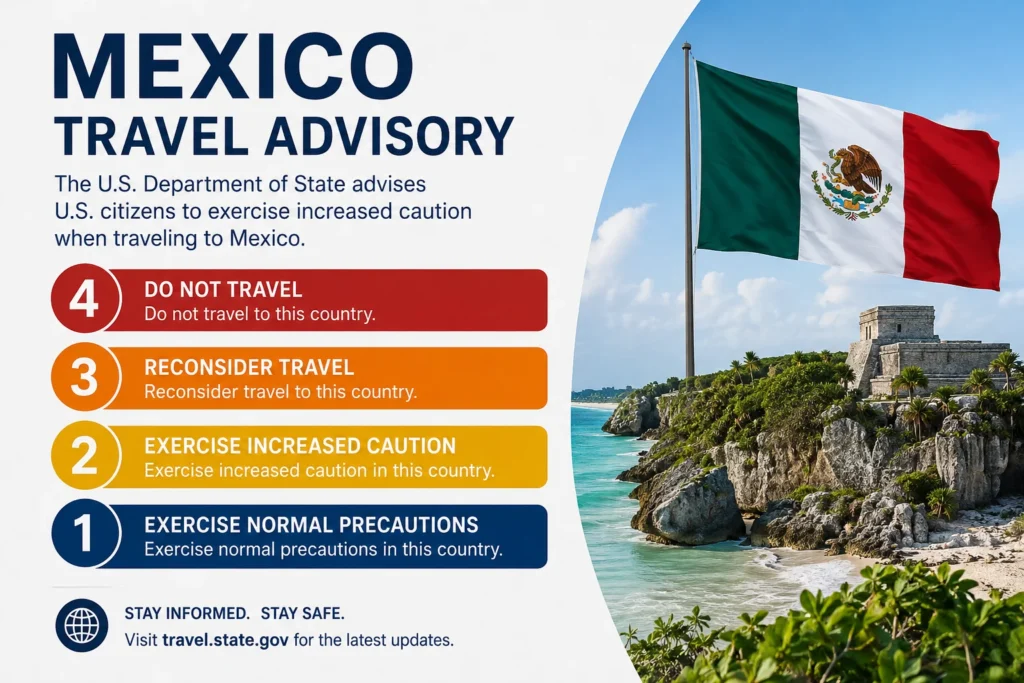
The United States Department of State has officially updated its comprehensive travel advisory for Mexico, signaling a renewed need for heightened vigilance among international tourists. The federal update maintains Mexico’s overall classification at Level 2, instructing citizens to exercise increased caution. However, the underlying data highlights substantial, localized escalation in violent crime, organized gang activities, and kidnapping threats across multiple regional jurisdictions.
Official consular data emphasizes that transnational criminal organizations continue to engage in volatile territorial conflicts over narcotics trafficking and human smuggling corridors. While major international resorts often feature distinct municipal security detachments, the boundaries between secure tourist zones and high-risk regional environments remain fluid.
Navigating the Geopolitics of Tourism and Global Events
This official security baseline arrives at a critical economic juncture for North American tourism. Public data from the Secretariat of Tourism of Mexico indicates that international arrivals surpassed 45 million visitors annually by the conclusion of recent economic cycles, contributing billions to the national hospitality, aviation, and service infrastructure.
The security assessment gains unprecedented urgency due to the upcoming FIFA World Cup 2026, which is scheduled to draw millions of spectators across joint host cities in the United States, Canada, and Mexico between June 11 and July 19, 2026. Official stadium venues located in Mexico City and Monterrey currently occupy Level 2 regional zones, requiring standard heightened awareness.
Conversely, the host city of Guadalajara is situated within the state of Jalisco, which sits at a more severe Level 3 “reconsider travel” designation due to pervasive cartel presence. To mitigate these overlapping threats, official binational reports confirm that federal agencies are deploying nearly 100,000 specialized security personnel across host municipalities under an integrated defense strategy known as Plan Kukulkán.
Decoding the Federal Regional Risk Classifications
The Department of State utilizes a strict tiered framework to separate safe transit corridors from regions plagued by systemic cartel violence. Six specific Mexican states are currently bound to the most severe Level 4 “do not travel” restriction for federal employees, reflecting extreme domestic risks:
Colima
Guerrero
Michoacán
Sinaloa
Tamaulipas
Zacatecas
Outside of these absolute restriction zones, several tourist-frequented regions display deep structural dichotomies. In the state of Chihuahua, northern border sectors suffer from chronic human smuggling friction, whereas Chihuahua City and the historic Copper Canyon rail network remain accessible via monitored, official transport operations.
Within Sinaloa, coastal enclaves like Mazatlán and Los Mochis are designated as accessible exclusively if travelers arrive via direct commercial air travel, avoiding the highly volatile regional highway networks entirely. In Guanajuato, the federal advisory outlines a precise geographical boundary, warning travelers to avoid all sectors positioned north and east of Federal Highway 45D due to localized extortion and violent asset conflicts.
Furthermore, the state of Chiapas allows cautious passage to the archaeological hubs of Palenque and San Cristóbal de las Casas, provided tourists restrict their movements strictly to major federal toll roads or regional aviation hubs. Recent localized emergency updates from the U.S. Consulate General in Tijuana have also emphasized heightened vigilance surrounding the international airport infrastructure serving San José del Cabo and Cabo San Lucas due to sudden law enforcement encounters with armed actors outside traditional hotel districts.
The Strategic Security Matrix for International Transit
For individuals coordinating necessary travel to Mexico during this complex security environment, official consular bodies have outlined a mandatory operational playbook to systematically minimize field vulnerability.
Intercity Transport Guidelines
Ground navigation requires absolute adherence to daylight travel schedules. Federal data demonstrates that secondary rural roadways lack consistent police monitoring and present high probabilities for illegal cartel checkpoints or armed carjackings. Travelers must operate exclusively on high-frequency toll roads, locally designated as “Cuotas,” which feature superior engineering and regular military patrols.
Urban Mobility and Logistics
The use of unverified street taxis or arbitrary ride-sharing apps at major transit terminals is strongly discouraged by regional diplomatic missions. Travelers should arrange transport solely through licensed airport taxi syndicates or pre-verified hotel shuttle assets. Additionally, local regulatory protocols bar standard ride-share applications from picking up passengers directly inside specific international airport perimeters.
Financial and Personal Footprint
Criminal syndicates actively monitor public automated teller machines (ATMs) and banking centers to execute follow-home robberies. Tourists must conduct all financial transactions within secure interior hotel spaces or well-guarded commercial institutions. Public displays of material affluence, including expensive timepieces, high-end electronics, or visible currency operations, drastically escalate an individual’s target profile.
Mandatory Pre-Departure Institutional Protocols
The Department of State confirms that standard domestic health coverages, alongside major federal programs like Medicare or Medicaid, do not provide operational coverage outside the territorial United States. Consequently, international tourists must secure comprehensive travel medical insurance plans that feature explicit clauses for emergency medical evacuation from foreign sovereign territories.
Before crossing international boundaries, all citizens should register their complete flight itineraries, lodging details, and contact numbers with the Smart Traveler Enrollment Program (STEP). This complimentary federal registry allows local embassies to transmit immediate localized threat warnings, weather updates, and emergency evacuation protocols directly to the traveler.
Finally, maintaining secure digital copies of sovereign passports, entry visas, and medical records on encrypted cloud storage platforms ensures rapid identity verification at regional consular offices if primary physical documents face theft or unexpected seizure. By replacing casual travel planning with a disciplined, data-driven security strategy, international visitors can systematically navigate regional complexities while respecting the structural realities of the current geopolitical landscape.
For more travel news like this, keep reading Global Travel Wire