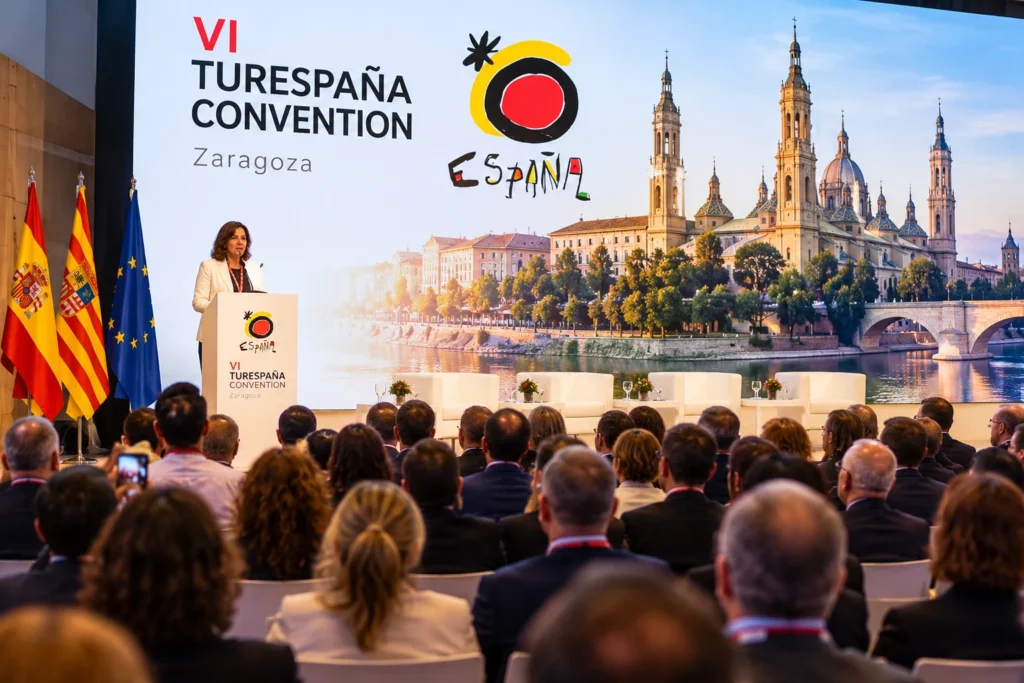
The Congress Palace of Zaragoza has officially opened its doors to more than 500 leading travel industry professionals, public institution representatives, regional tourism boards, and global trade specialists for the landmark VI Convention of Turespaña. Driven by the Institute of Tourism of Spain (Turespaña)—an autonomous organization operating under the Ministry of Industry and Tourism—and organized in partnership with the Zaragoza City Council, this high-level assembly positions international tourism as the core driver for the structural evolution of the nation’s travel sector.
Under the overarching banner “Do You Speak Global? International tourism as a lever for transformation,” the three-day convention addresses pivotal structural challenges facing Spanish destinations. Working sessions focus on altering traditional promotion and marketing paradigms, evaluating structural shifts across major origin markets, integrating artificial intelligence into destination management, and developing long-term sustainable management frameworks.
The official opening ceremony brought together prominent national and global leaders, including Spain’s Minister of Industry and Tourism, Jordi Hereu; the President of the Government of Aragon, Jorge Azcón; the Mayor of Zaragoza, Natalia Chueca; the Secretary-General of UN Tourism, Shaikha Alnuwais; and the CEO of the World Travel and Tourism Council (WTTC), Gloria Guevara.
Official Record Spending and Demand Management Policy
Opening statement disclosures provided by official government representatives highlighted impressive growth metrics for the national travel economy. Spain’s Minister of Industry and Tourism, Jordi Hereu, confirmed that the country welcomed 70 million international visitors through August, noting that total tourist expenditure is outpacing volume growth across major entry points.
Official ministry metrics confirm that the direct financial contribution of international visitors to Spain’s economy surpassed 100 billion euros by August. Furthermore, national labor figures confirm that 3,093,000 workers are currently employed directly within the tourism sector.
Minister Hereu advocated for a refined strategic approach focused on active demand management rather than passive volume accumulation. He emphasized transitioning away from historical, indiscriminate promotion models toward targeted selection criteria that determine how, when, and why travelers visit Spain, allowing local supply networks to curate high-value experiences.
Praising Spain’s leadership role on the global stage, WTTC CEO Gloria Guevara noted that Spain serves as an international benchmark for maximizing visitor expenditure and establishing sustainable management practices across mature urban and coastal destinations.
Aragon Regional Growth Strategy and Infrastructure Investments
Addressing convention attendees, the President of the Government of Aragon, Jorge Azcón, showcased inland regions as vital components of the broader international tourism offering. President Azcón emphasized that managed visitor growth generates increased economic activity, employment opportunities, and infrastructure development across interior autonomous communities.
Official regional tourism statistics show that Aragon recorded 4,070,000 total visitors in 2025, including approximately 680,000 international travelers. This represents a solid increase from the 4,020,000 visitors recorded during the previous operating period, consolidating the regional benchmark of four million annual travelers.
The economic yield generated by this visitor volume exceeds 4.1 billion euros, representing approximately 10.7% of Aragon’s regional Gross Domestic Product (GDP) and supporting 67,000 direct and indirect jobs across local communities.
To sustain this momentum, regional authorities highlighted targeted investment initiatives:
Pirineos Plan Execution: A dedicated 90-million-euro investment initiative allocated for multi-year infrastructure, environmental, and mountain tourism enhancements.
Next Generation European Funds: Sustainable tourism development programs totaling 85 million euros, achieving an official execution rate of 99.27%. *Focus Keyword Identified: International Tourism Transformation
Meta Description: Spain advances international tourism transformation at the VI Turespaña Convention in Zaragoza, highlighting strategic market shifts and sustainable growth.
Spain Advances International Tourism Transformation Strategy at VI Turespaña Convention in Zaragoza
The Congress Palace of Zaragoza has hosted the sixth edition of the Turespaña Convention, bringing together over 500 tourism sector professionals, institutional representatives, destination managers, and industry specialists. Organized by the Institute of Tourism of Spain (Turespaña)—an autonomous body under the Ministry of Industry and Tourism—in collaboration with the Zaragoza City Council, the convention serves as a primary forum for shaping national tourism strategy. Under the banner “Do You Speak Global? International tourism as a lever for transformation,” the summit addresses strategic shifts across global source markets, the integration of artificial intelligence, advanced marketing models, and sustainable growth management.
Opening proceedings featured key leadership addresses setting out Spain’s long-term vision for managed demand, value-driven growth, and destination diversification. Official policy directives emphasize transitioning away from historical volume-based metrics toward deliberate management of visitor profiles, seasonality, and regional distribution.
National Indicators Confirm High-Value Growth and Employment Expansion
Official performance metrics presented by the Ministry of Industry and Tourism confirm strong momentum across Spain’s tourism economy. National figures document the arrival of 70 million international visitors through August, with total expenditure outpacing volume growth across major indicators.
Key economic figures highlighted in official ministry statements include:
Economic Contribution: International tourism expenditure reached €100 billion by August, demonstrating high-yield international demand across coastal and inland destinations.
Workforce Development: The national tourism sector supports 3,093,000 active workers, reflecting sustained employment expansion and economic stability.
Strategic Focus: Future tourism policy prioritizes intentional demand selection, matching destination offerings with specific market motivations, timing, and sustainability objectives.
National leadership reaffirmed that maximizing visitor spending while carefully managing local capacity represents the core framework for maintaining competitiveness across global travel markets.
Aragon Positioned as an Emerging Destination for Global Visitors
The regional administration of Aragon presented comprehensive statistics demonstrating how inland autonomous communities contribute significantly to Spain’s international travel appeal. Regional governance figures indicate that Aragon welcomed 4,070,000 total travelers in 2025, consolidating a benchmark above four million annual visitors. Among these arrivals, approximately 680,000 represented international travelers, expanding upon the 4,020,000 overall visitors recorded the previous year.
The economic footprint of tourism in Aragon generates over €4.1 billion annually, accounting for approximately 10.7% of the regional Gross Domestic Product (GDP) and sustaining 67,000 direct and indirect jobs. To ensure long-term stability and environmental protection, regional strategic plans focus heavily on investment efficiency and sustainable housing infrastructure:
Pirineos Plan: A dedicated investment roadmap directing €90 million toward infrastructure and environmental enhancement across high-altitude tourist zones.
Sustainability Funds: Execution of Next Generation tourism sustainability plans totaling €85 million in targeted funding, achieving a 99.27% allocation rate.
Connectivity Goals: A joint route development strategy targeting over 30 air connections serving 15 countries by 2027, aimed at exceeding 1.3 million annual passengers.
Cultural Milestones: Positioning the 2028 Bicentennial of Francisco de Goya’s death as a major global cultural campaign.
Workforce Housing Solutions: Implementation of the “More Housing, Better Tourism” program to ensure affordable housing availability for tourism sector workers in high-demand municipalities.
Regional leadership stressed that managed growth must directly support local development, workforce retention, and historical heritage preservation across mountain and rural districts.
Zaragoza Sets Urban Destination Benchmark Through Planned Events Strategy
The municipality of Zaragoza presented its city roadmap, detailing record tourist activity driven by targeted cultural programming, international route expansion, and urban heritage promotion. Municipal data confirms that Zaragoza closed 2025 with more than 2,300,000 overnight stays, delivering a direct economic impact of €700 million to the local urban economy.
To eliminate seasonal troughs, municipal planning focuses on a structured calendar of major international cultural events, urban festivals, and heritage showcases, including Easter week observances, Zaragoza Luce, and the Vive Latino festival. By coordinating regional connectivity bids to secure expanded international flight routes through 2027, municipal authorities aim to reinforce the city’s position as a year-round urban, gastronomic, and cultural destination.
Global tourism industry leadership attending the convention affirmed Spain’s status as an international benchmark for tourism management, noting the country’s success in attracting high-value international spending while advancing structured, sustainable regional governance.
For more travel news like this, keep reading Global Travel Wire