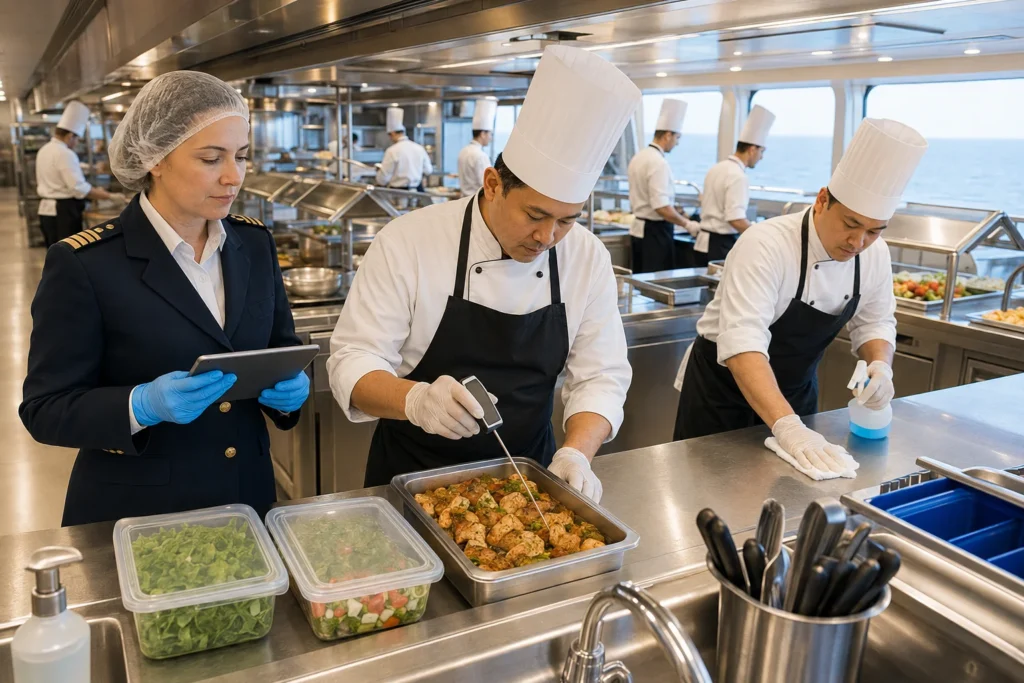
Official public health guidelines and maritime safety regulations governing commercial cruise ships have come under renewed focus following public discussions surrounding guest compliance and onboard hygiene practices. International public health frameworks maintained by government agencies enforce rigorous sanitation standards to protect passengers across commercial passenger vessels.
The Vessel Sanitation Program, administered by the United States Centers for Disease Control and Prevention under the Department of Health and Human Services, establishes strict operational protocols for food handling, utensil sanitization, and communal dining facilities on all foreign-flagged vessels calling on United States ports. These federal regulations ensure that commercial cruise ships maintain comprehensive sanitation measures across all public dining spaces.
Federal Public Health Standards and Maritime Inspection Guidelines
Under the Vessel Sanitation Program, commercial cruise ships undergo unannounced, comprehensive environmental health inspections twice each year. These detailed audits assess every aspect of shipboard public health, including potable water systems, galley equipment cleanliness, food storage temperatures, child care center hygiene, and integrated pest management.
Federal inspection criteria mandate strict guidelines for washing, rinsing, and sanitizing all reusable food-contact surfaces and service utensils:
High-Temperature Commercial Dishwashing: Mechanical dishwashing systems on passenger vessels must operate at high sanitizing temperatures—typically maintaining final rinse water temperatures between 180 and 194 degrees Fahrenheit—to ensure complete elimination of surface pathogens and bacterial contaminants.
Chemical Sanitization Standards: Utensils and food equipment subjected to manual three-compartment sink washing must be treated with approved EPA-registered chemical sanitizers at precise parts-per-million concentration levels before being returned to service.
Continuous Utensil Cycling: Public buffet lines and self-service food stations are required to cycle serving utensils at strict intervals—typically every four hours or immediately if contamination is reported—to prevent bacterial cross-contamination.
Maritime health regulations dictate that any piece of cutlery or food service equipment identified as contaminated or damaged must be immediately removed from active circulation and routed through full commercial decontamination protocols before reuse.
Enforcement of Passenger Conduct and Onboard Health Policies
Commercial passenger cruise lines maintain comprehensive Guest Conduct Policies designed to protect public health, safety, and passenger comfort across shared venues. These rules, enforced by shipboard security officers and hotel management staff, explicitly outline expected behavioral standards in public areas, including main dining rooms, open-deck buffets, and recreational spaces.
According to official cruise line policy frameworks and ticket contract conditions, passengers who engage in unhygienic behavior, disrupt public dining spaces, or fail to follow reasonable health and safety instructions from crew members may face administrative actions. Onboard consequences range from formal warnings and loss of specific service privileges to involuntary disembarkation at the next scheduled port of call and permanent bans from future sailings.
To maintain continuous health monitoring, crew members assigned to self-service buffet areas undergo mandatory food safety training. Personnel are stationed at dining entrances and buffet lines to monitor service equipment, enforce hand hygiene compliance, replace utensils, and ensure that food handling remains compliant with international maritime public health standards.
Advanced Sanitation Measures in Modern Cruise Ship Dining
In response to evolving public health expectations and regulatory guidance from international maritime health authorities, commercial cruise lines have continuously updated dining room infrastructure and food service formats.
Major sanitation enhancements deployed across modern cruise fleets include:
Staff-Attended Serving Stations: Transitioning traditional self-service buffet lines into crew-assisted stations where trained staff members serve food directly to guests, minimizing direct passenger contact with shared serving tongs and ladles.
Integrated Handwashing Stations: Installing automated, touchless handwashing sinks and hand sanitizer dispensers directly at the entrances of all primary dining venues, requiring guest usage prior to entering food service zones.
Frequent Surface Decontamination: Implementing mandatory cleaning schedules where high-touch public surfaces—including dining tables, chair backs, beverage dispensers, and condiment containers—are continuously wiped down with hospital-grade disinfectants throughout operational hours.
These preventive measures are complemented by real-time public health reporting systems. Under United States federal law, passenger vessel operators must report any elevated rates of gastrointestinal illness among passengers or crew to public health officials prior to arrival at any domestic port.
Long-Term Outlook for Maritime Passenger Safety
The ongoing implementation of rigorous public health protocols underscores the cruise industry’s commitment to maintaining safe, hygienic travel environments for millions of annual vacationers. As global travel continues to expand, adherence to established public health guidelines, continuous staff training, and proactive passenger health monitoring remain central to preserving safety and operational integrity across the international cruise sector.
For more travel news like this, keep reading Global Travel Wire