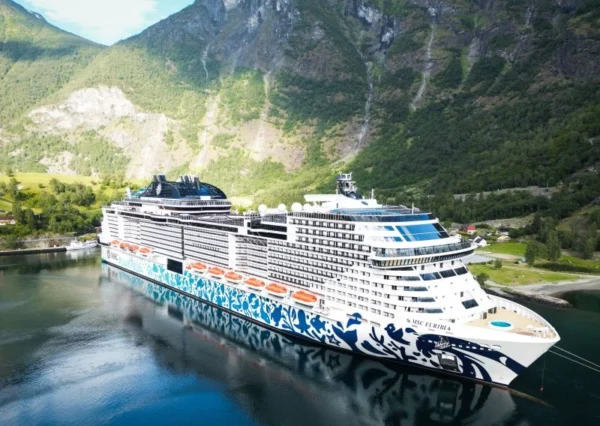
European cruise tourism is entering a new phase of environmental accountability after MSC Cruises announced independently verified methane emissions results for two of its newest LNG-powered cruise ships. The development reflects growing pressure across Europe’s travel sector to improve sustainability standards while maintaining strong demand for luxury cruise vacations.
The company confirmed that the methane emissions performance of MSC World Europa and MSC Euribia was independently assessed and verified by Bureau Veritas Marine & Offshore under the European Union’s FuelEU Maritime regulation. According to MSC Cruises, this marks the first time a cruise operator has received certification based on actual methane emissions measurements rather than relying on standard regulatory assumptions.
The independently validated data showed methane emissions of 1.67% for MSC World Europa and 1.48% for MSC Euribia. Both figures were significantly below the FuelEU Maritime default regulatory benchmark of 3.1%, highlighting stronger operational performance than previously estimated under standard assumptions.
The announcement arrives as European cruise travel continues to expand across the Mediterranean, Northern Europe, and other major coastal tourism regions. Sustainability has become a growing concern among travelers, governments, and tourism authorities, particularly as Europe accelerates efforts to reduce greenhouse gas emissions from transport sectors including aviation, rail, and maritime tourism.
FuelEU Maritime Pushes Cruise Industry Toward Cleaner Operations
The European Union introduced FuelEU Maritime as part of its broader climate strategy aimed at reducing emissions from ships operating in European waters. The regulation encourages the use of cleaner fuels, greater energy efficiency, and enhanced emissions monitoring systems throughout the maritime sector.
Cruise operators are now under increasing pressure to demonstrate measurable environmental improvements as regulators tighten sustainability requirements across Europe’s travel economy.
Methane emissions have become a central issue in the cruise and shipping industries because liquefied natural gas, while cleaner than conventional marine fuels in some respects, can release methane during engine operations. This phenomenon, commonly known as methane slip, has drawn heightened scrutiny from environmental regulators and climate experts.
Although LNG significantly reduces sulfur oxides, particulate matter, and some carbon emissions compared with heavy fuel oil, methane remains a potent greenhouse gas. As a result, European authorities and the International Maritime Organization have intensified efforts to improve emissions tracking and operational transparency.
MSC Cruises stated that independently verified operational data provides a more accurate representation of real-world environmental performance compared with generalized estimation models traditionally used in maritime compliance systems.
Verified Data Could Influence Future Maritime Regulations
The certification process relied heavily on real operational measurements collected from both vessels during active service. Industry observers believe this could shape future regulatory discussions surrounding LNG-powered ships and emissions compliance standards.
Michele Francioni, chief energy transition officer at MSC Cruises, emphasized the importance of independently validated environmental data in supporting more transparent sustainability reporting across the cruise sector. The company also noted that accurate methane measurement may contribute to future international decarbonization negotiations involving global maritime authorities.
Bureau Veritas Marine & Offshore, which conducted the verification process, reviewed operational emissions data to assess compliance with FuelEU Maritime standards. The certification also received flag state approval, further strengthening the legitimacy of the process within international shipping regulations.
Independent verification is becoming increasingly important as travelers and tourism authorities demand proof of sustainability claims rather than broad environmental pledges. Cruise operators across Europe are now investing heavily in advanced propulsion technologies, emissions monitoring systems, and alternative fuel strategies to remain competitive in a rapidly changing market.
LNG Cruise Ships Reshape European Travel Experience
MSC World Europa and MSC Euribia are among the company’s newest dual-fuel LNG-powered vessels, capable of operating on both liquefied natural gas and traditional marine fuels. These ships form part of MSC Cruises’ wider strategy to modernize its fleet while aligning with international decarbonization goals.
The growth of LNG-powered cruise ships is also reshaping the European travel experience. Modern vessels increasingly combine environmental technologies with luxury-focused amenities, expanded itineraries, and upgraded onboard experiences aimed at attracting environmentally conscious travelers.
Cruise tourism remains a major contributor to local economies throughout Europe, supporting hotels, restaurants, transportation providers, tour operators, and coastal attractions. Mediterranean cruise hubs in countries such as Italy, Spain, Greece, and France continue to experience rising passenger volumes, particularly during peak summer travel seasons.
As sustainability becomes a stronger factor in travel decision-making, cruise lines are expected to place greater emphasis on transparent environmental reporting and independently verified performance metrics. Analysts believe this trend could influence booking patterns, brand reputation, and long-term investment strategies throughout the global cruise industry.
Sustainability Pressures Continue to Transform Cruise Tourism
The cruise sector is facing mounting pressure from governments, environmental organizations, and travelers to accelerate its transition toward lower-emission operations. Alongside LNG adoption, companies are investing in shore power systems, advanced wastewater treatment technologies, energy-efficient ship designs, and alternative fuel research.
European climate initiatives are expected to further tighten emissions standards over the coming years, making operational transparency increasingly essential for cruise operators serving European destinations.
MSC Cruises’ verified methane emissions certification signals a broader industry shift toward measurable sustainability performance rather than generalized environmental commitments. As cruise tourism evolves under stricter climate regulations, independently validated emissions data may become a defining factor in how cruise brands position themselves in Europe’s competitive travel market.
For more travel news like this, keep reading Global Travel Wire