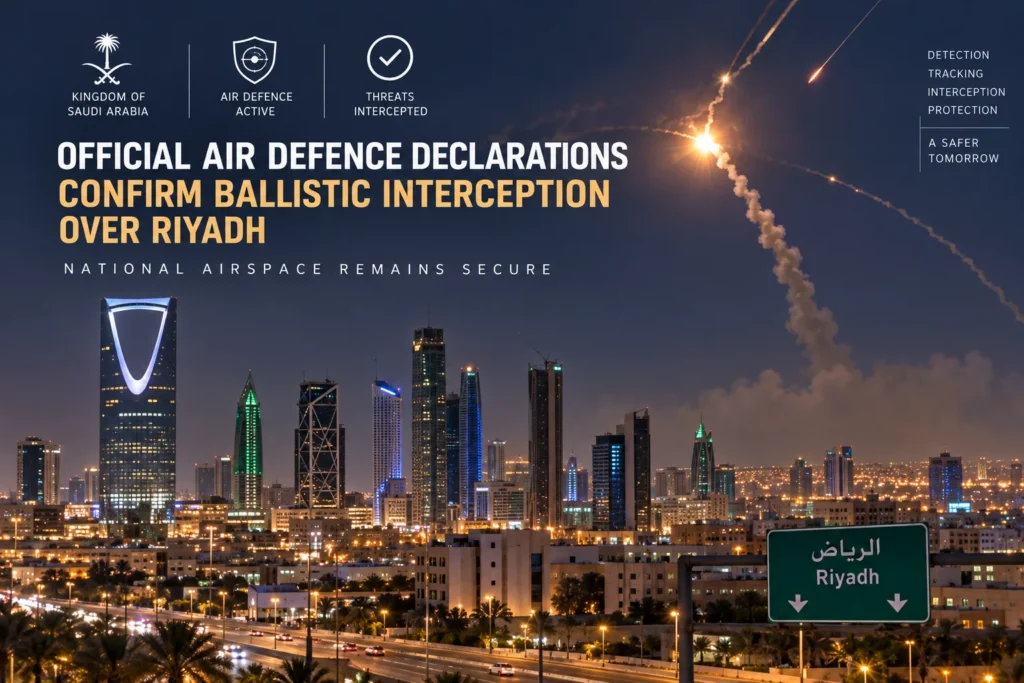
Official public statements released by the military coalition leadership confirm that regional air defence networks successfully intercepted a ballistic missile directed toward the capital city of Riyadh. Official announcements confirm that the aerial threat was neutralized in flight, preserving primary municipal operations and public transport infrastructure across the capital district.
Spokespersons for the Saudi-led coalition detailed that civil air defense systems detected the incoming target at dawn, triggering localized safety alerts before successfully intercepting the projectile. Authorities confirmed that additional drone and missile threats aimed at infrastructure in surrounding industrial centers—including Yanbu, Taif, Baysh, and Farasan—were similarly thwarted by national air defence forces.
Comprehensive Air Safety and Flight Monitoring Operations
In the immediate aftermath of the air defense operation, national aviation authorities and regional transport departments instituted safety reviews across primary airport terminals. While localized air raid alerts briefly activated safety protocols near King Khalid International Airport in Riyadh, civil aviation authorities report that standard security checks were completed to ensure the continued safety of international air travel and commercial passenger operations.
Major commercial air carriers operating across the Arabian Peninsula are closely monitoring airspace notifications and civil aviation bulletins. International passenger transport departments advise air travelers to confirm departure times and flight statuses directly with operating carriers, as heightened monitoring procedures may lead to temporary schedule adjustments or revised air corridor routing.
Aviation safety boards recommend several proactive steps for international passengers traveling through regional hubs:
Reconfirm flight schedules and departure gate information using official airline passenger portals or terminal tracking applications prior to traveling to the airport.
Maintain updated personal contact details within airline booking records to receive automated travel alerts.
Regularly review official foreign affairs bulletins and government security notifications issued by national consular offices.
Verify that travel insurance plans cover potential delays, flight rebooking fees, or unexpected itinerary modifications caused by regional airspace adjustments.
Tourism Board and Hospitality Contingency Guidelines
Tourism agencies and hospitality networks across major Saudi urban hubs are reinforcing safety standards and guest communication protocols. The Kingdom continues to attract international visitors for corporate travel, cultural events, and religious pilgrimages. Destination management organizations emphasize that municipal infrastructure remains resilient, with emergency management agencies operating at full capacity to safeguard public safety.
Hotel management groups and regional tour operators are urged to maintain flexible reservation policies and provide clear guidance to international guests. Destination boards report that hospitality venues and cultural sights are coordinating directly with civil defence authorities to ensure visitor facilities remain secure and fully aligned with national public safety guidelines.
Foreign diplomatic missions continue advising international citizens to utilize official government registration portals, such as traveler enrollment services. These official tools allow consular offices to transmit direct security advisories, emergency updates, and transport instructions to registered travelers during operational disruptions.
Heights of Vigilance for Regional Visitors
Official civil defence statements remind residents and international visitors across urban centers to observe standard public safety precautions and remain attentive to official municipal alerts. Authorities reiterate that civil safety measures and air defence systems remain fully operational to ensure the security of major population centers and international travel corridors.
As civil aviation regulators and government transport ministries continue tracking regional airspace conditions, global travel organizations are preparing for dynamic flight scheduling. International travelers planning routes involving Middle Eastern airspace are strongly advised to remain adaptable, rely exclusively on verified government announcements, and follow instructions issued by local public safety authorities.
For more travel news like this, keep reading Global Travel Wire