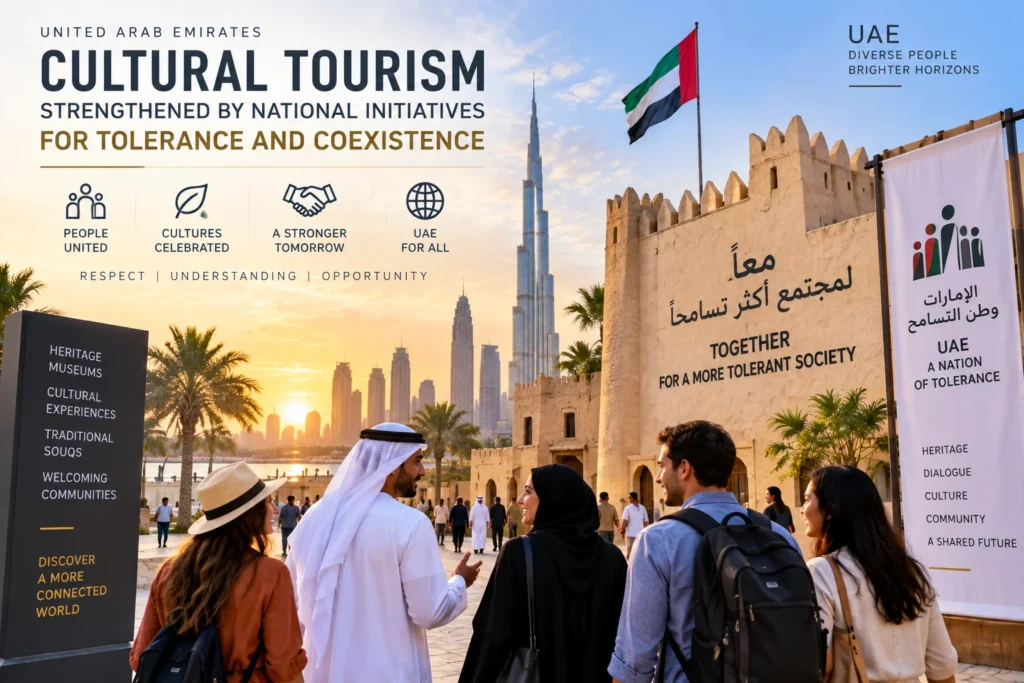
The United Arab Emirates is expanding its position as a global destination for cultural tourism through continuous government statements and national policies focused on intercultural dialogue, peaceful coexistence, and pluralism. Official ministerial declarations highlight how the nation’s social model—built on hosting over 200 nationalities in a harmonious environment—directly reinforces its standing as an international capital for cultural exchange and heritage travel.
During high-level international forums organized in partnership with the United Nations, government officials have reiterated the country’s whole-of-society strategy to counter extremism and hate speech. By empowering community leaders, civil society, technology partners, women, and youth, the UAE continues to showcase an inclusive cultural environment that attracts millions of international leisure travelers, heritage enthusiasts, and global convention delegates each year.
Architectural Landmarks Fuel Interfaith and Heritage Tourism
At the core of the UAE’s cultural tourism appeal are physical monuments dedicated to interreligious dialogue, mutual respect, and architectural innovation. The official opening of landmark cultural centers, such as the Abrahamic Family House on Saadiyat Island in Abu Dhabi, has established a worldwide benchmark for interfaith tourism.
The Abrahamic Family House brings together three distinct houses of worship—a mosque, a church, and a synagogue—alongside a shared educational center designed to foster engagement and mutual understanding. Tourism boards and cultural authorities report that these unique architectural centers attract global travelers seeking authentic educational experiences, architectural photography, and deep historical insights.
Key cultural and architectural highlights driving global visitor interest include:
The Eminence Ahmed El-Tayeb Mosque, featuring delicate mashrabiya latticework screens that preserve privacy while welcoming light.
The St. Francis Church, designed with a forest of vertical timber columns oriented to maximize natural light and symbolize Divinity.
The Moses Ben Maimon Synagogue, incorporating a diagrid facade and bronze chainmail details that honor traditional Sukkot shelters.
Shared educational gardens and visitor centers that offer regular guided tours, public exhibitions, and cultural programming.
Global Agreements and Diplomacy Shape the National Tourism Identity
The foundation of the UAE’s cultural tourism framework is deeply tied to historical diplomacy and international human rights agreements. The signing of the Document on Human Fraternity in Abu Dhabi by Pope Francis and the Grand Imam of Al-Azhar, Dr. Ahmed El-Tayeb, established a lasting legacy that continues to draw international scholars, spiritual tourists, and cultural historians to the region.
Furthermore, the UAE’s leadership in drafting UN Security Council Resolution 2686 on Tolerance, Peace, and Security highlights the nation’s proactive foreign policy. Tourism development authorities emphasize that international visitors prioritize destinations that offer physical safety, social stability, and an open, welcoming atmosphere for diverse nationalities.
By embedding values of tolerance into national legislation and public policy, the Ministry of Tolerance and Coexistence ensures that the country’s hospitality sector remains universally accessible and culturally inclusive.
Strategic Role of Tourism in Promoting Peaceful Coexistence
National tourism strategies are designed to leverage travel as a bridge for global peace and cross-cultural understanding. Official tourism statistics indicate that the UAE’s multi-billion-dollar investment in museum districts, heritage preservation, and global cultural events serves as a primary engine for sustainable economic diversification.
International visitors to cities across the Emirates encounter a diverse tapestry of active places of worship, including historic churches, Hindu temples, Sikh gurdwaras, and Buddhist centers, operating alongside Islamic architectural sites. This broad religious and cultural pluralism guarantees that international tour operators can market the country as a dynamic, inclusive, and multi-faceted travel hub.
Consular affairs offices and international tourism agencies continue to promote the UAE as an ideal destination for family vacations, educational student exchanges, and high-level international summits.
Long-Term Vision for Sustainable Cultural Destination Growth
As the United Nations advances reforms to prioritize crisis prevention and peacebuilding, the UAE’s national model demonstrates how cultural diplomacy and tourism reinforce one another. Official government statements reaffirm that promoting tolerance is not merely an ethical imperative, but a practical pillar for long-term economic prosperity, national security, and visitor satisfaction.
By constantly expanding its portfolio of world-class museums, preserving regional heritage sites, and hosting international dialogue conferences, the UAE ensures that its cultural tourism sector will continue to thrive. Global travelers planning journeys to the region can look forward to an enriching travel experience grounded in safety, openness, and celebrated cultural diversity.
For more travel news like this, keep reading Global Travel Wire