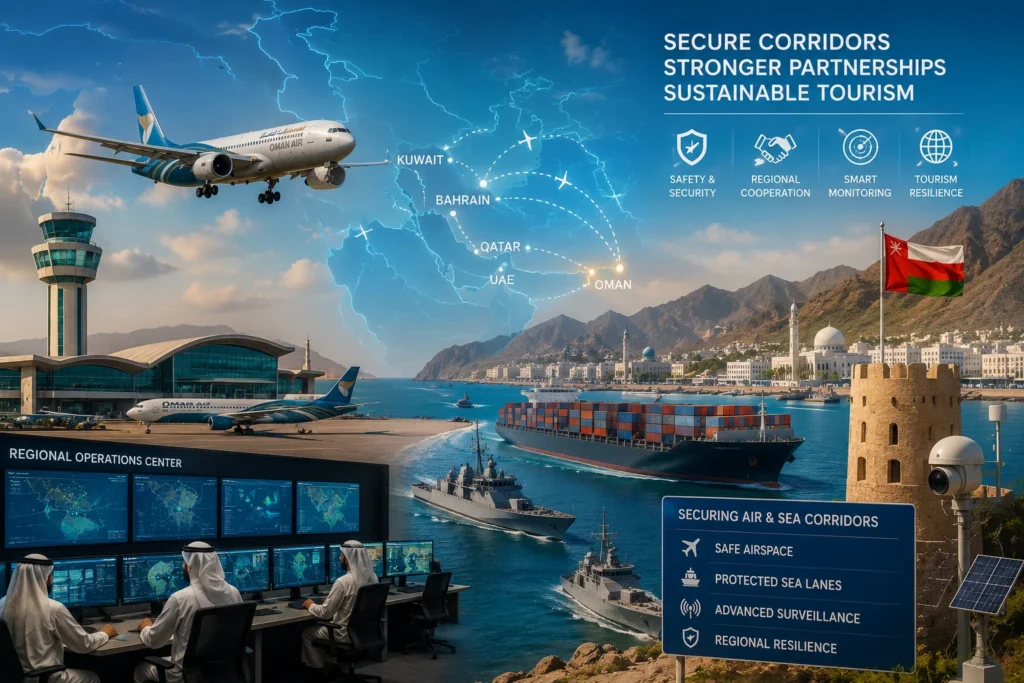
The global travel sector has focused intensive analytical attention on the southwest Asian transit frameworks, where the coordination of airspace and marine lanes remains foundational to structural economic stability. Positioned at a critical geographical intersection, the Sultanate of Oman, working in alignment with the broader Gulf Cooperation Council (GCC) network, has taken a decisive role in structuring regional safety protocols. Official ministerial briefings out of Muscat indicate a concerted diplomatic effort to ensure the long-term protection of commercial flight paths and marine corridors, shielding the broader Middle East tourism economy from logistical volatility.
According to statistical performance indicators released by regional civil aviation boards and tourism ministries, the Gulf zone has established itself as an indispensable nexus for international transit and luxury leisure travel. The preservation of open, predictable transit pathways is vital for retaining high global traveler confidence and securing multi-billion-dollar investments in hospitality and aviation infrastructure across the peninsula.
Safeguarding Marine Ecotourism in the Musandam Enclave
At the heart of Oman’s localized coastal strategy is the Musandam Governorate, an enclave renowned for its dramatic limestone fjords, marine biodiversity, and community-managed travel systems. The Oman Ministry of Heritage and Tourism has prioritized the implementation of structural zoning laws within the adjacent waters to isolate leisure shipping from heavier commercial maritime corridors. These steps ensure that local eco-adventures remain thoroughly insulated from nearby transit activities.
Public environmental directives emphasize that clear maritime separation protocols help protect delicate coral ecosystems and vulnerable marine habitats from industrial impact. In Musandam, local families operate traditional wooden dhow excursions, depending on stable coastal conditions to fund community-based marine conservation projects and sustain remote village economies.
Further down the coastline, the United Arab Emirates port of Fujairah, situated just outside the narrowest channel segments along the Gulf of Oman, continues to expand its footprint as a major base for scuba diving and marine archaeology. Official regional tourism portfolios stress that avoiding technical accidents or localized fuel leaks is paramount to preserving the extensive coral garden sanctuaries and designated underwater parks that draw thousands of international eco-travelers annually.
Securing Transcontinental Aviation Corridors and Passenger Flow
Simultaneously, the coordination of regional airspace architecture forms the second major pillar of the Gulf’s structural defense strategy. The massive international hubs of Dubai, Doha, and Abu Dhabi operate as vital air bridges connecting Europe, Asia, Africa, and the Americas. Joint operational updates from regional civil aviation authorities highlight that air traffic management frameworks are continuously optimized to provide stable, uninterrupted routing protocols.
By working closely with international air transport organizations, regional aviation coordinators implement tactical spacing mandates and structured air corridors. These actions allow commercial carriers to bypass active naval operations seamlessly, maintaining strict arrival schedules and protecting the vast transit passenger network. This high level of regulatory preparedness prevents operational bottlenecks, ensuring that global passenger traffic continues to flow smoothly through the region’s main terminals.
Distribution of Regional Travel and Safety Indicators
The specific operational focus areas across the primary transit nodes highlight a clear division of regional roles:
Musandam Peninsula (Oman): Anchors Fjord Cruising and Marine Ecotourism, focusing on traditional dhow operations and community conservation funding.
Fujairah (UAE): Anchors Coastal Diving and Marine Parks, providing an alternative deep-water port and extensive coral habitat protections.
Dubai & Abu Dhabi (UAE): Serves as Global Civil Aviation Hubs, implementing advanced airspace safety corridors to sustain international transit confidence.
Doha (Qatar): Functions as an International Transit Corridor, ensuring flight routing stability and seamless transcontinental connections.
Persian Gulf Waters: Manages Commercial and Cruise Shipping, regulating daily transit volumes to stabilize maritime travel insurance frameworks.
Strategic Outlook for the Gulf Travel Infrastructure
Long-term tourism development strategies across the region remain highly optimistic, supported by updated regulatory frameworks. The Oman Ministry of Heritage and Tourism recently implemented comprehensive structural overhauls to its national tourism regulations, mandating strict risk management plans and safety audits across all adventure and maritime operations. These updated legal standards enhance institutional readiness while preserving the country’s reputation as a secure, sustainable destination.
Through the careful synchronization of marine traffic management and the enforcement of predictable civil aviation routing, the nations of the Arabian Gulf continue to build a highly resilient framework. By positioning safety and ecological preservation as core components of national infrastructure planning, the region successfully secures its status as a world-class hub for luxury coastal voyages and transcontinental air travel, guaranteeing a stable future for the collective Middle East tourism market.
For more travel news like this, keep reading Global Travel Wire