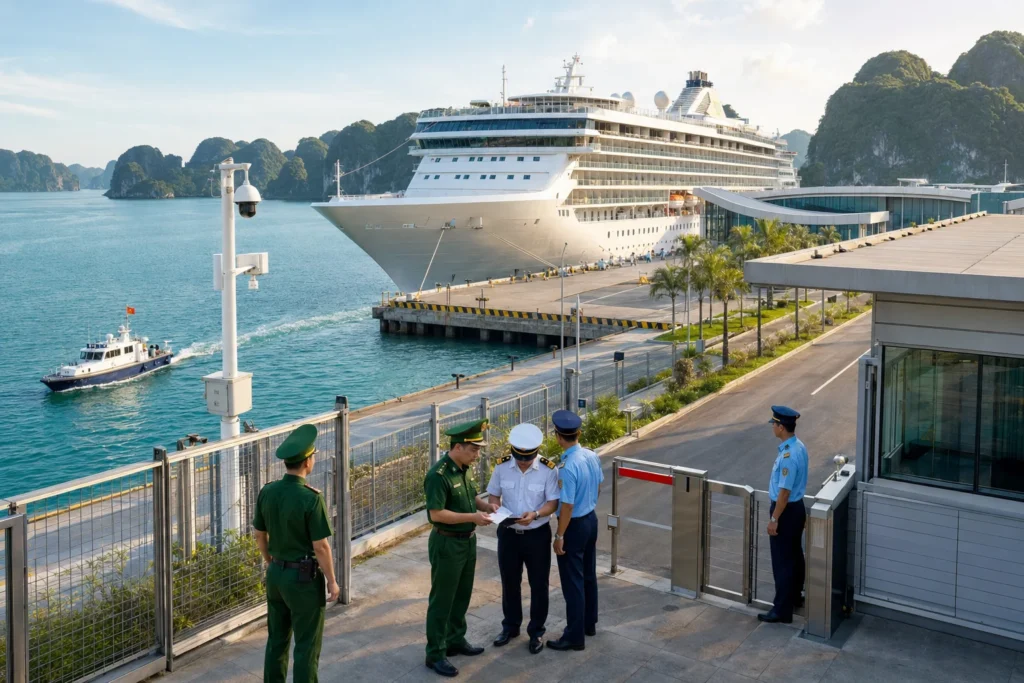
The Government of Vietnam has officially issued Decree 289/2026/ND-CP, establishing a unified legal framework for security, public order, and border control across key seaport border gates managed by the Ministry of Public Security. Taking effect on October 1, 2026, the new regulation introduces modernized electronic clearance mechanisms, defined transit protocols, and streamlined processing rules for international cruise liners operating in Vietnamese territorial waters.
The decree establishes detailed administrative guidelines covering inspection, physical supervision, the issuance of shore leave permits for seafarers, and boarding authorizations for local shore personnel. By defining clear operational responsibilities across government ministries, port authorities, and provincial municipal leadership—including the People’s Committees of Cần Thơ City, Đồng Tháp Province, and Vĩnh Long Province—the measure aims to safeguard maritime borders while supporting sustainable international cruise tourism and trade efficiency.
Strict Transiting Guidelines and Captain Responsibilities
Under the regulatory provisions, vessel captains assume direct legal responsibility for maintaining order, managing onboard crew and passengers, securing cargo, and safeguarding customs seals throughout the transit period across Vietnamese maritime jurisdiction. During transit, captains must strictly prevent unauthorized individuals from boarding or disembarking, prohibit non-authorized vessels from mooring alongside, and enforce a total freeze on unapproved maritime activities.
Exceptions to these disembarkation and boarding restrictions apply strictly to authorized personnel executing official duties. Exempted groups include marine pilots, specialized state management officers, clearance officials, and emergency medical teams boarding to provide urgent healthcare to passengers or crew members.
The decree further outlines systematic border procedures across different maritime journeys. Inbound vessels, their crew, and passengers must complete formal entry immigration procedures at their very first port of call upon entering Vietnam’s maritime border area. Conversely, foreign and domestic vessels departing the country must finalize all exit clearance protocols at the final seaport border gate before crossing the territorial sea boundary. Transiting vessels must fulfill transit clearance formalities immediately upon entering Vietnamese waters, while ships moving between domestic seaports must execute formal transfer procedures at both the port of departure and the destination port.
Specialized Operating Rules for International Cruise Ships
Recognizing the vital economic role of ocean travel, Decree 289 outlines tailored administrative rules aimed at balancing rigorous port security with smooth travel experiences for international cruise guests.
International travel agencies operating cruise itineraries in Vietnam are required to submit essential documentation to the port border police no later than 12 hours prior to a vessel’s scheduled arrival. Required submissions include detailed tour programs, valid international travel business licenses for first-time cruise calls, passenger manifests, and visa approval documentation where applicable. Eligible cruise passengers will be issued landing visas directly on board by port border police in full accordance with national immigration laws, ensuring hassle-free shore excursions.
For international cruise liners authorized to carry domestic passengers between Vietnamese ports, travel businesses must supply comprehensive passenger manifests and travel schedules in advance. When disembarking at domestic stops, foreign national passengers must present a valid passport or recognized international travel document, while Vietnamese citizens are required to show an official national identity card or passport to port border police.
To ensure ongoing public safety, port border police retain the authority to conduct targeted onboard inspections in coordination with port authorities. Special inspections may be initiated if stowaways are detected, if there are reasonable grounds to suspect violations of security or public order, or if indications arise that forged travel documents are being utilized.
Expanding Digital Clearance via the National Single Window
A central pillar of the decree is the mandatory expansion of digital administration across the maritime sector. Electronic clearance procedures will be processed directly through the Vietnam National Single Window portal, significantly reducing physical paperwork and accelerating port turnaround times for commercial and passenger vessels.
The electronic clearance framework applies broadly to Vietnamese commercial vessels on domestic and international routes, foreign-flagged ships entering, exiting, transiting, or transferring between domestic ports, and foreign crew members serving aboard these ships. Domestic fishing vessels and local fishing crews currently processed manually will gradually transition to the digital single window system as local port police and management agencies upgrade information technology infrastructure.
In the event of unforeseen technical outages or system maintenance affecting the Vietnam National Single Window portal, maritime operators will be permitted to complete standard clearance procedures manually, preventing operational bottlenecks at seaport border gates. By modernizing administrative workflows, Vietnam reinforces its commitment to secure, transparent, and highly efficient maritime tourism operations.
For more travel news like this, keep reading Global Travel Wire