The landscape of international travel and cross-border mobility has reached an unprecedented turning point as governments aggressively update their bilateral travel treaties and consular agreements. According to official public information and immigration metrics released for the 2026 calendar cycle, the strength of national travel documents is undergoing a major structural reconfiguration. This reorganization reflects shifting diplomatic alliances, emerging trade corridors, and deliberate national strategies to enhance freedom of movement for global citizens.
A passport functions as far more than a routine identity card; it serves as a direct indicator of a country’s diplomatic credibility and geopolitical stability. For international tourism, cross-border commerce, and academic exchange, the publication of updated passport parameters establishes an important benchmark for measuring how easily travelers can navigate international networks without facing extensive administrative obstacles or prolonged embassy processing queues.
Singapore Commands the Apex of Cross-Border Mobility
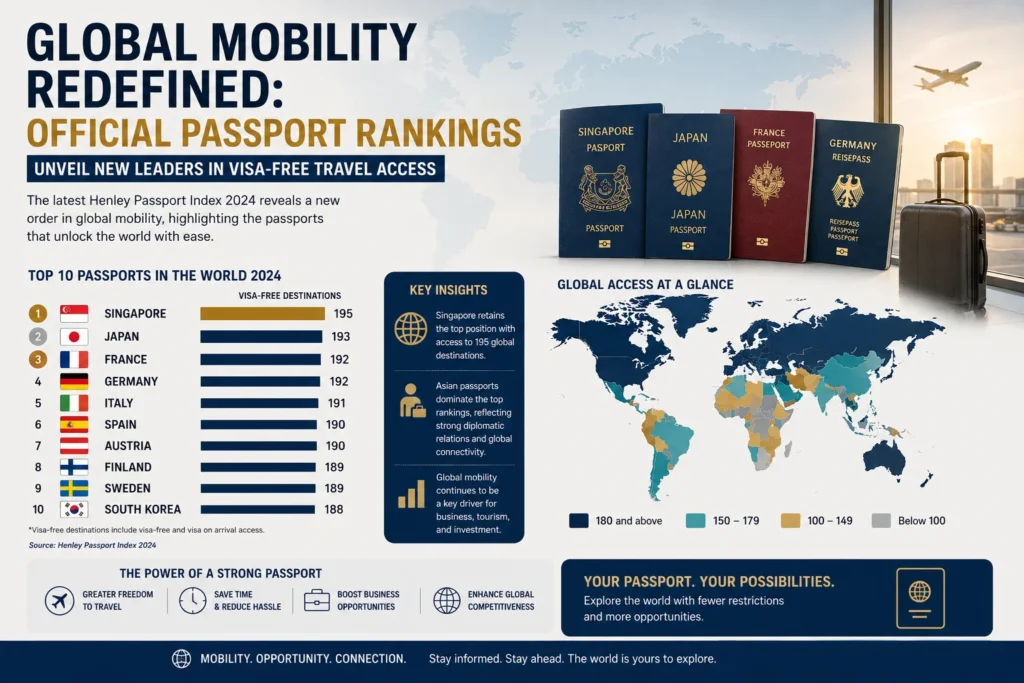
Official statistical evaluations confirm that Singapore continues to hold the absolute pinnacle of travel freedom. According to verified international transit metrics, the city-state grants its citizens borderless entry or automated visa-free access to an astonishing 192 destinations out of 227 evaluated travel zones worldwide. This sustained dominance highlights the efficacy of the country’s balanced foreign policy, strategic trade integration, and exceptional security compliance standards.
The practical impact for Singaporean passport holders is a total elimination of transaction friction when planning short-notice international travel. The country’s proactive engagement in establishing reciprocal electronic travel authorizations and border exemptions has created a highly efficient paradigm that other sovereign governments seek to emulate.
The East Asian Alliance and the Ascent of the Middle East
Directly following the city-state, Japan and South Korea maintain their positions at the forefront of global travel access, with ordinary passport holders possessing access to 187 destinations without requiring a pre-arranged visa. The advanced technological, automotive, and manufacturing sectors of these East Asian nations necessitate high levels of corporate and luxury mobility, which their respective ministries have successfully secured through decades of focused diplomatic investment.
Concurrently, one of the most remarkable long-term structural shifts in international travel history is unfolding in the Gulf region. The United Arab Emirates has successfully consolidated its position at the absolute top tier of global travel freedom, now matching the East Asian heavyweights with visa-free access to 187 destinations.
According to official ministry statements, this historic climb is the direct outcome of the UAE’s aggressive visa liberalization strategy and strategic international partnerships. By positioning its primary aviation hubs as the central connective tissue for transcontinental airlines, the nation has successfully translated economic influence into borderless access, presenting an optimized blueprint for rapid diplomatic expansion.
European Nations Solidify High-Capacity Openness
European countries continue to populate the upper echelons of global travel flexibility, heavily supported by regional integration frameworks and unified border agreements. Sweden shares a highly competitive space alongside the UAE, granting its citizens access to 186 destinations.
Directly behind, a massive group of European nations handles high-frequency global transit with an access score of 185 destinations. This cohort includes:
Western European leaders: France, Germany, and the Netherlands
Mediterranean gateways: Spain and Italy
Northern European hubs: Denmark, Finland, and Norway
Alpine and Atlantic centers: Switzerland, Luxembourg, and Ireland
The table below breaks down the structural hierarchy of the world’s most mobile populations based on the latest official consular data:
| Global Mobility Tier | Participating Sovereign Nations | Total Visa-Free Destinations | Primary Regional Regulatory Catalyst |
| Top Tier | Singapore | 192 | Unilateral trade pacts and optimized consular security |
| Second Tier | Japan, South Korea, United Arab Emirates | 187 | Strategic aviation expansions and bilateral agreements |
| Third Tier | Sweden | 186 | Unified Nordic and European integration frameworks |
| Fourth Tier | Spain, France, Germany, Italy, Netherlands, Denmark | 185 | Core Schengen compliance and global trade priorities |
| Fifth Tier | Austria, Greece, Portugal, Malta | 184 | High-density tourism networks and border reciprocity |
The Shifting Positions of Traditional Western Powers
Despite maintaining substantial cultural and economic influence across international networks, traditional Western powers like the United Kingdom and the United States have seen a comparative recalibration in their global standings. The United Kingdom currently occupies a position allowing borderless entry to 182 destinations, while the United States provides access to 179 destinations.
While both passports still offer extensive operational advantages for corporate commuters and leisure tourists, their gradual stabilization relative to rapidly rising Asian and Middle Eastern nations points toward a broader decentralization of global passport power. Furthermore, evolving border proposals regarding mandatory biometric data tracking and advanced registration for allied nations may introduce new layers of administrative data management in the coming years.
Guidelines for Maximizing International Travel Routing
As global access levels fluctuate and the gap between the world’s strongest and weakest travel documents impacts tourist flows, national tourism boards suggest that travelers implement specific operational practices to guarantee smooth transit:
Always Verify Electronic Travel Status: Many destinations that do not require a formal consular visa sticker still mandate the acquisition of an electronic travel authorization at least 72 hours prior to boarding your flight.
Monitor Dual-Citizenship Frameworks: International business professionals holding multiple nationalities should strategically deploy the passport that provides optimized automated entry based on real-time regional agreements.
Account for Security Screening Buffers: Given the increased volume of international passengers moving through primary hubs, travelers should schedule a minimum of three hours for interline connections to successfully navigate automated biometric processing terminals.
The alignment of travel documentation with updated geopolitical realities confirms that mobility remains a key asset in modern tourism development. By committing to comprehensive international trust, structural governance, and open border policies, the leading nations in global passport rankings are successfully transforming how the world connects, ensuring that international travel remains an accessible reality for millions of global citizens.
For more travel news like this, keep reading Global Travel Wire