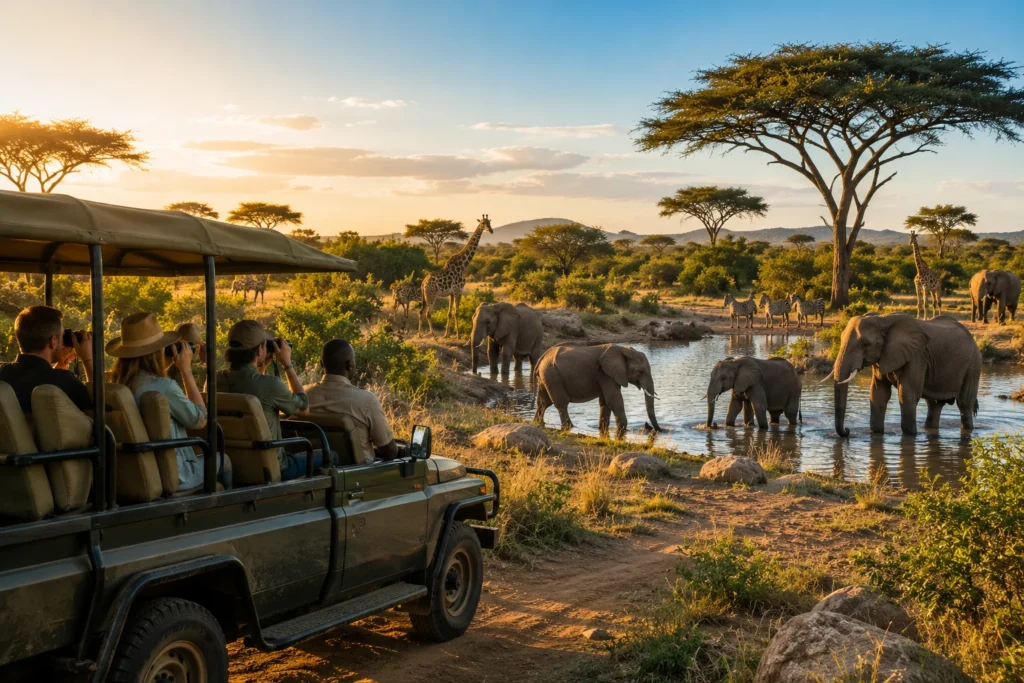
International travel to the African continent is expanding rapidly, led by high global demand for ecotourism, nature travel, and pristine wildlife reserves. Official metrics released by the United Nations World Tourism Organization confirm that international tourist arrivals across Africa reached historic peaks, exceeding pre-pandemic baselines and cementing the region as a standout performer in global travel recovery.
This sustained momentum is driving targeted investment into national parks, wildlife conservation initiatives, and regional transport infrastructure. According to tourism board disclosures and public wildlife management agencies across East, Southern, and North Africa, travelers are increasingly prioritizing biodiversity, conservation-led travel, and authentic wilderness experiences over standard urban vacations.
Premier Safari Destinations Leading Wildlife Travel Demand
National park authorities and official conservation boards have highlighted ten key natural reserves attracting significant global traveler interest, reflecting the sheer diversity of landscapes across the continent.
Serengeti National Park, Tanzania
Tanzania’s flagship conservation area remains a central pillar of East African wildlife travel. Maintained by the Tanzania National Parks Authority, the park is globally recognized as a UNESCO World Heritage site. It serves as the primary stage for the annual Great Migration, where over one million wildebeest and zebra move across the ecosystem. Public wildlife monitoring notes strong year-round predator activity, with high densities of lions, cheetahs, and leopards operating across the Seronera Valley and surrounding plains.
Masai Mara National Reserve, Kenya
Managed under local county council jurisdiction in partnership with national conservation bodies, Kenya’s premier reserve is renowned for its big cat populations. Official wildlife survey data shows high concentrations of lions, cheetahs, and leopards. The reserve experiences its peak visitor activity during the annual river crossings, when migratory herds transit north from neighboring ecosystems, creating one of the world’s most significant natural spectacles.
Bwindi Impenetrable National Park, Uganda
The Uganda Wildlife Authority oversees this critical conservation site, home to roughly half of the world’s remaining mountain gorilla population. Guided trekking regulations enforced by public wardens ensure sustainable visitor access while protecting vulnerable primate families within the dense Albertine Rift forest environment.
Amboseli National Park, Kenya
Famous for its dramatic backdrop of Mount Kilimanjaro, Amboseli operates under the stewardship of the Kenya Wildlife Service. Official research programs hosted within the park represent some of the longest-running wild elephant studies globally. Seasonal wetlands within the reserve attract wide varieties of waterfowl and large mammal herds, making it a key site for environmental research and wildlife photography.
Kruger National Park, South Africa
South African National Parks manages this massive conservation area, which stands as one of Africa’s most accessible wildlife destinations. The park supports high biodiversity metrics, including robust populations of the Big Five—lion, leopard, elephant, buffalo, and rhinoceros—alongside more than 500 cataloged bird species. State-managed infrastructure allows for controlled self-drive tourism alongside regulated private concession operations.
Okavango Delta, Botswana
Protected through Botswana’s Department of Wildlife and National Parks, this vast inland delta is recognized internationally for its pristine wetland ecosystem. Seasonal flooding from the Okavango River transforms the Kalahari terrain into an aquatic sanctuary, supporting high concentrations of elephants, hippopotamuses, and rare wetland species monitored under national sustainability frameworks.
Etosha National Park, Namibia
Under the direction of Namibia’s Ministry of Environment, Forestry and Tourism, Etosha is defined by its massive salt pan structure. Official wildlife monitoring highlights the park’s network of natural and managed waterholes, which serve as vital gathering points for endangered black rhinoceroses, lions, and specialized desert wildlife during dry seasonal periods.
South Luangwa National Park, Zambia
Overseen by the Department of National Parks and Wildlife in Zambia, South Luangwa is widely celebrated as the birthplace of guided walking safaris. Strict park management policies allow licensed rangers to conduct on-foot wilderness excursions, offering low-impact exploration centered around strong leopard tracking and riverine ecology along the Luangwa River.
Mana Pools National Park, Zimbabwe
Managed by the Zimbabwe Parks and Wildlife Management Authority, this UNESCO World Heritage location along the Zambezi River offers specialized wilderness experiences. Official park regulations permit guided walking safaris and river canoeing, giving visitors direct access to floodplains populated by bull elephants, hippopotamuses, and diverse birdlife.
Mahale Mountains National Park, Tanzania
Situated along the isolated shores of Lake Tanganyika, Mahale Mountains operates as a strictly protected sanctuary for wild chimpanzees. Public park authorities restrict motorized transport within the interior forest zones, requiring visitors to access habituated primate groups via foot treks, supported by national conservation personnel.
For more travel news like this, keep reading Global Travel Wire