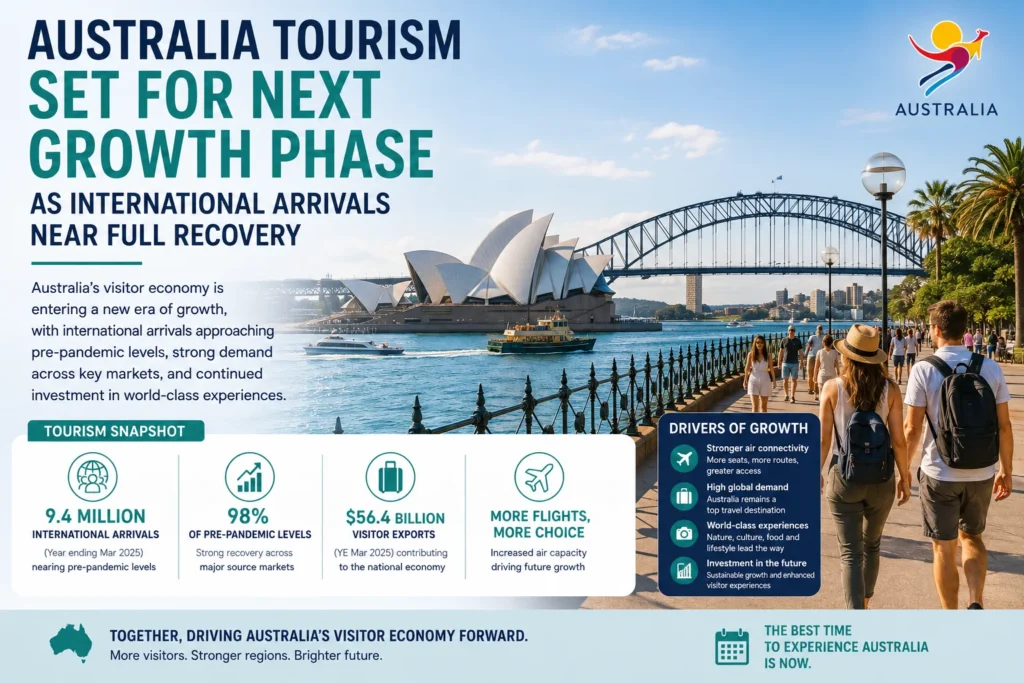
With international visitor arrivals rebounding to 98 percent of pre-pandemic levels, Australia’s accommodation and visitor economy is transitioning into a new growth phase. Official industry data and research forecasts indicate that as the initial recovery phase concludes, Australia’s hotel sector is uniquely positioned to capture a larger share of global travel, driving revenue growth across key gateway cities and regional tourism hubs.
According to research benchmarks evaluating the national travel sector, international arrivals reached 9.16 million in the 12 months ending May 2026. This represents a 9 percent increase year-on-year, bringing total overseas visitor volumes within striking distance of 2019 levels. However, because Australia’s resident population has expanded over the same period, matching past visitor numbers relative to a larger population base reveals significant untapped capacity for future market expansion.
Understanding International Visitor Intensity and Growth Potential
To evaluate destination performance accurately, travel analysts utilize the international visitor intensity metric, which measures total annual overseas arrivals relative to the resident population. In 2019, Australia recorded an international visitor intensity ratio of 0.37 arrivals per resident. In the 12 months ending May 2026, that ratio stood at 0.32 arrivals per resident.
Achieving the 2019 intensity benchmark against today’s larger population would have required 10.23 million international arrivals—approximately 1.07 million more visitors than recorded. This statistical gap highlights a major growth opportunity for national tourism authorities, airport operators, and hotel developers.
Industry forecasting models indicate that returning to 2019 visitor intensity levels by 2030 could lift national hotel occupancy rates to 80 percent. Simultaneously, revenue per available room (RevPAR) is projected to reach $225—a 24 percent increase over current operational performance. Major gateway markets, including Sydney, Melbourne, and Brisbane, are expected to absorb the largest share of this growth due to established international flight connections and premier event infrastructure.
Higher Visitor Expenditure and Extended Length of Stay Drive Value
While total arrival numbers continue to climb toward historical peaks, the economic profile of international travelers visiting Australia has strengthened significantly. Overseas visitors represent one of the highest-value demand segments for the accommodation sector, spending more per trip and staying longer than in previous years.
Official tourism statistics reveal significant gains in key visitor metrics:
Increased Average Expenditure: Average spend per international visitor increased by 31 percent, rising from $5,195 in the year ending March 2019 to $6,795 in the year ending March 2026.
Extended Hotel Stays: The average length of stay for international guests lengthened from 6.7 nights to 8.6 nights, generating higher room-night demand per arrival.
Elevated Daily Yield: Extended stays combined with higher overall budgets have raised average daily rates across commercial accommodation providers.
This shift toward a higher-value visitor profile means that even modest gains in international arrival volumes yield disproportionate financial benefits for hotel owners, operators, and local tourism businesses.
Strong Domestic Foundation Insulates Accommodation Sector
The anticipated surge in international travel builds upon an exceptionally resilient domestic travel base. Throughout the multi-year recovery period, domestic travelers provided crucial stability for the accommodation industry, accounting for approximately 70 percent of total hotel room nights nationwide.
This robust domestic demand cushions the hotel industry against shifting global economic conditions, establishing a secure revenue baseline. As international flight capacity restores and global marketing campaigns take effect, incoming overseas travelers represent pure additive demand for an already stable market.
Furthermore, structural conditions across the Australian hotel landscape favor existing operators. A constrained new hotel construction pipeline—driven by elevated building costs and tight planning approvals—means that rising traveler demand will interact with limited new room supply. This supply-demand dynamic increases the likelihood that additional visitor arrivals will directly translate into higher occupancy rates and room yield growth.
Major Events and Connectivity Propel Future Tourism Demand
Australia’s distinctive natural environment, world-class culinary scene, and strong reputation for safety continue to position the country as a premier long-haul destination. Looking ahead, a robust pipeline of major sporting, business, and cultural events will play a vital role in accelerating international visitation.
Major international events serve as key economic drivers for gateway cities, drawing global media attention and generating tens of thousands of incremental hotel room nights per event. Upcoming highlights, including major international sporting tournaments and global trade conventions through 2027 and beyond, are expected to deliver substantial near-term boosts to international passenger arrivals.
By aligning targeted international marketing, expanded aviation capacity, and strategic event scheduling, Australia is well-positioned to capitalize on global travel demand, delivering sustained economic growth across the nation’s tourism and hospitality ecosystem.
For more travel news like this, keep reading Global Travel Wire