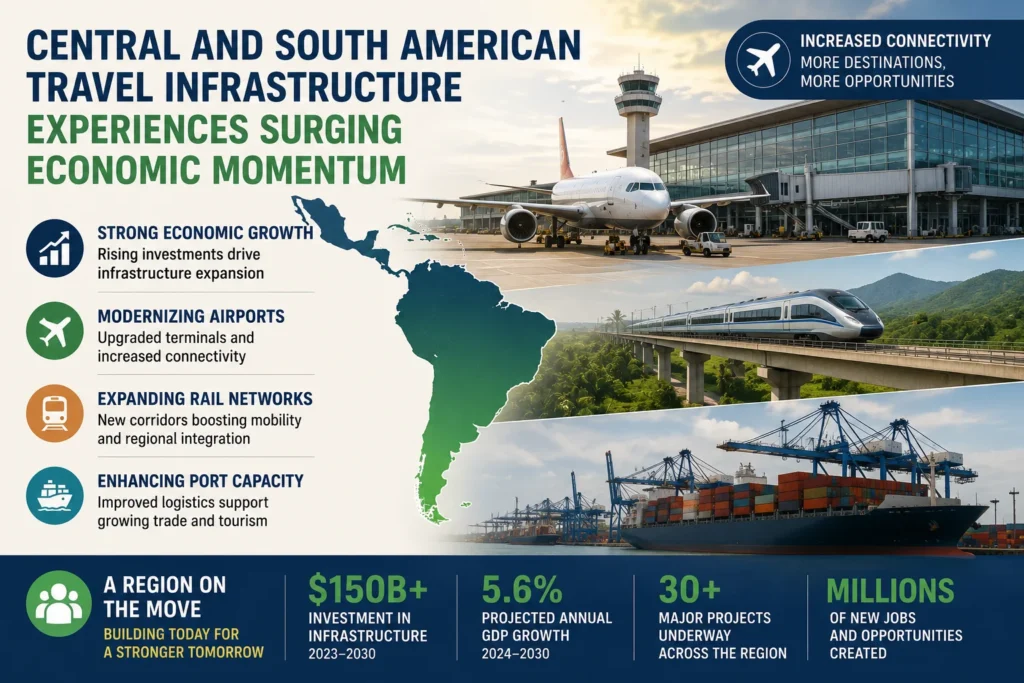
The international travel and hospitality landscape is witnessing a definitive realignment as destinations across Central and South America project unprecedented expansion metrics. According to the newly finalized 2026 Economic Impact Research published by the World Travel & Tourism Council, the regional tourism sector is positioned to significantly outpace global development baselines. Backed by highly resilient domestic vacation markets and a sharp escalation in incoming foreign arrivals, the combined geographic territory is serving as a primary locomotive for the global leisure sector.
Statistical modeling from the research initiative indicates that the gross domestic product linked directly to travel and tourism across Central and South America will expand by an impressive 4.1 percent. This targeted performance comfortably eclipses the projected global economic expansion average of 3.2 percent for the same period. Furthermore, financial inflows from international visitor spending are forecast to experience a powerful 7.8 percent surge region-wide. This broad-based momentum is highly insulated from the shifting geopolitical bottlenecks and route restructurings currently impacting traditional destination corridors across other parts of the world, making the Americas a highly attractive focus for hospitality capital.
Landmark Institutional Hotel Projects Move Forward In Ecuador And Argentina
The structural data points to Ecuador as the fastest-accelerating country market within the sub-continent. The nation is on track to achieve a spectacular 11.6 percent jump in localized travel and tourism GDP. Close behind is Bolivia, where industry outputs are set to grow by 10.3 percent, reinforced by an extraordinary 25.8 percent spike in inbound international visitor spending. Historically, the Ecuadorian hospitality arena has remained decentralized and widely untouched by corporate chain infrastructure. However, major hotel developers are shifting their long-term pipelines to exploit this high-yield environment.
Construction frameworks are moving rapidly on several upscale assets, notably including the InterContinental Guayaquil. Managed under the InterContinental Hotels Group portfolio, the 101-room luxury asset is advancing toward scheduled physical completion. Simultaneously, Marriott International is progressing with its specialized coastal inventory footprint via the Courtyard by Marriott Playas, a 150-room lifestyle asset designed to meet the growing demands of premium corporate and leisure travelers.
Argentina represents another highly lucrative terrain where multinational hospitality conglomerates are securing immediate market share. Melia Hotels International is executing a aggressive regional clustering model, constructing the 150-room Melia El Calafate alongside the strategically located INNSIDE by Melia Costa del Este. The Spanish hospitality major is further solidifying its high-end resort presence near the southern tip of the continent with the planned launch of the 200-room Gran Melia Ushuaia.
Concurrently, corporate giants like Wyndham Hotels and Resorts are utilizing their midscale Howard Johnson moniker to anchor presence across growing secondary tourism hubs, including specialized builds in Colon, Cinco Saltos, and Tandil. Hilton Worldwide is matching this expansion speed by deploying a varied portfolio strategy consisting of Hampton by Hilton, Tru, and Hilton Garden Inn assets, highlighted by the upcoming launch of the premium Hilton Ushuaia property.
Premium Lifestyle Brands Capitalize On Brazil’s High Capacity Tourist Hotspots
As the largest single travel and tourism economy in South America, Brazil is managing a sustainable 2.1 percent year-on-year increase in overall sector output, with inbound visitor spending rising by a steady 3 percent. Due to the sheer scale of the domestic consumer market, global institutional operators like Accor and Hilton are systematically introducing their lifestyle brands to diversify local urban hotel portfolios.
However, the most notable commercial activity is occurring within dedicated resort enclaves. In the highly sought-after alpine tourism hub of Gramado, located within the Rio Grande do Sul region, pioneering construction is underway on a new 150-room Club Med resort. The location is uniquely positioned to capture high-spending seasonal travelers drawn to the microclimate of the region, which features a distinct snowy winter season.
This development is complemented by an expansive lifestyle resort complex managed under the Hard Rock Hotel brand, which will introduce a massive combination of 858 luxury rooms and private residence club units to the local market. These large-scale projects indicate a growing confidence from global asset management firms looking to establish permanent positions inside premium South American leisure markets.
Midscale Brand Proliferation Connects Diverse Regional Travel Routes
A key driver behind the widening accessibility of South American destinations is the cross-border expansion of specialized midscale accommodation networks. The City Express brand ecosystem, which was strategically acquired and integrated into the global Marriott International distribution system, is executing an aggressive cross-border expansion roadmap.
Corporate development logs confirm that seven separate City Express properties are currently scheduled for construction across key commercial and leisure nodes in Brazil. This regional rollout is structurally mirrored by parallel site developments advancing through Peru, Bolivia, and Argentina. By placing highly standardized, digitally integrated select-service properties along major transit corridors, hotel groups are successfully lowering the cost barriers to travel, providing modern business travelers and independent leisure tourists with predictable, high-quality lodgings as the broader South American tourism sector expands toward its historic targets.
For more travel news like this, keep reading Global Travel Wire