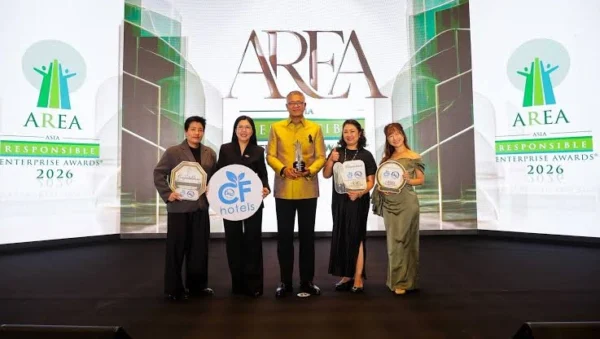
Thailand has strengthened its position as a regional leader in sustainable tourism after the Tourism Authority of Thailand’s Carbon Footprint Hotels platform won the Green Leadership category at the Asia Responsible Enterprise Awards 2026 in Malaysia.
The award was presented on 26 June 2026 and officially announced by the Tourism Authority of Thailand on 2 July. It recognises the country’s progress in turning low-carbon tourism policy into practical action across the accommodation sector through measurable emissions management, digital tools and access to green finance.
Known as CF-Hotels, the platform has expanded rapidly since becoming publicly active in 2024. It has grown from 21 pilot properties to more than 900 registered hotel accounts across Thailand, demonstrating strong interest from accommodation providers seeking clearer guidance on energy use, waste, water consumption and greenhouse gas emissions.
Participating hotels have recorded reductions totalling 16,838.79 tonnes of carbon dioxide equivalent. This has been compared with the environmental benefit of planting more than 1.2 million mature trees.
Digital Platform Turns Climate Goals into Hotel Action
CF-Hotels was created to help hotels and other accommodation providers measure, manage and reduce their environmental impact through a standardised digital system.
Operators can build an environmental inventory covering electricity, fuel, water, waste and greenhouse gas emissions. This gives businesses a clearer picture of where emissions are generated and where operational improvements can be made.
The platform moves sustainability beyond general promises by providing hotels with data that can support investment decisions, management planning and measurable carbon reduction.
For Thailand’s tourism industry, this is particularly important because accommodation is one of the sector’s most resource-intensive components. Hotels operate throughout the year, requiring cooling, lighting, laundry, food preparation, water systems and waste management.
Reducing emissions across these areas can create significant environmental and financial benefits.
Small and Independent Hotels Gain Wider Access
One of the strongest features of CF-Hotels is its accessibility to small and medium-sized accommodation businesses.
Thailand’s hospitality sector includes international resorts and urban hotel groups, but it also depends on boutique properties, family-run guesthouses, independent hotels and regional operators. Many smaller businesses lack the staff, funding or technical knowledge required to conduct complex carbon assessments.
CF-Hotels lowers this barrier by giving operators access to structured data collection and assessment tools without requiring them to develop their own systems.
This can help smaller properties understand their performance, compare energy use over time and identify practical changes such as installing efficient lighting, improving cooling systems, reducing food waste or adjusting laundry operations.
The result is a broader national sustainability programme that is not limited to large hotel brands.
Green Finance Supports Real Hotel Investment
The platform also connects environmental performance with green-finance opportunities, helping hotels move from measurement to action.
Thailand’s low-carbon transition has been supported by cooperation involving the Bank of Thailand and commercial banks through the Financing the Transition initiative. The programme was created to help businesses, particularly small and medium-sized enterprises, access financial products designed for practical environmental improvements.
CF-Hotels has also mobilised more than 29.3 million baht through the ThaiCI Fund to support low-carbon transition projects.
This financial link is crucial because hotel upgrades often require significant capital. Solar installations, efficient cooling equipment, water-saving systems and waste-management infrastructure can reduce long-term operating costs, but the initial investment may be difficult for smaller operators.
By connecting credible carbon data with finance, the platform gives lenders more information while helping hotels demonstrate the value of proposed environmental improvements.
Energy Savings Strengthen Hotel Profitability
The business benefits of CF-Hotels extend beyond environmental reputation.
Hotels that understand their energy, water and waste profiles can identify where resources and money are being lost. Electricity costs can be reduced through efficient air conditioning and lighting, while better water management can lower utility expenses.
Food-waste monitoring can also improve purchasing decisions and reduce unnecessary spending across restaurant and catering operations.
These savings are increasingly valuable for hotels facing rising operating costs and strong competition. Sustainability can therefore support profitability rather than functioning only as an additional expense.
Carbon readiness may also improve access to international tourism markets. Corporate travel buyers, tour operators and environmentally conscious guests are placing greater emphasis on verified sustainability practices when choosing accommodation.
International Standards Improve Competitiveness
CF-Hotels supports accommodation providers seeking alignment with internationally recognised carbon and sustainability frameworks.
This can help Thai hotels prepare for changing expectations from overseas partners, responsible travel programmes and future green procurement requirements.
Carbon measurement also gives hotels a foundation for communicating progress more clearly. Rather than relying on general environmental claims, operators can show that they are collecting data, identifying emissions and implementing reduction plans.
For travellers, this creates a clearer way to support responsible accommodation choices. Visitors may not understand every technical aspect of greenhouse gas accounting, but they can recognise properties taking measurable steps to reduce their impact.
Award Strengthens Thailand’s Tourism Leadership
The AREA 2026 Green Leadership Award gives Thailand greater regional authority in sustainable tourism development.
The achievement demonstrates how destination organisations can connect public policy, hotel operations, finance and digital technology through one practical system. It also reinforces Thailand’s image beyond beaches, culture, wellness and hospitality by adding measurable environmental progress to its tourism identity.
With more than 900 registered hotel accounts, substantial emissions reductions and millions of baht mobilised for transition projects, CF-Hotels has moved beyond the pilot stage.
Its continued expansion shows that the future competitiveness of tourism will depend not only on visitor numbers, but also on whether destinations can demonstrate responsible, efficient and resilient growth.
For more travel news like this, keep reading Global Travel Wire