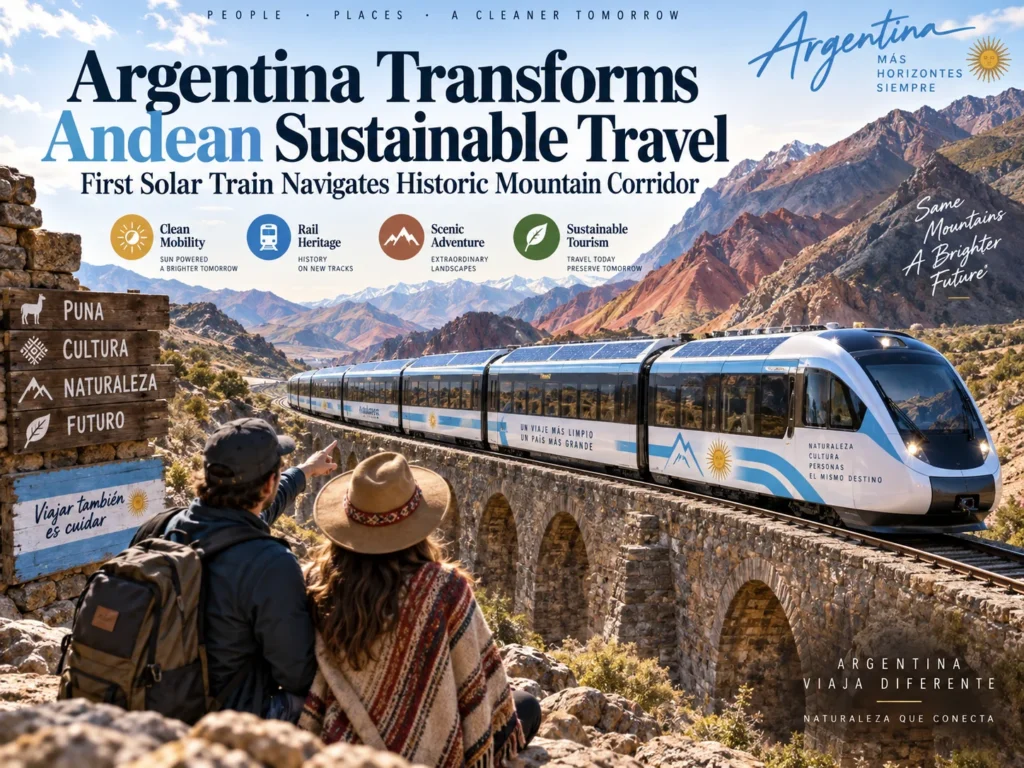
More than 90,000 passengers have traveled through the UNESCO World Heritage site of Quebrada de Humahuaca since passenger rail operations resumed in June 2024, ending a 30-year hiatus along the historic line. This restoration represents a major transition toward renewable transit infrastructure driven by the Tren Solar de la Quebrada, a battery-electric multiple unit (BEMU) system powered by regional solar energy generation in Argentina’s high-altitude Jujuy province.
Geopolitics and Sustainable Infrastructure in the Andes
The Quebrada de Humahuaca has served as a primary trade and cultural migration passage through the Andes for millennia. By reintroducing passenger rail services along this valley, the provincial government of Jujuy aims to expand regional tourism without relying on carbon-intensive diesel transport. The project acts as a model for off-grid rail electrification, demonstrating that remote mountainous landscapes can support high-volume eco-tourism without requiring extensive overhead catenary wire installations.
The project aligns with international guidelines for preserving cultural landscapes and UNESCO World Heritage corridors. Replacing fossil fuel engines with quiet, zero-emission technology reduces chemical and acoustic pollution across heritage sites. Integrating rail transit into the regional economy supports slow-travel initiatives, encouraging international visitors to spend more time exploring connected municipalities rather than driving personal vehicles along mountain roads.
Technical Specifications and Operational Mechanics
The Tren Solar de la Quebrada runs on an energy-efficient operational model centered on local renewable generation. Classified as a Battery Electric Multiple Unit (BEMU), the train does not generate its primary power through rooftop solar panels while in motion. Instead, it draws electricity from Jujuy’s regional solar grid into specialized high-capacity lithium iron phosphate storage units installed at charging hubs.
Key Technical Parameters
Route Total Distance: 42 kilometers between Volcán and Tilcara
Primary Power Source: Distributed Jujuy regional solar grid energy
Energy Storage Capacity: 6 Lithium iron phosphate batteries (352 kWh capacity per two-car unit)
Operational Range: 100 to 120 kilometers per single full charge
Active Fast-Charging Hubs: Volcán and Purmamarca rail stations
Planned Charging Infrastructure: Tilcara terminal station expansion
Passenger Volume: 90,000+ total recorded arrivals
Rolling Stock Configuration: Two-carriage trainsets carrying up to 70 seated passengers
A core component of the train’s efficiency is its regenerative braking technology. As the train navigates steep downhill slopes along the mountain line, kinetic energy generated during braking converts back into electrical current and recharges the onboard lithium batteries. This closed-loop efficiency extends overall battery longevity while decreasing the frequency of stationary plug-in recharges.
Economic Impact and Railway Electrification Analysis
For international travel planners and regional tourism boards, the Tren Solar de la Quebrada showcases modular railway electrification. The battery system provides an operational range between 100 and 120 kilometers—nearly three times the distance of its active 42-kilometer route. This operational cushion provides reliable schedule management during unexpected travel delays or periods of lower solar generation.
For travelers visiting Northern Argentina, the railway simplifies local logistics. Prior to its launch, reaching the towns along the Quebrada required private vehicles or local buses. The rail system connects these communities into a single hop-on, hop-off travel route. To balance operational costs associated with lithium battery systems and dedicated solar charging stations, regional tourism authorities maintain tiered pricing models that differentiate between local residents and foreign tourists.
From a international railway standards perspective, the project serves as a practical model for remote geography electrification under framework principles promoted by the International Union of Railways (UIC). By eliminating overhead catenary wires, the provincial government avoided high capital infrastructure costs. The charge-and-run approach—utilizing strategic fast-charging stations—offers a scalable framework for mountain regions globally. Planned expansions toward Humahuaca and the northern border region are testing the limits of this charging network to extend sustainable rail links deeper into the high-altitude interior.
For more travel news like this, keep reading Global Travel Wire