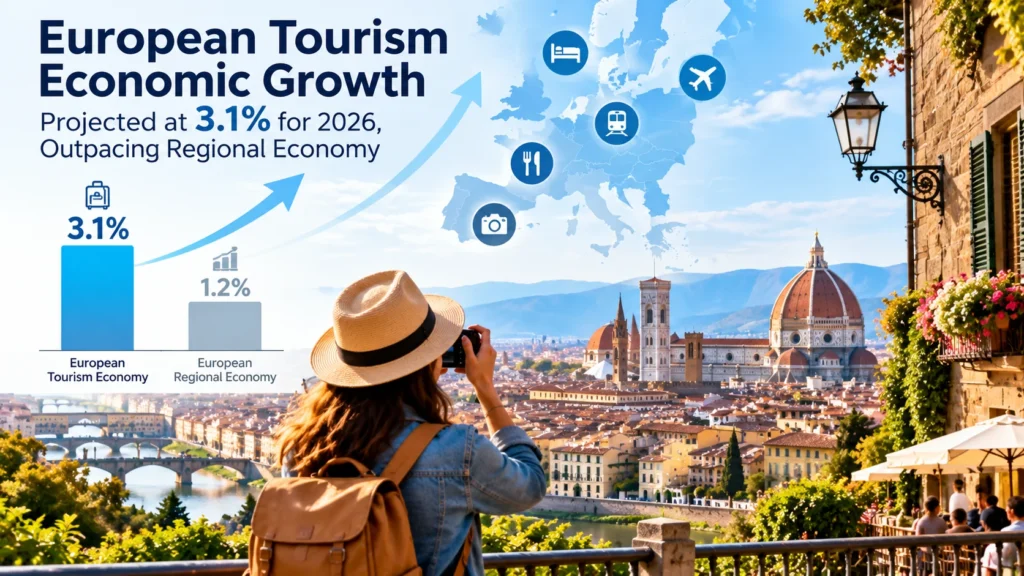
Travel and tourism across Europe is forecast to grow by 3.1 percent in 2026, accelerating from the 2.6 percent growth recorded in 2025 and outpacing the broader regional economy, according to data released by the World Travel & Tourism Council (WTTC).
Unveiled at the opening press conference of the 26th WTTC Global Summit in Valletta, Malta, the Economic Impact Research highlights the sector’s continued resilience amid ongoing geopolitical and macroeconomic uncertainties. Over 1,000 delegates—including more than 200 CEOs and international government figures—have gathered in the Maltese capital to discuss strategic public policy, investment frameworks, and long-term sector competitiveness.
The gathering features prominent global voices, including former Canadian Prime Minister Justin Trudeau, former Spanish Prime Minister José María Aznar, European Commissioner for Sustainable Transport and Tourism Apostolos Tzitzikostas, and Nick Adams, the first US Presidential Envoy for Tourism.
Global Outlook and European Market Divergence
The WTTC outlook projects that global Travel & Tourism will expand by 2.5 percent in 2026, outperforming overall global gross domestic product (GDP) growth. Last year, the sector generated $11.6 trillion globally, accounting for 9.8 percent of global GDP and supporting 366 million jobs worldwide—representing nearly one in every nine positions globally.
Europe is expected to outperform the global average across several metrics:
International Spending: Foreign visitor expenditure across European destinations is projected to rise by 5.8 percent.
Leisure Spending: Leisure travel expenditure is forecast to increase by 3.1 percent across the region.
Business Travel: Corporate travel spending is expected to grow by 4.2 percent as business mobility recovers.
Employment Support: The travel and tourism sector continues to support approximately one out of every ten jobs across the European continent.
WTTC leadership emphasized that capturing this projected growth requires deliberate policy decisions from national governments.
Official statements from WTTC executive leadership outlined the conditions needed to sustain expansion:
“Travel & Tourism continues to demonstrate remarkable resilience. Globally, the sector contributed US$11.6 trillion to the economy last year, representing 9.8% of global GDP, and supported 366 million jobs – nearly one in every nine jobs worldwide. In Europe, the outlook is even stronger, with Travel & Tourism forecast to grow 3.1% in 2026. This is a sector that is ready to invest and innovate, but governments must create the right conditions – enabling seamless travel, strengthening connectivity, developing talent and supporting sustainable growth.” — Gloria Guevara, WTTC President & CEO
“The WTTC Global Summit brings together the leaders shaping the future of Travel & Tourism. Malta’s Government has shown strong leadership and commitment to our sector, making it an ideal host for these important discussions. Over the coming days, we will strengthen partnerships, advance new initiatives and help ensure Travel & Tourism continues to drive growth, investment and opportunity around the world.” — Manfredi Lefebvre, Chairman of WTTC
Host Nation Focus: Malta’s High-Value Tourism Model
Malta was selected to host the global summit as the Mediterranean island nation shifts its destination strategy from volume-driven growth toward a high-value, sustainable tourism model.
Official Economic Impact Research projects that Travel & Tourism will contribute $4.9 billion to Malta’s economy in 2026, accounting for 16.9 percent of the national GDP and supporting more than one in five jobs locally. In 2025, Malta recorded a 16.8 percent annual increase in the sector’s GDP contribution—the highest growth rate among European economies, where the regional average stood at 2.6 percent.
Maltese tourism officials underscored the priority of community-centered growth during the opening events:
“Through our vision for the future we are not seeking to welcome more visitors only. We want to create greater value, not only economic, but also social and environmental. We want tourism that is sustainable and resilient. Tourism that embraces innovation while remaining rooted in our identity.” — Carlo Micallef, CEO of the Malta Tourism Authority
“To welcome more than 200 of the world’s leading voices in Travel and Tourism is a recognition not only of Malta’s achievements as a tourism destination, but also of the role we aspire to play within the wider international tourism community. Above all, we must ensure that the well-being of our communities remains at the heart of this progress, so that the benefits of growth are shared and our development remains sustainable for generations to come.” — Dr Charles Mangion, Chairman of the Malta Tourism Authority
FUTU[RE]SET Framework and Core Priority Areas
Organized under the overarching theme “FUTU[RE]SET,” the Valletta summit focuses on transforming industry dialogues into actionable policy measures.
The summit agenda targets key structural pillars necessary to bolster international competitiveness:
Infrastructure & Investment: Mobilizing public and private capital toward sustainable transit networks and hospitality facilities.
Seamless Connectivity: Streamlining border protocols, visa processing, and air transport capacity to reduce travel friction.
Technology & AI Integration: Accelerating artificial intelligence adoption across passenger logistics, booking systems, and destination management.
Workforce & Community Alignment: Developing regional tourism talent while ensuring long-term economic benefits accrue directly to resident communities.
For more travel news like this, keep reading Global Travel Wire