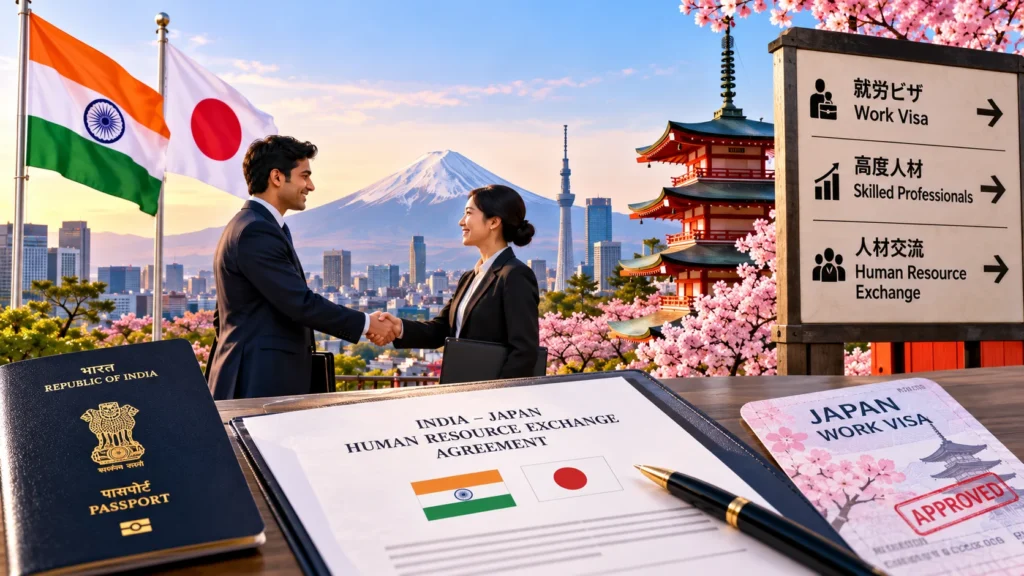
The Ministry of Foreign Affairs of Japan and Press Information Bureau of India have confirmed expanded bilateral frameworks designed to facilitate overseas mobility for Indian professionals across 19 designated economic sectors. Facing significant workforce shortages driven by an aging demographic, the Government of Japan has outlined long-term national planning to attract approximately 1 million foreign workers by 2040 to sustain economic expansion.
Under the national Specified Skilled Worker (SSW) program, Japanese government agencies aim to recruit roughly 805,700 international professionals over a five-year timeline across key shortage industries, including information technology, healthcare, manufacturing, construction, and hospitality.
India-Japan Human Resource Exchange Framework
A major driver of Indian professional mobility to East Asia is the landmark India-Japan Human Resource Exchange Partnership. The bilateral treaty establishes a target to exchange 500,000 personnel in both directions over a five-year period, specifically designating 50,000 skilled and potential talents moving from India to Japan.
The bilateral framework directly integrates Indian applicants into established Japanese immigration pathways, including:
Engineer / Specialist in Humanities / International Services (E/SH/IS): Serves university-educated professionals in software engineering, technical design, corporate consulting, and global business management.
Highly Skilled Professional (HSP) Visa: A points-based immigration track evaluating academic background, professional experience, and annual salary thresholds, offering accelerated pathways to permanent residency.
Specified Skilled Worker (SSW) Program: Offers Type 1 (up to five years) and Type 2 (renewable status with family sponsorship) visas for technical professionals fulfilling sector-specific skills assessments.
Official government guidelines confirm that Japanese language fluency is not mandatory across all engineering and technical categories, lowering entry thresholds for qualified global applicants.
High-Demand Sectors and Operational Visa Requirements
To qualify for work authorization, foreign applicants must secure a formal job offer from a Japan-based employer and obtain a Certificate of Eligibility (COE) issued by the Immigration Services Agency of Japan.
The core industries prioritized under national recruitment drives include:
Technology & Engineering: Software development, system architecture, artificial intelligence, and civil engineering.
Healthcare & Nursing Care: Geriatric care management, medical technology, and hospital support services.
Manufacturing & Construction: Industrial product manufacturing, infrastructure construction, and mechanical assembly.
Services & Logistics: Hospitality operations, agricultural technology, and international supply chain management.
Standard application documentation requires a valid passport, official degree certificates or technical qualifications, proof of relevant professional experience, a signed employment contract, and an approved Certificate of Eligibility.
Social Security, Living Standards, and Permanent Settlement
Foreign professionals working under valid Japanese employment visas receive comprehensive statutory protections and access to national social welfare infrastructure.
Official ministry guidelines highlight several statutory social benefits available to foreign employees:
Universal Healthcare: Enrollees in the national health insurance system (Kokumin Kenko Hoken) pay 30 percent of total medical treatment expenses, with the remaining 70 percent covered by public health funds.
Double Taxation & Pension Protections: The India-Japan Social Security Agreement prevents duplicate pension contributions, while bilateral tax agreements eliminate double taxation on earned income.
Family & Education Allowances: Public primary and secondary education is tuition-free for resident children, with eligible foreign workers receiving monthly child allowances ranging between 10,000 Yen and 15,000 Yen.
Permanent Residency Pathways: Long-term foreign workers may apply for Permanent Residency (PR). Updated immigration regulations require applicants to hold a 5-year visa status at the time of PR application, replacing the previous 3-year visa eligibility threshold, supported by a transitional grace period through March 31, 2027.
For more travel news like this, keep reading Global Travel Wire