Europe’s accelerating railway digitalisation is creating a new safety discussion: how should trains protect passengers when sophisticated electronic systems are operating under degraded or emergency conditions?
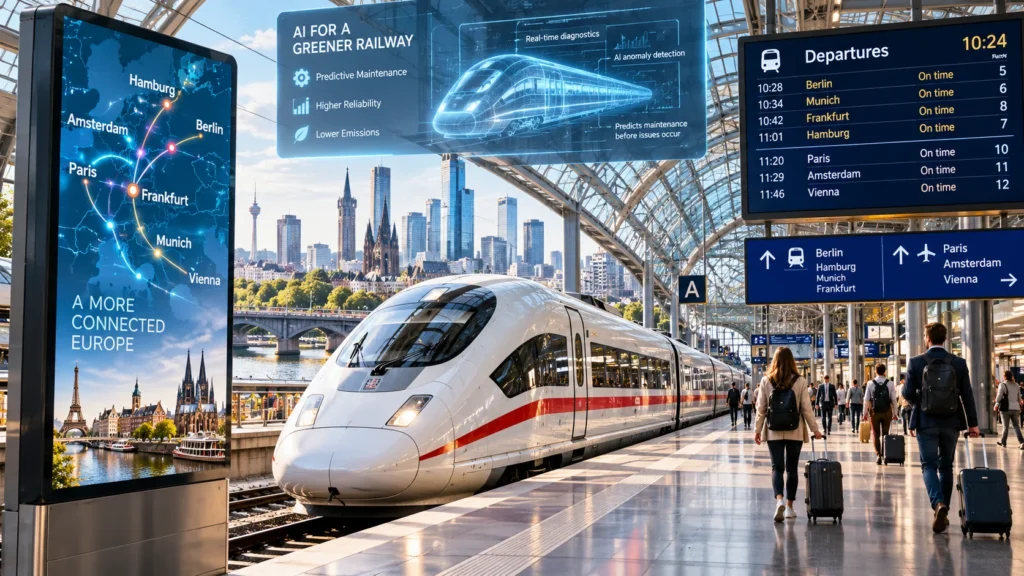
Modern European rail increasingly depends on interconnected signalling, communications and control technology. At the centre of that transformation is the European Rail Traffic Management System, or ERTMS, which incorporates the European Train Control System alongside railway radio communications and associated operational rules. The European Union Agency for Railways identifies ETCS as a cab-signalling system incorporating automatic train protection.
These systems provide significant benefits. They support interoperability, automatic train protection and more efficient cross-border rail operations.
However, greater digital sophistication is also directing attention toward resilience: ensuring critical passenger-protection functions remain available when normal operating conditions break down.
Digital rail systems become increasingly interconnected
A modern passenger train is no longer simply an isolated mechanical vehicle.
Its operation can involve onboard computers, signalling equipment, communication networks and trackside infrastructure working together continuously.
ERA confirms that GSM-R serves as a communications system for European railways and provides data communications for ETCS, particularly in more advanced ETCS applications. Europe is also preparing for the transition toward the Future Railway Mobile Communication System as railway communications technology continues developing.
That connectivity improves everyday railway performance.
Yet safety engineering must also consider situations involving degraded operations, including loss of power, equipment damage or interrupted communications.
The question is therefore not whether digital technology belongs on trains. It clearly does.
The stronger question is how emergency protection can remain effective when other systems are unavailable.
Four RAMS principles shape railway safety
Railway safety engineering already recognises that dependable transport depends on more than one measurement.
IEC 62278-1:2025 establishes a railway-specific framework for reliability, availability, maintainability and safety, commonly known as RAMS.
The standard covers the railway system life cycle and establishes processes for specifying and demonstrating RAMS requirements. IEC 62278-2:2025 further addresses safety-related aspects of that system approach.
These four dimensions create an important foundation.
Reliability considers whether equipment performs its required function. Availability concerns whether it can operate when needed. Maintainability addresses recovery and repair. Safety focuses on keeping operational risks controlled.
Together, they reinforce a fundamental principle: railway safety depends on engineered systems working within a broader risk-management structure.
Mechanical independence enters the safety conversation
One emerging discussion concerns whether certain passenger emergency functions should retain a physically independent pathway alongside increasingly sophisticated electronic systems.
Mechanical systems have one obvious characteristic: they can potentially perform their intended function without depending on software instructions, data networks or continuous electrical power.
That does not make mechanical technology inherently superior.
Digital systems can monitor conditions, prevent unsafe train movements and communicate information at speeds impossible through purely mechanical controls.
Instead, the argument centres on diversity and separation.
Where appropriate, having an emergency function with different dependencies from primary operating systems can provide another layer of resilience.
Emergency escape highlights the digital-analog balance
Emergency egress provides a useful example.
During an unusual incident, passengers may encounter reduced visibility, damaged equipment, disrupted power or delayed external assistance.
In those circumstances, evacuation mechanisms need to remain understandable and usable.
UNECE Regulation No. 107 addresses emergency exits for buses and coaches rather than railway rolling stock, so it should not be interpreted as a European rail requirement. However, UNECE work around the regulation demonstrates the wider transport-safety importance attached to emergency doors, windows and passenger evacuation.
For railway designers, the broader lesson is resilience rather than direct regulatory equivalence.
Safe-T-Punch illustrates one mechanical approach
Safe-T-Punch is one example being promoted around this concept.
The manufacturer describes the product as a permanently fitted mechanical device intended to break compatible tempered-glass emergency windows through direct physical activation. It promotes applications across rail, bus, marine and specialist transport environments.
Its relevance to the wider discussion comes from independence.
According to the manufacturer, the mechanism does not require software, communication networks or electrical power to perform its intended glass-breaking function.
However, this should not be confused with evidence that Safe-T-Punch has become a mandated European railway standard. Its inclusion instead illustrates the type of independent mechanical technology manufacturers may consider alongside electronic safety architecture.
Passenger confidence depends on resilience
The stakes extend beyond engineering.
Rail is becoming increasingly important for European tourism and international mobility as passengers use high-speed, regional and cross-border trains to replace or complement short-haul flights.
Travellers experience digitalisation through better information, smoother operations and increasingly connected journeys.
Yet confidence also depends on how networks respond when normal conditions disappear.
Passengers may rarely use an emergency escape mechanism, but its importance becomes greatest precisely when surrounding systems are under pressure.
Europe’s strongest railway future could combine both worlds
The future of rail safety is therefore unlikely to become a contest between digital and mechanical technology.
ERTMS, advanced communications and automatic protection will remain central to European railway modernisation. At the same time, safety engineering will continue assessing reliability, redundancy, independence and degraded-operation scenarios.
For manufacturers and operators, the challenge is to determine which functions benefit from digital intelligence and which critical emergency functions require independent alternatives.
Europe’s most advanced trains may ultimately be judged not only by what their technology can do when everything works, but also by how effectively they protect passengers when something does not.
For more travel news like this, keep reading Global Travel Wire