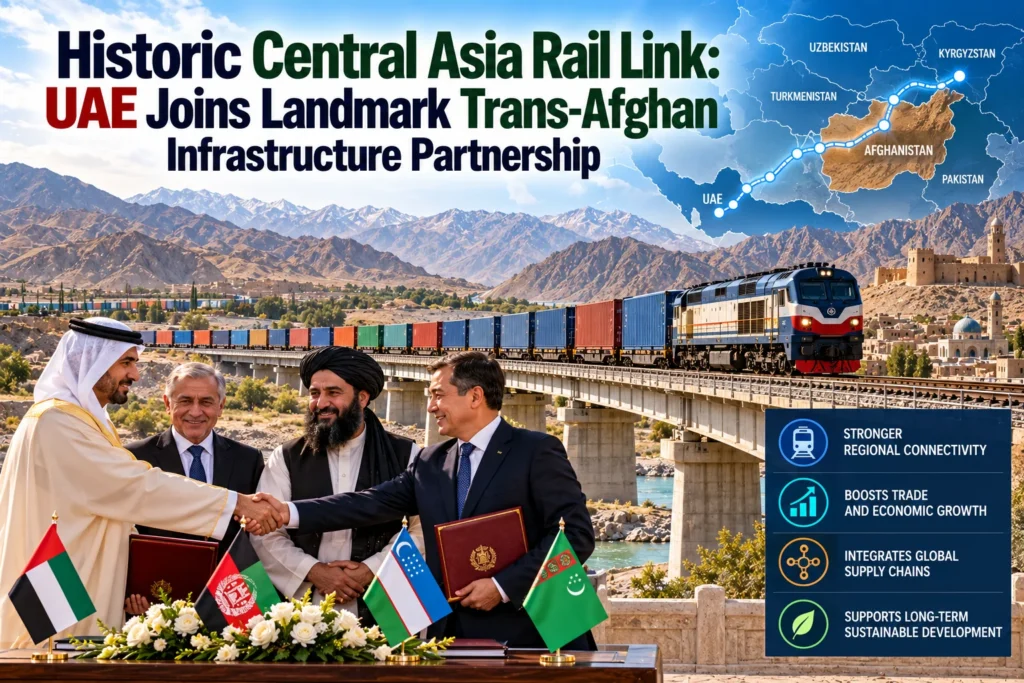
A major initiative to transform landlocked Silk Road destinations into connected international travel hubs has taken a definitive step forward. Government transport ministries from Kazakhstan, Uzbekistan, and the United Arab Emirates have formally entered into a tripartite agreement to drive the practical development of a unified regional railway network. Spanning Central Asia, Afghanistan, and Pakistan, this proposed transport corridor promises to redefine overland travel, economic connectivity, and heritage tourism across historic trade routes.
By introducing technical expertise, capital resource frameworks, and infrastructure leadership, the partnership provides new momentum to a cross-border rail project long envisioned as a transformative link between Central Asia and maritime ports on the Arabian Sea. For the regional travel and hospitality sectors, the expansion represents an extraordinary opportunity to establish accessible, scenic, and culturally rich trans-continental rail routes.
Unlocking Silk Road Heritage for International Tourism
Central Asia boasts some of the world’s most impressive UNESCO World Heritage sites, historic madrasas, and monumental Silk Road architecture. Destinations such as Samarkand, Bukhara, and Khiva in Uzbekistan, alongside the natural expanses of Kazakhstan, draw culture enthusiasts, historians, and eco-tourists from around the globe. However, reaching these inland cultural capitals from South Asia and the Gulf region has traditionally relied on air corridors or complex multi-stage journeys.
The development of a continuous rail corridor creates a direct land route connecting the mountain landscapes and historic urban centers of Central Asia directly to maritime gateways in Pakistan. Overland passenger rail travel offers immersive panoramic journeys across diverse terrain, appealing to slow-travel advocates, heritage tour operators, and adventure seekers looking to experience historic trade paths in modern comfort.
Strategic Trilateral Cooperation
The memorandum signed between the Kazakh Ministry of Transport, the Uzbek Ministry of Transport, and the UAE Ministry of Energy and Infrastructure establishes a formal framework to progress beyond theoretical planning. Under the official agreement, all three participating governments will form a permanent joint working group. This dedicated body is tasked with overseeing comprehensive engineering studies, environmental assessments, financial models, and technical alignment across all border crossing points.
Kazakhstan: Acts as a northern anchor, linking Central Asian steppe landscapes and industrial centers to regional logistics channels.
Uzbekistan: Serves as a vital Silk Road cultural hub, providing established high-speed rail expertise and heritage travel connections.
United Arab Emirates: Delivers world-class logistics management, international transport capital, and specialized infrastructure expertise to support large-scale network execution.
Expanding Sustainable Passenger and Cultural Transport
Global tourism trends highlight a growing preference for eco-friendly transit alternatives over short-haul flights. High-capacity rail networks represent one of the most efficient, low-emission travel solutions available today. Establishing a modernized rail route through mountainous regions and desert plains allows transport authorities to divert passenger traffic toward sustainable rail travel while expanding access to remote communities along the transit line.
For regional tour operators, a unified rail corridor opens up multi-country travel packages. International visitors will eventually be able to board high-speed and scenic sleeper services starting from coastal seaports, traveling through alpine valleys, and terminating at northern cultural sanctuaries. Integrated ticketing, standardized rail services, and modern station amenities are expected to form key components of the tourist transit experience.
Overcoming Technical and Geographic Challenges
Building a major railway line across complex mountain geography requires rigorous engineering and steady international coordination. Terrain considerations across high-altitude passes demand specialized track stabilization, tunneling solutions, and modern rail safety architecture to safeguard operations during extreme seasonal weather conditions.
The establishment of the joint technical working group ensures that survey teams can systematically map terrain conditions, establish uniform rail gauge standards, and plan multi-modal passenger hubs. Government authorities are focusing initial phases on completing technical feasibility studies to guarantee long-term operational safety, environmental protection, and structural resilience along every segment of the proposed route.
A Gateway to Regional Economic Expansion
Beyond direct passenger transit, the trans-Afghan transport corridor serves as an economic catalyst for rural and mountain economies. Railway stations positioned along scenic routes foster localized hospitality ecosystems, including boutique hotels, artisanal crafts, cultural guide services, and eco-tourism ventures. By transforming transit corridors into vibrant trade and cultural belts, local populations gain long-term employment opportunities tied directly to international visitor influxes.
As official planning moves forward under the guidance of the Kazakh, Uzbek, and UAE government delegations, the project stands out as a landmark venture in modern global transport. The continuous alignment of regional infrastructure policies highlights a shared commitment to building a connected, accessible, and sustainable future for Central and South Asian tourism.
For more travel news like this, keep reading Global Travel Wire