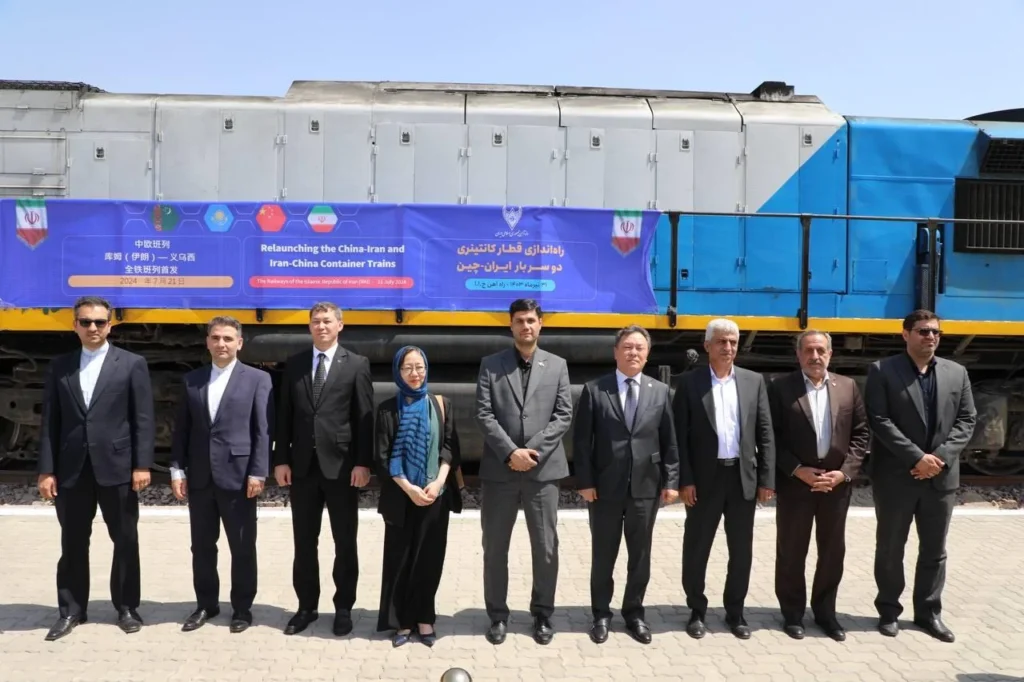
The geopolitical landscape of Central Asia is experiencing a significant infrastructure shift as Iran maximizes its domestic and international railway networks to sustain its trade and energy lifelines. In response to complex geopolitical conditions affecting traditional shipping lanes, the Iranian Ministry of Roads and Urban Development, in coordination with regional state partners, has overseen an unprecedented expansion in cross-border rail freight. According to transport sector disclosures, the operational frequency of trans-Eurasian freight routes has effectively tripled, shifting a notable volume of oil and Liquefied Petroleum Gas (LPG) transit onto secure, land-based rail architectures heading toward China and Pakistan.
This strategic adjustment marks a departure from traditional logistics dependencies. For decades, regional trade fluidly relied on maritime corridors traversing the Strait of Hormuz. With modern transit security re-routing global commerce, the deployment of integrated continental rail networks serves as a vital tool to ensure economic resilience, bypass external blockades, and solidify localized trade routes.
The Activation of the Trans-Central Asian Rail Network
The realignment of Iranian trade logistics centers heavily on the utilization of modern, overland corridors linking the Middle East directly to East Asia. A central component of this network is the 10,400-kilometer China-Iran railway corridor. Officially brought into service through joint ministerial protocols, this expansive trade artery bypasses volatile maritime waters entirely. The route originates within the industrial hub of Xi’an in western China and cuts directly across the sovereign territories of Kazakhstan, Kyrgyzstan, Uzbekistan, and Turkmenistan before terminating at the central container depots in Tehran.
Beyond pure security advantages, the trans-Central Asian rail network offers significant operational efficiencies regarding transit timelines:
Maritime Routing Baseline: Traditional sea-freight lanes connecting Persian Gulf ports to eastern Chinese refineries generally require up to 30 days of continuous travel.
Rail Corridor Standard: The unified overland rail journey across the integrated Central Asian grid successfully compresses the total transit window down to approximately 15 days.
By shaving transit times in half, regional planners are successfully mitigating the logistical delays associated with contested maritime checkpoints, offering a predictable schedule for sensitive energy and commodity shipments.
Surging Freight Frequencies and Regional Infrastructure Capital
Statistical operational data confirms a sharp acceleration in train dispatches since the implementation of recent maritime restrictions. Prior to the current transport surge, typical traffic along the Xi’an-to-Tehran rail corridor averaged roughly one scheduled freight transit per week. Current station logs from international border crossings indicate that dispatch frequencies have scaled rapidly, with heavy container trains now departing once every three to four days.
This operational surge is directly supported by multi-billion-dollar state investments intended to build long-term regional logistics connectivity. A prime example is the China-Kyrgyzstan-Uzbekistan railway project, backed by a major $2.35 billion infrastructure funding package. Additionally, coordinated ministerial announcements confirmed the successful integration of North-South transport links, marked by the arrival of specialized freight units traversing from Russia into Iran via Kazakhstan and Turkmenistan. This collective network architecture creates a highly robust regional logistics web designed to withstand external geopolitical pressures.
Operational Realities and Capacity Comparisons
While the acceleration of overland trade corridors underscores regional resilience, state transport engineers emphasize that land-based rail lines operate under distinct physical constraints compared to high-capacity maritime supertankers. The structural limits of rail transit require a highly synchronized, continuous flow of rolling stock to approximate the sheer volumes handled by sea:
Single Freight Train Capacity: A standard, fully optimized cargo train configured with specialized tank cars carries an average payload ranging between 60,000 and 70,000 barrels of crude commodities.
Standard Maritime Oil Tanker: A conventional maritime vessel regularly accommodates upwards of 600,000 barrels per voyage.
Very Large Crude Carrier (VLCC): Marine supertankers regularly transport capacities exceeding 2,000,000 barrels in a single transit cycle.
Geographical layouts introduce additional operational considerations. Iran’s primary extraction fields are naturally situated across its southern territories, while China’s high-capacity processing refineries remain concentrated along its eastern seaboard, necessitating well-planned intermodal transfers. Financially, while an individual rail shipment of 70,000 barrels yields a estimated revenue stream of $5.25 million to $7 million, these figures represent a structural shift toward targeted, secure distribution rather than an absolute replacement for high-volume sea trade.
Rather than viewing the rail network as a singular remedy, regional analysts and ministry statements frame the expanding Eurasian rail grid as a crucial stabilizing mechanism. By establishing a functional, sanction-proof land alternative, the participating nations are successfully diversifying their transport risks, protecting critical resource distribution networks, and building an interconnected economic geography across Central Asia.
For more travel news like this, keep reading Global Travel Wire