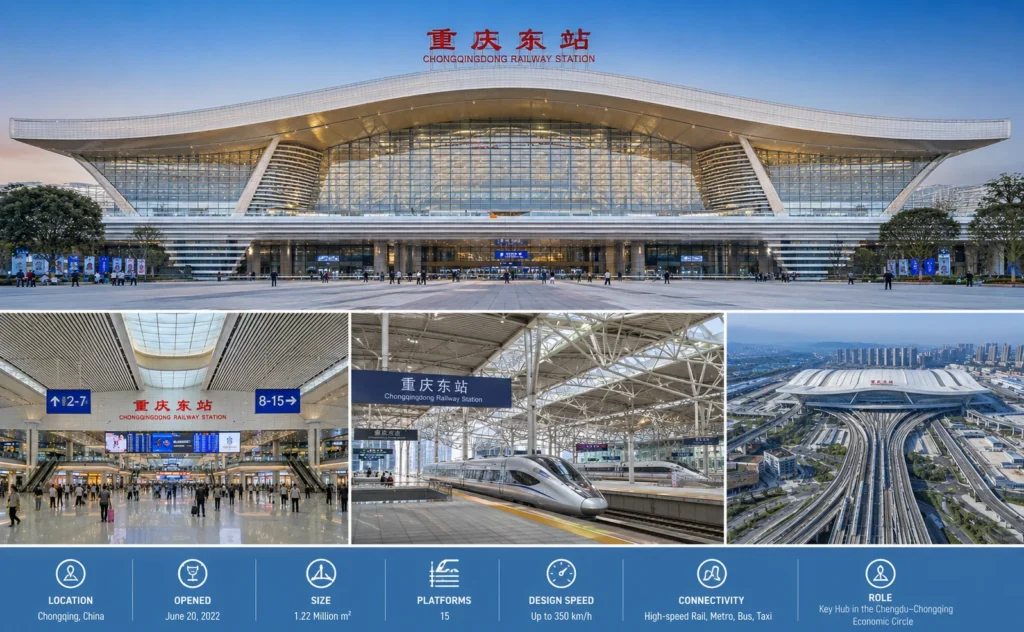
The expansion of global transport networks has reached a new pinnacle with the full operational deployment of the Chongqing East Railway Station in southwest China. Recognized officially as the world’s largest high-speed railway station constructed in a single, continuous phase by area, the massive multimodal transit complex stands as a definitive monument to modern civil engineering. Spanning an astonishing 1.22 million square meters—a geographic footprint equivalent to roughly 170 standard football fields—this monumental transport architecture marks a structural evolution in transit-oriented urban planning.
What makes the construction sequence uniquely compelling to international infrastructure experts is the extreme physical speed and geographical complexity of its execution. The primary structural components of the massive terminal were completed in an aggressive 38-month timeframe from detailed design blueprint finalization. This timeline is unprecedented for a project of this magnitude, which traditionally requires up to a decade of gradual development. Situated on the outskirts of the mountain metropolis within the Nan’an District, the mega-terminal now functions as the primary western nexus for the nation’s highly integrated “Eight Vertical and Eight Horizontal” national high-speed grid.
Reshaping Mountainous Topography Through Technical Precision
Unlike traditional ultra-large transport hubs that rely on expansive, flat alluvial plains, this new high-speed rail hub was engineered directly on top of highly irregular, mountainous terrain. Before the first foundations could be poured, engineers had to execute a massive site-leveling campaign to completely reshape an entire mountain ridge. This process required the excavation and structured reallocation of millions of cubic meters of earth and rock.
To manage this topographical challenge without compromising the structural integrity of the surrounding valley slopes, public construction teams utilized advanced three-dimensional digital terrain mapping. Long before heavy machinery arrived on-site, the entire mountain mass was digitized into a virtual simulation environment to calculate exact structural loads and optimal cutting paths. Specialized engineering crews then executed highly disciplined, controlled micro-blasting sequences to remove stubborn rock layers. This method minimized seismic vibrations in nearby residential zones, paving the way for a highly stable, multi-tiered foundation system capable of supporting an immense infrastructural load.
Deploying the Automated Workforce: The Robot Revolution in Civil Engineering
The core catalyst behind the blistering 38-month construction timeline was the implementation of a sophisticated, highly automated machinery ecosystem on the job site. Rather than relying solely on traditional manual labor, project management teams introduced multiple variants of specialized, automated construction robots operating over secure, high-bandwidth 5G communications networks. This robotic integration transformed the site into a living laboratory for next-generation heavy industry.
The automated workforce operated across multiple vertical layers of the construction zone, performing highly repetitive or physically hazardous tasks with mathematical precision:
Laser-Guided Screed Robots: Deployed continuously to distribute, level, and smooth extensive concrete flooring slabs, ensuring microscopic structural flatness across thousands of square meters.
Heavy-Lift Glass Installation Robots: Equipped with advanced vacuum suction arrays, these units effortlessly hoisted and positioned massive exterior curtain wall panels weighing up to 800 kilograms, drastically reducing the safety risks associated with high-altitude manual rigging.
Precision Welding and Structural Riveting Units: Worked around the clock to join heavy steel elements under automated supervision, keeping structural quality flawless while maximizing labor efficiency.
Structural Scale and Masterfully Engineered Structural Support Architecture
The raw volume of materials used underlines the sheer scale of the project. Public engineering logs from the municipal housing and urban-rural development commission confirm that the station absorbed nearly 2 million cubic metres of structural concrete and approximately 366,000 tonnes of engineered steel. The architectural design itself pays direct homage to the local environment, incorporating fluid, organic shapes inspired by the regional rivers and native Huangge trees.
One of the most complex engineering milestones involved the raising of the station’s massive steel roof structure, which covers an area of roughly 120,000 square meters. Instead of assembling the roof piece by piece at extreme heights, the entire 16,500-tonne steel canopy was pre-fabricated at ground level. Utilizing synchronized hydraulic lifting arrays, the massive canopy was slowly hoisted and slid 57 meters upward into its permanent position. The weight of this immense roof structure is supported by massive 41-meter-high tree-shaped steel columns, which provide advanced seismic resistance and structural stability against regional tectonic forces.
A Critical Logistics Node Driving Regional Connectivity
With its official operational opening, Chongqing East Railway Station operates a multi-level terminal layout spanning eight floors, incorporating 15 specialized passenger platforms and 29 operational tracks. The hub is built to handle up to 16,000 passengers per hour during peak travel periods, integrating high-speed rail lines with the expanding Chongqing Rail Transit metro network, regional bus terminals, and deep commercial city networks.
The activation of this high-speed rail hub dramatically compresses travel times across the country, transforming regional tourism dynamics. Travel from the central city to the southeastern districts has dropped from four hours to under sixty minutes. Furthermore, the station establishes a highly efficient “1-3-6 hours” travel circle: placing regional hubs like Chengdu and Guiyang within a one-hour window, connecting to Wuhan, Kunming, and Changsha within three hours, and establishing rapid six-hour corridors to coastal economic powerhouses including Beijing, Shanghai, and Guangzhou. This seamless integration provides a highly sustainable, carbon-efficient alternative to regional domestic flights, positioning the mountain-top terminal as a cornerstone of modern international transit infrastructure.
For more travel news like this, keep reading Global Travel Wire