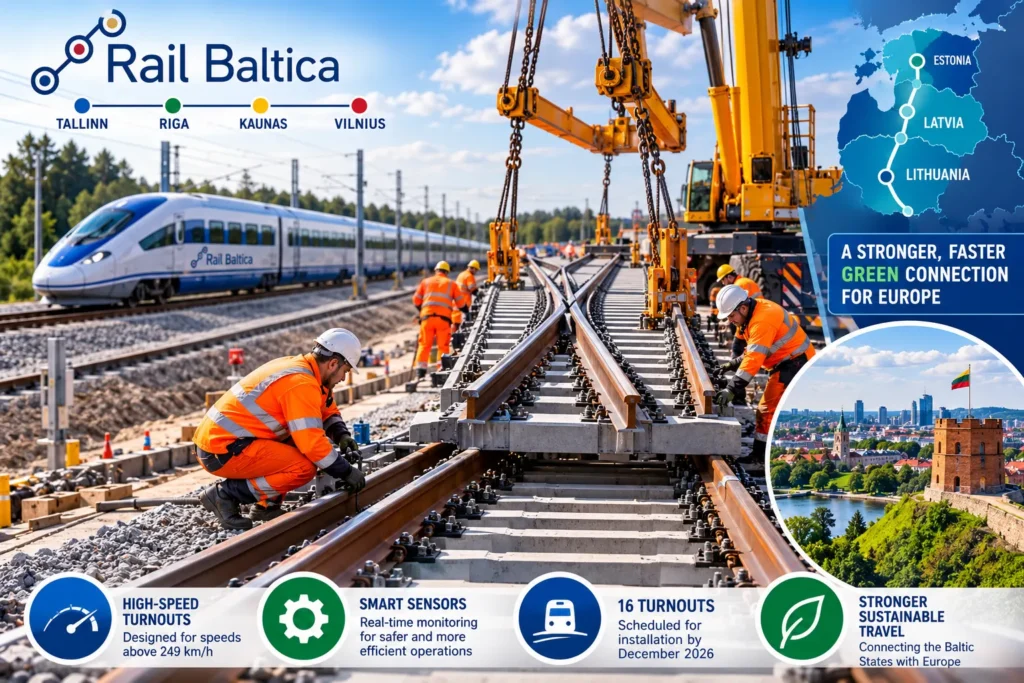
Lithuania’s Rail Baltica high-speed rail project has entered a significant construction phase with the installation of advanced railway turnouts on the Šveicarija–Žeimiai section. The development marks another milestone in establishing modern European railway connections across the Baltic region.
The Lithuanian Ministry of Transport and Communications confirmed the progress on 21 October 2026.
A total of 16 high-speed railway turnouts will be installed along the nearly nine-kilometre section, with completion scheduled for December 2026.
The advanced infrastructure incorporates sensor-based monitoring technology and supports railway operations at speeds exceeding 249 kilometres per hour.
The development strengthens Lithuania’s efforts to establish a modern railway corridor connecting the Baltic States with Central and Western Europe.
For international tourism, the project represents a long-term opportunity to improve cross-border accessibility and encourage sustainable European travel.
Lithuania Begins Installing Advanced High-Speed Railway Infrastructure
The Šveicarija–Žeimiai section has become one of the most advanced construction areas within Lithuania’s Rail Baltica development.
Installation of the first high-speed turnouts represents progress beyond preliminary earthworks and track preparation.
Turnouts allow trains to move safely between tracks while accessing stations, terminals, maintenance facilities and other railway infrastructure.
Their precision is particularly important on high-speed railways, where reliability directly influences operational safety.
The Rail Baltica systems differ considerably from traditional railway components.
They feature reinforced construction materials, precise track geometry and enhanced resistance to continuous operational loads.
These characteristics support the project’s requirements for dependable long-distance railway services.
Sixteen Smart Turnouts Scheduled for Installation by December 2026
Construction teams plan to install 16 turnouts across the Šveicarija–Žeimiai section before the end of 2026.
The equipment is being manufactured in Lithuania by voestalpine Railway Systems.
Railway construction is being undertaken by joint venture partners Leonhard Weiss International and Leonhard Weiss OÜ.
The project uses European-standard railway tracks measuring 1,435 millimetres between the rails.
This standard is essential for integrating the Baltic railway network with wider European infrastructure.
The installation programme represents an important step towards future technical compatibility across the international corridor.
However, completion of the turnouts will not immediately introduce passenger services, as additional infrastructure and railway systems remain necessary.
Sensor Technology Improves Railway Safety and Maintenance
The new turnouts incorporate integrated sensors designed to monitor their operating condition.
These systems will collect information about equipment performance and environmental conditions.
The technology can identify potential technical problems at an early stage, allowing maintenance teams to respond before disruptions develop.
Predictive monitoring can also help infrastructure operators improve maintenance planning and equipment reliability.
For future passengers, dependable railway infrastructure will be important for journey punctuality and operational safety.
Mindaugas Ivanavičius, Rail Baltica in Lithuania Director, emphasised that the railway’s development prioritises long-term reliability alongside increased speed.
The introduction of intelligent infrastructure demonstrates how digital technology is becoming increasingly important in modern European railway construction.
Major Engineering Operation Supports High-Speed Track Installation
Installing the first turnout requires specialised heavy-lifting equipment and precise engineering coordination.
The turnout consists of three major structural components.
Its largest intermediate section measures approximately 28 metres and weighs 30 tonnes.
Construction teams are using a mobile crane with a lifting capacity of 500 tonnes to position the equipment.
The scale of the operation demonstrates the technical complexity involved in developing high-speed railway infrastructure.
Workers will connect railway components using thermite welding.
This technique produces strong rail joints suitable for continuous welded railway tracks.
Accurate installation is essential for maintaining track stability and supporting safe railway operations.
Rail Baltica to Strengthen Tourism Connectivity Across Europe
Rail Baltica is designed to establish an electrified European-standard railway connecting Lithuania, Latvia and Estonia with Central and Western Europe.
The project could eventually transform international rail tourism by offering improved overland connections between major destinations.
Travellers visiting Lithuania, Latvia and Estonia would benefit from greater opportunities to combine several countries within one railway journey.
Vilnius, Kaunas, Riga and Tallinn are among the destinations expected to benefit from improved regional connectivity.
The Baltic region offers historic city centres, cultural attractions, coastal landscapes and distinctive national heritage experiences.
Improved railway accessibility could encourage longer itineraries and support tourism activity beyond traditional aviation gateways.
However, passenger service schedules and journey times will depend on the completion and commissioning of the wider network.
Lithuania Advances Construction Between Kaunas and Panevėžys
Rail Baltica construction continues across sections extending from Kaunas Palemonas towards Panevėžys District.
Following the completion of earthworks and engineering structures, contractors have progressed to installing the railway track superstructure.
Subsequent construction phases will include finishing activities and integrating railway subsystems.
Lithuania previously signed construction agreements covering approximately 114 kilometres between Kaunas and Panevėžys.
The Šveicarija–Žeimiai section has already achieved approximately 8.8 kilometres of European-standard track installation.
Further design and construction activities will support the development of the broader international railway corridor.
Sustainable Rail Tourism Gains Importance in the Baltic Region
Rail Baltica represents one of Europe’s significant cross-border transport infrastructure initiatives.
The electrified railway is intended to improve regional connectivity while strengthening civil and freight mobility.
For tourism, reliable international rail services could provide an alternative to road transportation and selected short-distance flights.
The project may also create opportunities for hotels, restaurants and local tourism businesses near future railway connections.
Deputy Minister of Transport and Communications Živilė Poželienė described Rail Baltica as a strategic investment in regional security and stronger European connectivity.
The installation of 16 advanced turnouts demonstrates Lithuania’s continued progress towards this long-term objective.
As construction advances, Rail Baltica could play an increasingly important role in connecting Baltic destinations with Europe’s wider tourism network, supporting more accessible and sustainable international travel.
For more travel news like this, keep reading Global Travel Wire