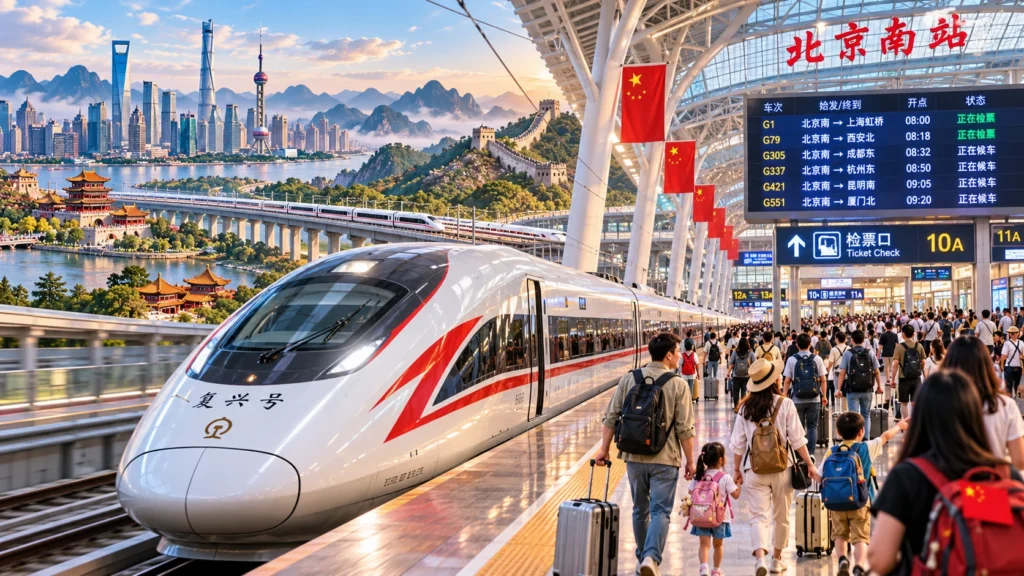
Official mobility statistics released by China State Railway Group Co., Ltd. confirm that the national railway network processed a record-breaking 25,204,000 passenger trips on October 1, marking the highest single-day passenger volume recorded in the country’s transport history.
The record surge occurred at the start of the annual National Day holiday travel period, eclipsing the previous single-day high of 24.84 million passenger trips recorded during May Day holiday operations earlier in the year.
The milestone underscores the critical role of state-planned infrastructure in enabling large-scale population mobility, connecting regional urban centers, and driving domestic leisure travel across provincial markets.
Scaling High-Speed Rail Infrastructure to Meet Surge Capacity
Managing single-day travel volumes exceeding 25 million passengers reflects the extensive expansion of national transportation infrastructure over recent decades. Official ministry statements confirm that China’s operating high-speed rail network spans approximately 48,000 kilometers, representing roughly two-thirds of the total global high-speed track coverage.
To accommodate extreme holiday demand peaks without operational disruptions, rail dispatchers utilize strategic planning and advanced dynamic scheduling:
Capacity Squeezing: Coupling electric multiple unit (EMU) train sets to double passenger capacity per scheduled departure slot.
Additional Service Slots: Deploying over 2,000 temporary peak-period train services along high-demand intercity travel corridors.
Data-Driven Demand Forecasting: Leveraging advance ticketing data to pre-position rolling stock near major population hubs and popular tourist destinations.
Multi-Tiered Pricing: Maintaining a combination of premium high-speed services alongside budget-friendly conventional passenger trains to accommodate varied traveler demographics.
Ministry projections estimate that total passenger trips across the national railway network will reach approximately 284 million throughout the broader holiday holiday travel window, demonstrating sustained high-density passenger throughput.
Regional Travel Hubs and Economic Decentralization
The rapid expansion of high-speed rail corridors has significantly altered domestic travel patterns, reducing transit times between major economic zones and mid-sized regional cities. Intercity networks directly link giant metropolitan clusters—such as the Yangtze River Delta and Pearl River Delta—with inland tourism destinations.
Regional operational reports highlight significant single-day passenger growth across key municipal destinations:
Northwest Regional Hubs: Major cultural destinations, including Xi’an in Shaanxi Province, recorded localized holiday arrival peaks supported by expanded high-speed connections.
Southern Travel Corridors: Commercial and transit centers, including Guangzhou in Guangdong Province, experienced major influxes of holiday travelers utilizing high-frequency regional lines.
Economic Integration: Enhanced transit access allows residents from secondary cities to access primary metropolitan labor markets while granting urban leisure travelers direct access to rural tourism destinations.
Transport authorities note that reducing travel duration across long distances transforms traditional annual family visits into routine short-term holiday excursions, distributing tourism revenue across provincial hospitality providers.
Managing Capacity and Future Infrastructure Demands
Despite significant network expansion, public transit authorities acknowledge that holiday travel demand continues to surpass ticket availability on peak dates. Official reports highlight ongoing efforts to balance regional service coverage and upgrade station management technologies.
The long-term development strategy emphasizes treating physical mobility as foundational public infrastructure, using long-range state planning to build transit capacity ahead of market demand. As national high-speed rail networks expand toward future operational targets, continuous investment in capacity management and digital scheduling remains essential to supporting domestic tourism growth across all regional provinces.
For more travel news like this, keep reading Global Travel Wire