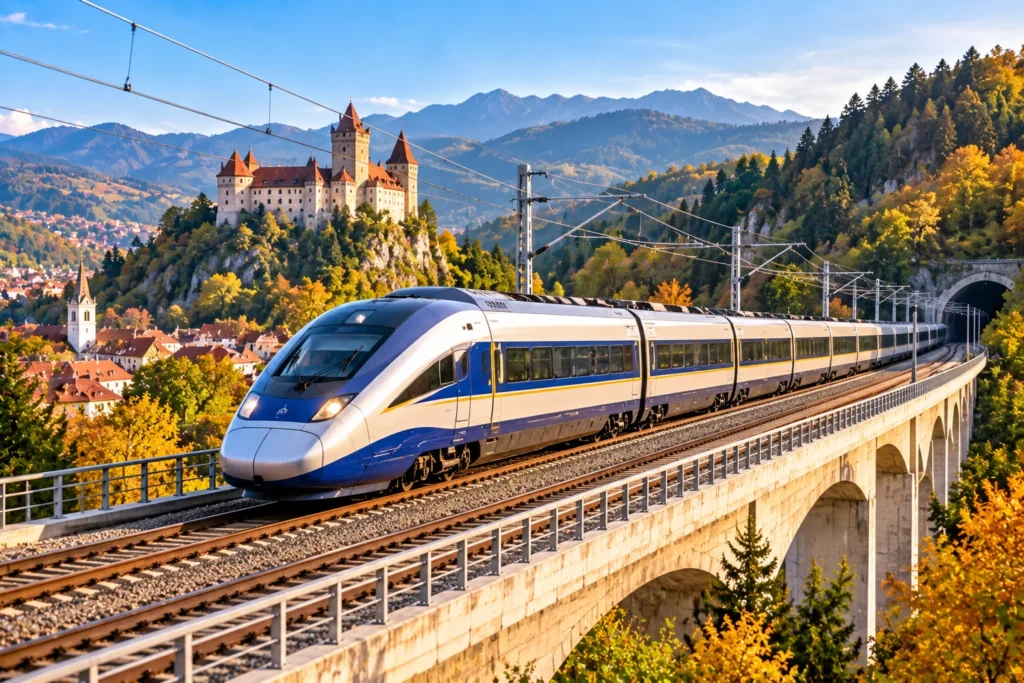
The transport network in Central Europe is set for a major transformation as official financing agreements move forward for a comprehensive modernization of Romania’s rail infrastructure. Designed to improve high-speed connections across key historic regions, a major upgrade targeting the strategic line between Brașov and Sighișoara will enhance regional connectivity, lower travel times, and support sustainable transit for millions of international visitors and local commuters every year.
Supported by official European infrastructure funding alongside national public investments, the initiative focuses on a crucial 113-kilometer section of double-track, electrified railway line located in central Romania. Once construction and technological updates are complete, passenger trains operating on the route will reach speeds of up to 160 kilometers per hour, while freight transit speeds will increase to 120 kilometers per hour.
By removing structural bottlenecks along the vital Rhine-Danube international transport corridor, the modernized corridor aims to shift significant traffic from regional highways onto energy-efficient electric rail networks, supporting broader European environmental goals.
Strategic High-Speed Connections Across Transylvania
The railway line connecting Brașov and Sighișoara serves as a key travel spine for Transylvania, linking two of the country’s most celebrated historical destinations. Brașov, famed for its medieval Saxon architecture, towering gothic landmarks, and nearby Carpathian mountain resorts, attracts steady streams of international visitors year-round. Sighișoara, recognized globally for its intact medieval citadel and historic clock tower, stands as an essential cultural stop for travelers exploring Central Europe.
Under current operational capacity, physical constraints along older sections of track have limited train frequency and overall speed. The comprehensive overhaul will dramatically streamline rail transit through the region, allowing travelers to hop between historical towns and cultural heritage sites with greater ease, comfort, and speed.
Official projections indicate that the upgraded railway corridor will carry approximately four million passengers each year upon full implementation. The project will also accommodate heavier, longer freight transport, carrying up to six million tonnes of cargo annually to better integrate domestic supply chains with broader pan-European markets.
Fostering Eco-Friendly Travel and Sustainable Tourism Growth
The expansion aligns directly with European Union sustainable transport strategies aimed at reducing carbon emissions across the travel and logistics sectors. By upgrading power systems, modernizing track beds, and installing advanced signaling technology, the project creates a high-capacity alternative to passenger car travel and heavy road haulage.
By providing travelers with a modern, low-emission alternative to motorways, the rail corridor reduces regional traffic congestion while encouraging long-distance eco-tourism. Travelers seeking low-carbon transit options will gain access to seamless, reliable connections spanning from major urban centers directly into scenic rural regions and preserved alpine valleys.
Infrastructure authorities emphasize that modernizing core transit corridors provides the foundation for sustainable destination growth. Higher train speeds and reliable timetables enable visitors to explore secondary destinations outside primary capitals without relying on private vehicles or regional domestic flights.
Technical Scope and International Partnerships
The total investment required for the comprehensive rail transformation reaches €2.25 billion, backed by verified public financing structures and multi-lateral development support. A recent official agreement secures €630 million in dedicated financing from European investment bodies to initiate core construction phases.
Beyond funding commitments, international technical bodies will collaborate closely with Romanian public transport authorities throughout the preparation, engineering, and implementation stages. This joint technical oversight ensures that the modernized line adheres to the highest safety standards, operational interoperability rules, and environmental protections required across European transport networks.
The project represents a long-term investment in regional connectivity, economic cohesion, and modern transit infrastructure. By linking major trade routes and top tourist destinations through high-speed, zero-emission transportation, Romania continues to solidify its role as a essential transport crossroads within Eastern Europe.
A Bright Future for European Rail Travel
As work progresses along the Brașov-Sighișoara line, the project stands as a model for regional infrastructure renewal. By combining speed, safety, and sustainability, the rail overhaul will make exploring Central Europe faster and more accessible for generations of travelers to come.
For more travel news like this, keep reading Global Travel Wire