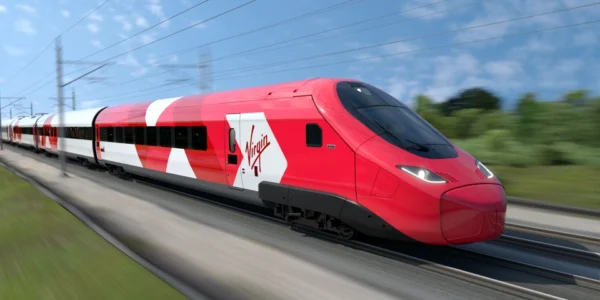
Virgin Trains has secured a major regulatory breakthrough in its plan to operate international high-speed rail services from London to continental Europe, opening the way for up to 20 daily return services to Paris, Brussels and Amsterdam.
The UK Office of Rail and Road decided on August 13, 2026 to pre-approve a framework track access agreement between London St. Pancras Highspeed and VTE OPCO Limited, operating as Virgin Trains. The regulator announced the decision on August 17.
The agreement provides access rights on the HS1 network from London St Pancras International toward the Channel Tunnel from October 1, 2030 until December 31, 2040.
However, travellers should not expect all 20 daily return services immediately. Virgin’s approved rights introduce routes progressively, making the decision an important step toward competition rather than confirmation of a complete timetable from opening day.
Paris becomes first destination in October 2030
London–Paris is scheduled to become Virgin’s first international route.
The approved framework initially provides six daily paths in each direction between October 2030 and March 2031. That allocation increases to 10 daily paths from April to September 2031 before reaching 13 daily services in each direction from October 2031.
Brussels services are planned to begin in February 2031 with four daily paths in each direction.
Amsterdam follows from September 2031 with three daily paths in each direction, although some Amsterdam access rights are subject to capacity conditions at London St Pancras International.
Once fully introduced, those allocations provide Virgin with access rights covering up to 20 daily return services.
Competition could reshape cross-Channel rail travel
The development could represent one of the most important changes to international rail travel from Britain in decades.
Eurostar currently provides the established direct passenger services linking London with Paris, Brussels and Amsterdam. Virgin’s entry would give travellers another operator on these major European city routes.
Competition could eventually increase seat capacity and provide greater choice in departure times, onboard products and fares.
However, lower prices are not guaranteed. Virgin’s eventual fare structure, service classes and commercial strategy have not yet been finalised.
For leisure travellers, additional trains could make city breaks easier to schedule. Business passengers could also benefit from a broader range of departure times between major European commercial centres.
Regulatory approval does not mean tickets are coming yet
The ORR decision is a significant milestone, but several major requirements remain before passengers can board.
Virgin must secure the rolling stock needed for international high-speed operation and complete relevant safety and regulatory processes.
It will also require access arrangements beyond HS1, including infrastructure through the Channel Tunnel and railway networks in continental Europe.
International services must operate across different signalling, safety and railway systems while also meeting border and passenger-processing requirements.
The October 2030 date should therefore be regarded as the beginning of Virgin’s approved access period and planned operating programme, subject to completion of these remaining steps.
Tickets are not currently available.
Temple Mills approval provides crucial London base
Virgin reached another important milestone in October 2025 when the ORR approved its application for access to Temple Mills International depot in east London.
Temple Mills is particularly important because it has facilities capable of supporting trains operating through the Channel Tunnel and on European rail networks.
The regulator concluded that Virgin presented the strongest case for using available depot capacity among competing applicants.
That decision helped move the project beyond its initial planning stage and provided Virgin with a pathway toward developing the maintenance and operational infrastructure required for international services.
New trains will shape future passenger experience
The latest HS1 agreement requires Virgin to use new rolling stock suitable for the route.
Virgin has previously outlined plans for a fleet of modern high-speed trains as part of its proposed cross-Channel operation.
New rolling stock could allow the company to build its passenger experience around contemporary expectations including connectivity, comfortable interiors, luggage requirements and hospitality.
The train specification will also need to satisfy the technical standards required for operating on British and continental European infrastructure.
For travellers, the eventual onboard proposition will be an important factor in determining whether Virgin can successfully challenge the incumbent operator.
London strengthens its role as European rail gateway
The approved routes connect London with three of Europe’s most important tourism and business destinations.
Paris remains one of the world’s leading visitor cities, while Brussels provides access to Belgium and major European institutions. Amsterdam remains a powerful leisure and business destination for British travellers.
Direct trains also provide a city-centre-to-city-centre alternative to short-haul aviation, avoiding many airport transfers at either end of a journey.
This gives international rail an increasingly important role in European tourism, particularly for travellers seeking convenient alternatives to flying.
2030 could begin a new cross-Channel era
Virgin still has considerable work ahead before its first international passenger train leaves St Pancras.
Nevertheless, the latest ORR approval creates a much clearer regulatory path.
Paris services are planned first from October 2030, followed by Brussels and Amsterdam during 2031 as the timetable expands toward its maximum 20 daily return services.
If Virgin successfully completes its rolling stock, infrastructure and regulatory programme, travellers could eventually gain something that has long been missing from direct London–continental Europe high-speed rail: meaningful operator choice.
For more travel news like this, keep reading Global Travel Wire