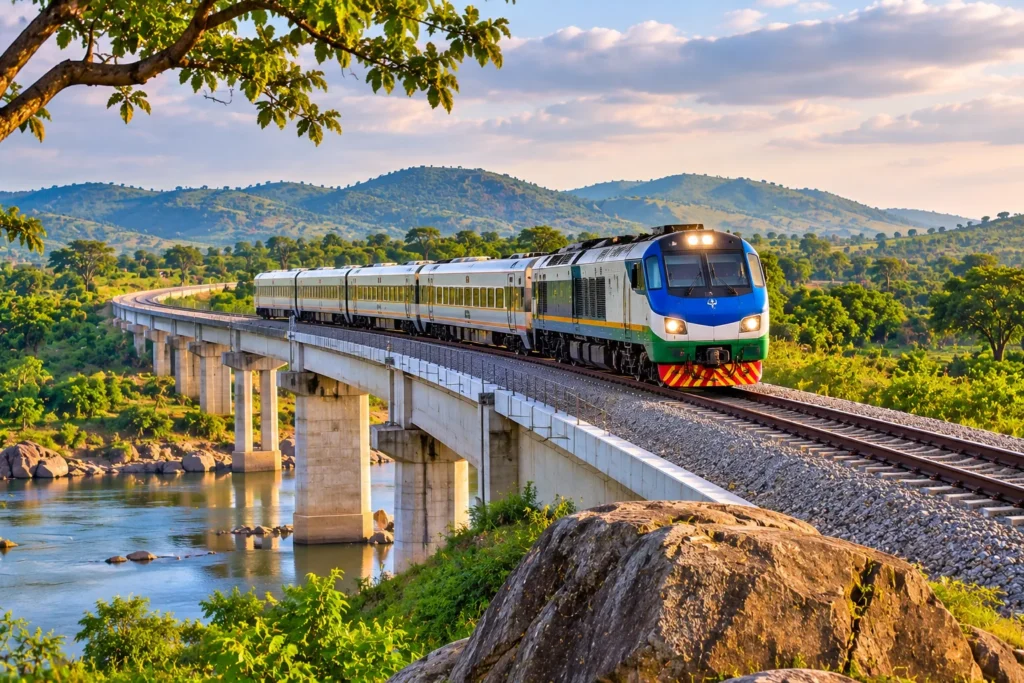
Official project agreements executed by the Ministry of Finance, the Ministry of Transport of the United Republic of Tanzania, and the African Development Bank have formalized a 1.2 billion US Dollar commercial financing facility to construct Lot 6 of the national Standard Gauge Railway. Stretching 411 kilometers between Tabora and the historic port city of Kigoma on the shores of Lake Tanganyika, the electrified standard-gauge line establishes a modern overland transport spine. Beyond serving industrial freight and agricultural trade with the Democratic Republic of Congo and Burundi, the infrastructure initiative represents a transformative breakthrough for tourism mobility across Tanzania’s Western Safari Circuit.
Government development releases confirm that the credit arrangement brings together nine international commercial banking institutions, including HSBC, FirstBank UK, Bank of Africa United Kingdom, Deutsche Bank, Société Générale, Commerzbank, Nedbank, Stanbic Bank Tanzania, and First Abu Dhabi Bank. The financing structure is underpinned by an 800 million US Dollar partial credit guarantee provided by the African Development Bank alongside syndicated private credit insurance capacity. By completing this critical railway segment, public transport authorities are establishing an accessible, low-emission travel corridor directly connecting the Indian Ocean coast at Dar es Salaam with the inland lakes and premier wildlife reserves of western East Africa.
Unlocking the Western Safari Circuit and Ecotourism Gateways
Official travel advisories and destination guides published by the Tanzania Tourist Board highlight the western region as one of Africa’s most pristine yet logistically secluded safari frontiers. The terminal station at Kigoma functions as the primary mainland launching point for two of the continent’s most ecologically significant wildlife sanctuaries: Gombe Stream National Park and Mahale Mountains National Park. Both reserves are internationally celebrated for harboring wild chimpanzee populations, intact tropical montane forests, and diverse primate ecosystems.
Historically, reaching these remote destinations required expensive multi-leg bush flights or extended overland travel across unpaved roadways, constraining foreign tourist volumes and visitor dispersal. The introduction of high-speed passenger services along the electrified standard-gauge railway will drastically shorten overland journey times across the central interior. Domestic and international visitors arriving at Julius Nyerere International Airport in Dar es Salaam will be able to embark on seamless, scenic rail journeys through Morogoro, Dodoma, and Tabora directly to Lake Tanganyika, creating an affordable and environmentally sustainable overland transit alternative.
Tourism ministry planners note that expanding rail transit into Kigoma will also stimulate water-based eco-tourism on Lake Tanganyika, the world’s second-deepest freshwater lake. Passenger ferries and eco-cruise vessels operating out of Kigoma and the historical trading port of Ujiji will be able to integrate train schedules with guided lake voyages, linking travelers to lakeside eco-lodges, snorkeling sites, and cross-border cultural itineraries across to Kalemie in the Democratic Republic of Congo.
Modern Rail Infrastructure and Sustainable Transit Standards
Engineering briefs published by the Tanzania Railway Corporation outline that the 411-kilometer Tabora–Kigoma alignment is designed to support electric passenger train operations traveling at speeds of up to 160 kilometers per hour. The transition from legacy narrow-gauge diesel operations to electrified passenger rail aligns with national sustainability commitments and green transport frameworks endorsed across the East African Community.
The construction of modern passenger stations equipped with digital ticketing terminals, passenger lounges, and intermodal transport connections is expected to foster regional economic development along the central transit corridor. By moving passenger traffic onto electrified rail lines, the project lowers the regional carbon footprint per passenger kilometer compared to long-distance automotive and aviation routes. Regional authorities emphasize that the development of clean, high-capacity transport infrastructure protects the sensitive ecosystems surrounding western national parks while facilitating responsible, high-volume visitor movement.
Economic Diversification and Community Tourism Opportunities
Official statements from the African Development Bank emphasize that the strategic importance of the Standard Gauge Railway extends across local community supply chains. While the railway provides mining operators and agricultural producers in western districts with a direct freight line to the Port of Dar es Salaam, passenger operations provide immediate economic opportunities for regional hospitality providers, certified safari guides, and local cultural artisans.
Municipal authorities along the Tabora and Kigoma routes report that upgraded transport connectivity encourages private investment in secondary hotel construction, cultural heritage museums, and culinary services. Improved market access allows regional agricultural cooperatives to supply fresh produce directly to high-end wilderness lodges in Mahale and Katavi National Park, keeping economic benefits anchored within local communities.
Furthermore, tourism boards emphasize that improved infrastructure promotes balanced regional tourism distribution. By encouraging visitors to explore beyond northern circuit destinations such as the Serengeti and Ngorongoro Crater, the standard-gauge railway distributes economic vitality across diverse geographic districts, ensuring long-term resilience for Tanzania’s broader visitor economy.
Long-Term Outlook for East African Regional Travel Corridors
The formalization of the 1.2 billion US Dollar commercial financing facility marks a decisive phase in executing Tanzania’s multi-billion-dollar national railway master plan. As construction advances along the Tabora–Kigoma link, regional tourism stakeholders and conservation bodies are preparing to integrate passenger rail schedules into international holiday marketing programs.
With global leisure travelers placing greater emphasis on sustainable travel, wilderness conservation, and authentic cultural immersion, the electrified railway positions Western Tanzania as an accessible global eco-tourism destination. Through coordinated public capital deployment, multilateral development backing, and proactive tourism governance, Tanzania is building an integrated transit network that protects natural heritage while driving sustainable economic growth.
For more travel news like this, keep reading Global Travel Wire