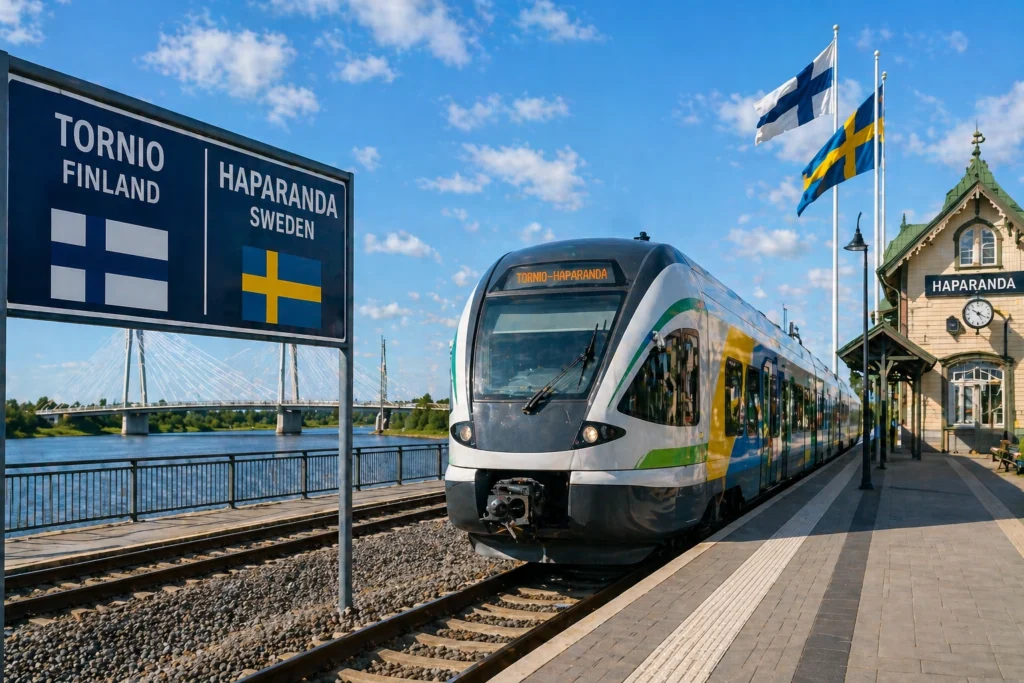
Finland and Sweden are set to restore passenger rail travel between Tornio and Haparanda through a newly funded cross-border rail link that could reshape mobility across northern Europe. Backed by a £1.65 million agreement, the project will reconnect the neighboring border towns after decades without direct passenger rail service, creating a more sustainable and convenient alternative to buses and cars.
The route is expected to debut in June and is being viewed as an important milestone for regional tourism, local connectivity and the long-term ambition of a more integrated European rail network. For travelers, it opens fresh possibilities to explore northern Scandinavia by train while reducing reliance on higher-emission transport options.
A Cross-Border Rail Route Returns
Passenger trains once linked Tornio in Finland and Haparanda in Sweden, but services were discontinued decades ago. Since then, residents and visitors crossing this section of the border have largely depended on road transport, despite rail infrastructure remaining in place.
The return of rail service restores a practical connection between two closely linked communities and gives the wider region a stronger transport backbone. For border-area workers, families and tourists, the new service promises easier movement between both countries.
Solving the Rail Gauge Challenge
One of the biggest barriers to restoring direct service has been the difference in rail gauges used by the two nations. Finland uses a broader 1524mm gauge, while Sweden operates on the standard European 1435mm gauge. That technical mismatch has historically complicated through-running passenger trains.
The new solution turns Haparanda station into a transfer hub. Travelers will arrive on one train, move through the station and board another train on the adjacent track designed for the other gauge. While not a nonstop service, the arrangement creates a workable and efficient cross-border connection.
Why This Matters for Tourism
The rail link is more than a transport upgrade. It has strong tourism potential for both countries. Northern Finland and northern Sweden are home to Arctic landscapes, winter tourism, summer wilderness experiences and growing demand for nature-based travel. Easier train access can attract visitors seeking scenic, low-stress journeys through the region.
Travelers heading to Lapland, the Arctic Circle or northern coastal cities may now find rail a more appealing option. Rail journeys also tend to encourage slower travel, where visitors spend more time in regional towns, supporting local hotels, restaurants and attractions.
New Opportunities for Cities and Regions
The restored link strengthens connections between destinations including Tornio, Haparanda, Rovaniemi and Oulu, with future potential to improve access to more Swedish cities such as Luleå and beyond. Better connectivity can stimulate business travel, education links and leisure tourism across both sides of the border.
For smaller communities in northern Europe, improved rail access can be especially valuable. It supports economic resilience by connecting remote areas to larger domestic and international transport networks.
A Sustainable Alternative to Air and Ferry Travel
The project also aligns with wider European sustainability goals. Rail is widely regarded as one of the most environmentally efficient ways to travel long distances. As travelers become more climate-conscious, better rail options can shift demand away from short-haul flights and private car journeys.
The route may also appeal to travelers comparing alternatives such as long ferry crossings between Finland and Sweden. While journey times vary depending on onward connections, many passengers may value the comfort, scenery and lower-emission profile of rail travel.
A Step Toward Bigger European Rail Dreams
Transport planners have long discussed the possibility of seamless long-distance rail journeys stretching across Europe. While that vision remains ambitious, every new cross-border link brings the continent closer to easier international train travel. The Tornio-Haparanda service shows that even complex infrastructure barriers can be overcome with practical planning.
If successful, the project could inspire similar solutions in other regions where technical standards have slowed cross-border rail growth.
What Travelers Can Expect Next
As the June launch approaches, the new Finland Sweden rail link is generating excitement among rail enthusiasts, sustainability-minded travelers and regional tourism operators alike. It offers not just a restored route, but a symbol of how rail can reconnect communities and unlock new visitor flows.
For northern Europe, this is more than a train service. It is the beginning of a new era in cross-border travel, where convenience, sustainability and regional growth move forward on the same track.
For more travel news like this, keep reading Global Travel Wire