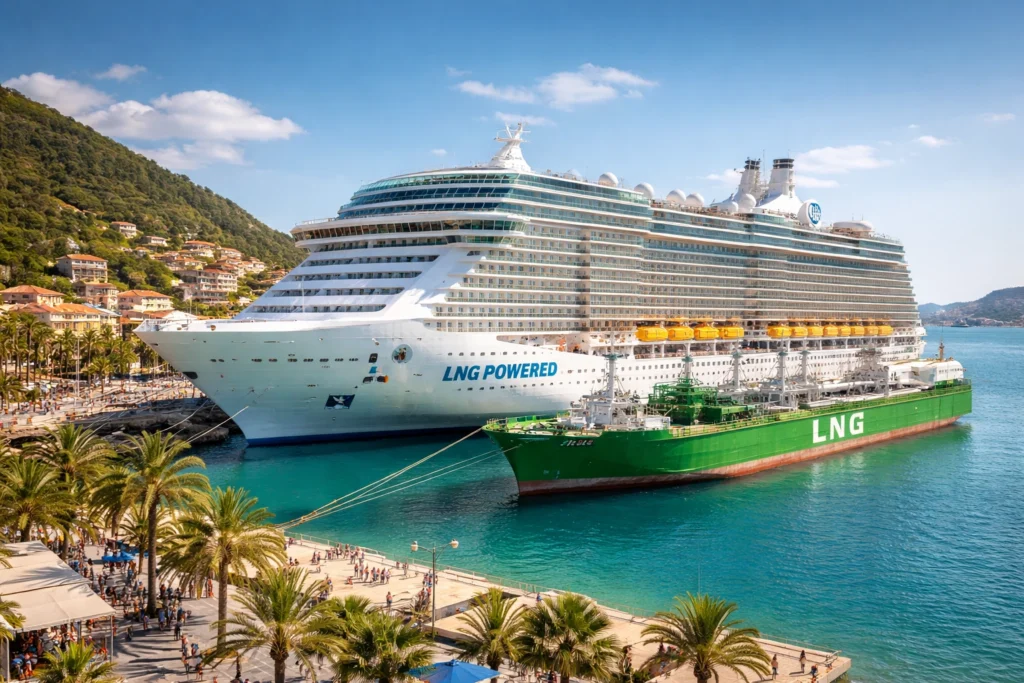
The global cruise industry is accelerating its shift toward cleaner operations as tighter environmental rules reshape the future of maritime tourism. A new technical analysis identifies liquefied natural gas, or LNG, as the most immediate and scalable fuel option currently available for cruise decarbonisation.
The finding arrives at a crucial moment for travel companies, port cities, and tourism destinations that depend heavily on cruise arrivals. With regulators demanding faster emission cuts, operators now need practical solutions that work today rather than waiting for future technologies to mature.
LNG has rapidly moved into that role by offering immediate reductions in harmful pollutants while supporting continued global cruise operations.
Why LNG Matters Right Now
Cruise lines face growing pressure from international environmental frameworks and regional emission standards. They must lower greenhouse gas output, reduce air pollution, and maintain reliable itineraries across major travel routes.
LNG offers a workable balance between those priorities.
Compared with conventional marine fuels, LNG can significantly reduce sulfur oxides, nitrogen oxides, and particulate matter. These pollutants often affect air quality in busy ports and coastal tourism centers where cruise ships berth close to urban communities.
For destinations, cleaner fuel use can improve the visitor experience while helping local authorities meet sustainability goals.
That makes LNG not only a shipping issue, but also a tourism issue with direct impact on residents and travelers alike.
Cleaner Ports, Better Visitor Experience
Many of the world’s most popular cruise destinations rely on their image as clean, scenic, and enjoyable places to visit. Air quality concerns have increasingly shaped debates around cruise tourism in historic cities, islands, and waterfront communities.
Lower-emission ship operations can help address those concerns.
When ships produce fewer local pollutants, passengers and residents may experience cleaner air around terminals, promenades, and city centers. This can strengthen destination appeal and support a more positive relationship between tourism growth and community wellbeing.
As sustainability becomes a key travel priority, destinations that welcome cleaner ships may gain a stronger competitive position.
Industry Adoption Gains Speed
One of the strongest signals in the analysis is the scale of LNG adoption already underway. LNG has become the most widely used alternative fuel in the cruise segment, both in active fleets and in future ship orders.
That momentum matters because large-scale adoption creates confidence across the wider travel ecosystem.
Cruise companies need proven fuel systems, safety standards, crew training, and dependable supply networks. LNG already offers much of that foundation.
Unlike some emerging fuels still in early development, LNG can support immediate deployment across major cruise markets. This allows operators to modernize fleets while continuing to serve popular itineraries in Europe, North America, Asia, and beyond.
Expanding Infrastructure Supports Growth
Fuel transition depends on infrastructure, and LNG’s progress has accelerated because ports worldwide continue to expand bunkering capability.
Major cruise hubs increasingly provide LNG refueling services, helping ships maintain schedules without major operational disruption. Reliability remains critical in tourism, where delays can affect passengers, shore excursions, and local businesses.
As more ports invest in compatible systems, cruise lines gain flexibility to plan cleaner routes across multiple regions.
This network effect strengthens LNG’s position as the leading bridge fuel during the sector’s transition phase.
Methane Slip Remains a Key Challenge
Despite its advantages, LNG is not free from criticism. One of the biggest concerns involves methane slip, where unburned methane escapes during engine use or fuel handling.
Methane is a powerful greenhouse gas, so reducing these emissions remains essential for LNG’s long-term credibility.
The industry is already responding through improved engine designs, stronger monitoring systems, and onboard technologies that cut methane losses. Continued innovation will be vital if LNG is to retain support from regulators, destinations, and sustainability-minded travelers.
In short, LNG solves several immediate problems, but it still requires ongoing improvement.
Future Fuels Could Build on Today’s Systems
The analysis also points to the growing potential of bioLNG and synthetic methane. These next-generation fuels could use existing LNG infrastructure while delivering much lower lifecycle emissions.
That creates an important pathway for cruise operators.
Rather than replacing entire fuel networks again, future renewable fuels may plug into systems already being built today. This can lower transition costs and accelerate progress toward deeper decarbonisation.
However, scaling those alternatives will depend on investment, supply growth, and clear policy support.
If governments encourage innovation, the cruise sector could move from transitional LNG toward even cleaner solutions faster than expected.
Sustainability Becomes a Travel Advantage
Environmental performance now influences booking decisions across the travel market. Many passengers want holidays that align with their values, while destinations increasingly seek tourism models that reduce environmental pressure.
Cruise brands investing in cleaner fuel strategies can therefore gain commercial advantages. They may attract environmentally aware travelers, strengthen brand trust, and secure better relationships with port communities.
Likewise, destinations welcoming lower-emission ships can position themselves as responsible tourism leaders.
This shift shows how sustainability has moved from a niche concern to a core part of tourism competitiveness.
Bridge to a Cleaner Cruise Future
LNG is not the final answer to cruise decarbonisation, but it is currently the most practical one at scale. It allows operators to cut emissions now, comply with tougher rules, and continue connecting travelers with destinations around the world.
For the travel industry, that immediate progress matters.
As future fuels develop and technology improves, LNG is likely to remain a central stepping stone in the journey toward cleaner cruising.
In an era of rising environmental expectations, the cruise sector’s transition has already begun—and LNG is leading the first wave forward.
For more travel news like this, keep reading Global Travel Wire