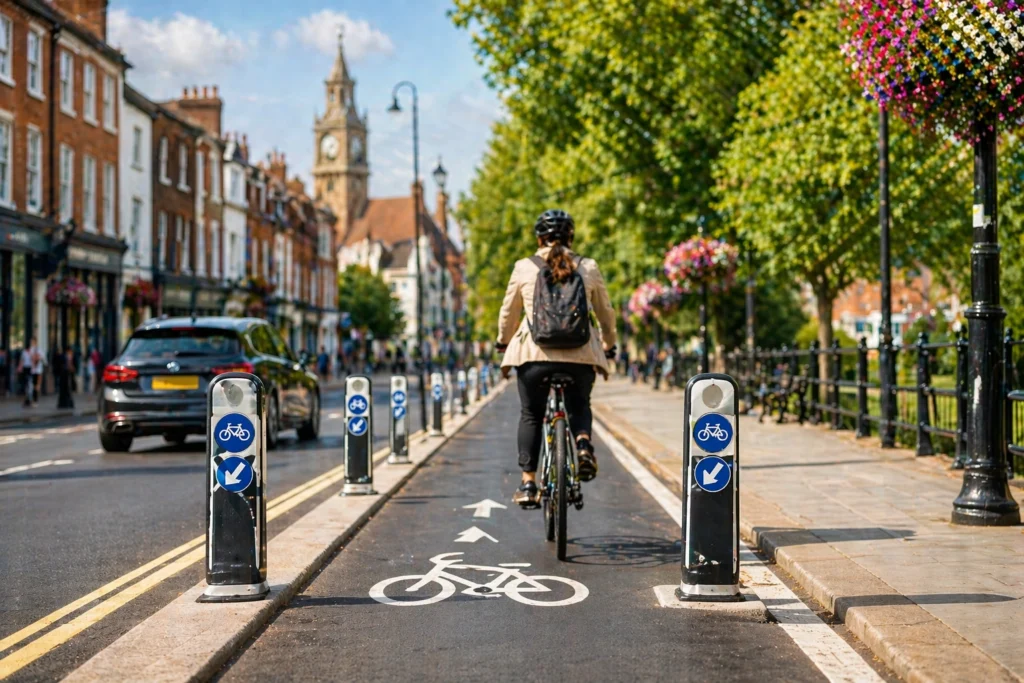
The United Kingdom is advancing its active travel strategy with a new infrastructure trial in Newbury, England, where compact Mini-Metro bollards and removable socket systems are being used to create safer, clearer cycling routes. The project highlights how practical street design can improve mobility for residents while also enhancing the visitor experience for travelers exploring towns and cities by bike or on foot.
As destinations worldwide focus on sustainable transport, the Newbury scheme shows how smaller infrastructure upgrades can have a significant impact on tourism, urban movement and future maintenance efficiency.
Safer Streets for Cyclists and Visitors
The trial, led by West Berkshire Council in partnership with contractor Volker Highways, is designed to clearly separate cycle lanes from motor traffic on busy streets. By creating more visible boundaries, the project aims to make cycling routes feel safer and easier to navigate.
That matters not only for daily commuters but also for visitors unfamiliar with local roads. Travelers often choose walking and cycling to explore destinations more closely, especially in market towns, historic centers and scenic regional areas. Infrastructure that reduces confusion and improves confidence can encourage more people to travel actively.
For tourism destinations, safer routes can increase visitor dwell time, support local spending and improve overall satisfaction.
What Are Mini-Metro Bollards?
The Mini-Metro bollards used in Newbury are compact traffic separators designed for locations where street space is limited. Each unit includes directional signage for cycleways while maintaining a low-profile footprint that avoids cluttering the streetscape.
This is particularly valuable in towns where public space must balance traffic flow, pedestrian movement and visual appeal. Oversized barriers can overwhelm urban environments, while smaller, well-designed features preserve character while still delivering safety benefits.
The bollards also include reflective panels that improve visibility for motorists, helping reduce potential conflicts between cars, cyclists and pedestrians.
For visitors navigating unfamiliar streets, clearer visual guidance can make journeys smoother and more intuitive.
Rebound Technology Improves Safety
A key feature of the system is its rebound base. If struck, the bollard bends or yields rather than remaining rigid.
This design can lower the risk of injury and reduce damage in mixed-traffic areas where occasional contact may occur. It also helps keep infrastructure functional over time, an important factor for busy visitor destinations that depend on reliable routes throughout the year.
For tourism-focused towns, resilient infrastructure means fewer disruptions during peak seasons and events.
Future Maintenance Made Easier
One of the most innovative elements of the Newbury trial is the use of retention socket systems. These allow bollards to be removed, replaced or repositioned more easily without major excavation work.
That can significantly reduce roadworks, closures and visual disruption in the future. Instead of lengthy maintenance projects affecting cycle lanes or pedestrian routes, authorities can make changes faster and with less inconvenience.
For travelers, this means more consistent route availability. For local councils, it offers a flexible long-term solution as transport needs evolve.
This approach may prove especially useful in destinations with seasonal tourism surges, festivals or changing street layouts.
Positive Early Feedback Builds Momentum
According to the project summary, feedback after the first weeks of operation has been highly positive. The scheme has been praised for its finish, visibility and suitability for cycle lane environments.
Strong public response is important because traveler perceptions often mirror local sentiment. Places that feel organized, welcoming and easy to move around tend to leave stronger impressions on visitors.
If local users embrace safer active travel routes, authorities may be encouraged to expand similar systems elsewhere.
Why It Matters for Tourism
Active travel infrastructure is increasingly linked to destination competitiveness. Modern travelers are looking for more sustainable, immersive and flexible ways to experience places. Walking and cycling routes allow visitors to engage with neighborhoods, waterfronts, parks and heritage sites at a slower pace.
In the UK, where towns and cities attract millions of domestic and international visitors, better non-motorized transport can complement rail travel, public transport and self-drive holidays.
Newbury’s trial demonstrates how even technical road upgrades can support broader tourism goals by making exploration easier and more enjoyable.
A Model for Other Destinations
Although the project is local, its relevance is much wider. Many destinations across Britain and Europe are looking for cost-effective ways to improve cycling safety without large-scale reconstruction.
Compact bollards, flexible installation systems and low-maintenance designs could offer a practical template for other communities seeking to modernize streets while protecting local character.
That could benefit coastal towns, heritage cities, university hubs and rural gateways where active travel plays a growing role in visitor movement.
The Future of Journey Quality
Travel is no longer judged only by where people go, but by how easily and enjoyably they move once they arrive. Safe cycling lanes, walkable streets and intuitive navigation are now part of the destination experience.
The Newbury trial shows how thoughtful design can improve that journey quality. If expanded, solutions like Mini-Metro bollards may help shape a future where UK destinations become even more accessible, sustainable and attractive for the next generation of travelers.
For more travel news like this, keep reading Global Travel Wire