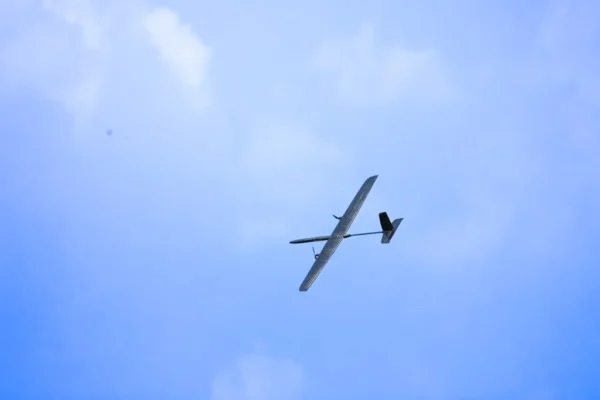
Bengaluru-based aerospace company Alteon has raised $2.5 million in pre-seed funding to develop autonomous aircraft capable of remaining airborne over the ocean for several months.
The funding round was led by Lachy Groom, with additional investment from Together Fund. It follows an offshore test in early August during which an Alteon aircraft completed several autonomous loops less than one metre above the open sea.
The low-altitude demonstration validated a critical part of the company’s planned dynamic soaring system. Alteon will now advance testing focused on extracting energy from wind, extending flight endurance and eventually achieving sustained flight without conventional propulsion.
If developed successfully, the technology could support continuous weather observation, maritime monitoring and scientific research. It could also improve the information available to aviation, coastal destinations, cruise operators and authorities responding to severe weather or maritime emergencies.
Albatross flight inspires new technology
Aircraft have traditionally needed to land for fuel, maintenance or recovery. Alteon is attempting to challenge that limitation by creating machines that can operate continuously for months and potentially more than a year.
Its approach takes inspiration from albatrosses. These seabirds travel across enormous ocean areas by using differences in wind speed and direction to gain energy while expending relatively little effort.
Known as dynamic soaring, this flight technique allows movement between layers of air travelling at different speeds. Converting the natural process into a reliable autonomous system requires precise control, efficient structures and the ability to respond rapidly to changing conditions.
The challenge becomes greater when an aircraft flies extremely close to the ocean. Waves, turbulence, wind shifts and moisture create an unpredictable operating environment with little room for navigation errors.
During the August test, Alteon’s aircraft autonomously completed consecutive loops while maintaining an altitude below one metre. The result demonstrated its ability to perform complex manoeuvres under real offshore conditions.
Propulsion-free flight remains ultimate goal
Alteon’s next testing phase will focus on capturing sufficient wind energy to increase endurance. The long-term objective is an aircraft that can fly autonomously for months without relying on traditional propulsion.
Founder Samay Sanghvi said the underlying ability to gain energy through dynamic soaring is already understood. However, building an aircraft that remains airborne for more than a year will require progress across autonomy, aerodynamics, structural engineering, efficiency and reliability.
As flight durations grow from hours to months, every aircraft system must meet a significantly higher standard. Components must operate accurately and repeatedly while coping with harsh marine conditions and limited opportunities for physical intervention.
The company plans to use the new investment to expand research and development, move beyond its latest offshore demonstration and prepare for potential large-scale aircraft deployment.
Continuous monitoring could support travel safety
Persistent autonomous aircraft could provide real-time information across ocean regions that remain difficult and expensive to monitor.
Potential uses include weather forecasting, ocean science, maritime traffic tracking, fishing activity observation and critical infrastructure surveillance. Fleets could also coordinate with autonomous systems used for emergency response, defence and commercial operations.
For tourism and transport, more continuous ocean data could improve understanding of weather systems affecting coastal communities, island destinations and shipping routes. Earlier or more detailed observations may support operational decisions by airports, airlines, cruise companies and emergency authorities.
Tourism destinations vulnerable to storms depend on timely information to protect visitors, infrastructure and local businesses. Persistent aircraft could complement existing observation systems by gathering data over wide marine areas for extended periods.
The technology may also help authorities detect illegal fishing, smuggling and other maritime activity. Stronger monitoring can support safer waters around ports, cruise corridors and coastal tourism zones.
However, these uses remain prospective. Alteon must still demonstrate sustained energy capture, reliable long-duration autonomy and safe operations over much longer periods.
Founder builds company through experimentation
Sanghvi began exploring the concept in 2023 after completing high school. Without formal engineering training, he developed his knowledge through practical experimentation with radio-controlled aircraft.
Repeated prototype construction, testing, crashes and failures helped establish the technical foundation for Alteon. Early support came from Emergent Ventures and 1517 before Sanghvi formally launched the company in 2025.
Alteon has since expanded into a team of 20 people based in Bengaluru. Its growth highlights India’s increasing role in deep-technology development and autonomous aviation research.
Groom said the project could eventually support large numbers of aircraft operating continuously in the sky. Such fleets could perform tasks that currently require ships, personnel and extensive infrastructure.
Together Fund co-founder Shubham Gupta described ocean endurance as the central challenge the company seeks to solve. He said the concept combines autonomous flight with the ability to draw energy from wind.
Major engineering challenges lie ahead
Months-long aviation will demand exceptional reliability. The aircraft must survive prolonged exposure to saltwater conditions, changing winds and mechanical stress while maintaining communications and navigation.
Regulatory approvals, airspace integration and safe coordination with conventional aviation will also be essential before fleets can operate at scale.
Nevertheless, the August test gives Alteon an important foundation. Its aircraft demonstrated autonomous precision in one of aviation’s most demanding environments.
By combining wind energy, autonomy and efficient flight, Alteon is pursuing a new class of persistent aircraft. Success could transform how governments, scientists and travel industries observe the oceans and respond to risks across the world’s largest shared environment.
For more travel news like this, keep reading Global Travel Wire