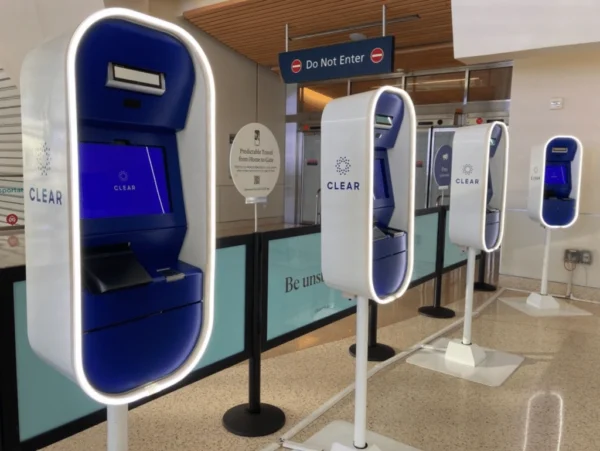
Business travel in the United States is entering a more biometric, technology-driven era following the launch of CLEAR Corporate Memberships, an enterprise programme designed to make airport journeys easier for travelling employees.
CLEAR formally unveiled the initiative during the Global Business Travel Association Convention 2026 in Chicago. The programme combines CLEAR+, biometric airport eGates, the CLEAR mobile application, Concierge services and workplace enrolment support for CLEAR and TSA PreCheck.
The development comes as airports and governments worldwide expand facial recognition and digital identity systems. Germany, Singapore, India and the United Arab Emirates are among markets developing their own approaches to biometric passenger processing.
For corporations, this transformation could make airport efficiency an increasingly important part of travel policy.
CLEAR Targets the Corporate Travel Market
CLEAR Corporate Memberships represent a significant expansion beyond individual airport memberships.
Companies can now provide eligible employees with CLEAR+ access as part of a broader business travel benefit. CLEAR says its network includes more than 150 CLEAR+ lanes across 62 airports, giving frequent domestic travellers access across many major US aviation markets.
Employees can use biometric identity verification before continuing to TSA baggage screening and security procedures. The service does not eliminate security requirements or replace travel management companies, airline booking systems or corporate travel platforms.
Instead, its focus is the airport journey.
The CLEAR application also provides security wait-time information, airport traffic conditions and estimated gate distances. These tools can help travellers decide when to leave their homes, offices or meetings.
Concierge Services Add Human Airport Assistance
CLEAR is combining biometric technology with personal assistance.
Its Concierge service allows travellers to book an airport ambassador who can help with baggage, navigation and movement through security toward the gate or lounge.
This feature may be particularly attractive to executives managing tight schedules, complicated connections or frequent multi-city journeys.
Companies can also organise workplace enrolment events for CLEAR and TSA PreCheck, reducing the need for employees to complete parts of the enrolment process independently.
However, biometric processing cannot guarantee a delay-free airport experience. Congestion, security conditions, airport operations and lane availability can still influence journey times.
Germany Advances Biometric Border Processing
The United States is not alone in transforming passenger identity procedures.
Frankfurt Airport in Germany continues developing digital border processing as Europe introduces the Entry-Exit System for eligible non-EU travellers.
The system electronically records entries and departures while collecting biometric information including facial images and fingerprints. Frankfurt Airport is introducing self-service processes in stages, allowing eligible travellers to enter information before completing border verification.
Germany’s approach differs from CLEAR because it forms part of airport and government border infrastructure rather than an employer-purchased membership.
For international business travellers, this demonstrates how different biometric systems may become part of the same journey.
Singapore Expands Passport-Less Travel
Singapore provides another model.
Passport-less immigration clearance has been fully implemented across Changi Airport’s four terminals. Singapore residents can use facial and iris biometrics without presenting passports during eligible immigration procedures, while foreign visitors can use passport-less processing when departing the country.
Singapore authorities reported that close to 127 million travellers cleared immigration without producing passports during 2025 as biometric processing expanded across the country’s checkpoints.
For corporate travellers moving frequently through Asia, faster immigration technology could reduce friction during international journeys.
India Pushes Digital Airport Identity
India is also developing biometric passenger processing as its aviation market expands.
Digi Yatra uses facial recognition-based digital identity technology to streamline movement through participating airports.
Unlike CLEAR, the Indian model is designed as a passenger-facing aviation infrastructure programme rather than a corporate membership product.
Its expansion highlights how rapidly growing aviation markets are looking toward automation to manage increasing passenger volumes while improving airport flow.
For multinational companies, employees may therefore encounter different digital identity systems depending on the market in which they are travelling.
Dubai Connects Biometrics With Premium Travel
Dubai International Airport provides another example of biometric technology becoming integrated across multiple passenger touchpoints.
Emirates passengers who register for its biometric services can use facial recognition at selected check-in facilities, immigration processes, lounges and boarding gates in Terminal 3.
Emirates says travellers can register through its application or at airport check-in, while eligible passengers can then use biometric recognition during future journeys.
Dubai’s approach demonstrates how biometric technology can operate alongside premium airport hospitality and airline services.
Privacy Becomes a Corporate Travel Priority
Greater biometric adoption also creates new questions for businesses.
Corporate travel managers must consider employee consent, data protection, security procedures and the handling of personal identity information before introducing biometric benefits.
Unlike a payment card or password, biometric identifiers cannot simply be replaced.
Companies considering CLEAR Corporate Memberships should therefore evaluate airport coverage, employee travel frequency, privacy requirements and measurable productivity benefits before implementing programmes widely.
Business Travel Becomes Increasingly Digital
CLEAR’s corporate launch signals an important change in how companies may manage employee journeys.
The future is unlikely to depend on one universal biometric system. Instead, travellers may encounter commercial platforms in the United States, government border systems in Singapore, airport programmes in Germany and India, and airline-integrated biometric journeys in Dubai.
For business travellers, the result could be faster, more connected airports.
For employers, the challenge will be balancing convenience, productivity and security as digital identity becomes a growing part of global corporate travel.
For more travel news like this, keep reading Global Travel Wire