Every frequent flyer knows the anxiety of standing by an empty airport baggage carousel as the conveyor belt slows to a halt. Whether arriving late for an executive summit or landing in a coastal resort town, missing luggage turns a planned trip into an immediate logistical ordeal.
Across global transport networks, millions of checked items are mishandled each year due to tight flight connections, transfer failures, and manual sorting errors. Recent aviation sector data reveals that while digital transformation has significantly improved baggage processing efficiency across major hubs, mishandled luggage continues to impose substantial financial burdens on commercial air carriers. Beyond operational expenses for couriers and tracing operations, baggage delays create significant friction for international travelers who increasingly expect real-time transparency.
The Evolution of Connected Travel Gear and Smart Luggage Infrastructure
To address baggage vulnerability and enhance the overall transit experience, travelers are turning to high-tech luggage solutions. Smart luggage has evolved rapidly from an emerging product category into a core element of personal travel technology.
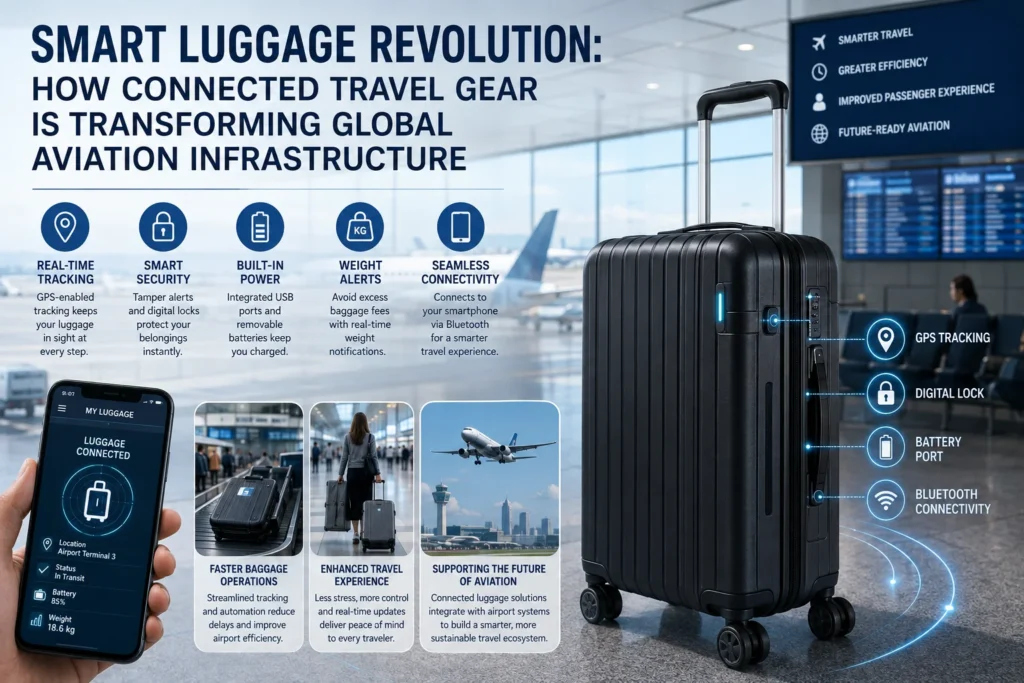
At the core of smart luggage design is embedded tracking capability. Utilizing integrated Global Positioning System (GPS) chips, Bluetooth low-energy beacons, and mobile network connectivity, modern suitcases transmit real-time location metrics directly to smartphone applications. Travelers can verify whether their bag has been loaded onto an aircraft, monitor its location on the apron, or trace its movement through an arrival terminal.
Beyond location tracking, modern connected luggage incorporates a wide range of functional hardware features:
Integrated Weight Sensors: Digital scales built into carry handles allow passengers to verify compliance with strict airline weight limits before reaching check-in counters.
App-Controlled Security Systems: Digital locks, biometric fingerprint scanners, and proximity sensors notify users if their suitcase moves beyond a designated distance.
Onboard Power Banks: Integrated battery systems power internal sensors and provide accessible USB charging ports for mobile devices during extended airport layovers.
Market Trajectory and Industry Adoption Driving Smart Luggage Market Growth
Market growth projections underline a strong shift in consumer purchasing habits toward connected travel gear. Industry analytical forecasts indicate that the global smart luggage sector is on track to expand rapidly, rising from a multi-billion-dollar market value into a major industry segment by the beginning of the next decade.
This sustained growth is heavily supported by broader aviation technology integration. Global civil aviation guidelines—including international baggage tracking mandates established under International Air Transport Association (IATA) Resolution 753—require air carriers and airport operators to track bags at key operational transfer points, including check-in, aircraft loading, intermediate transfers, and terminal arrival.
As commercial airlines modernize their internal tracing platforms and integrate passenger-facing digital location tools into official mobile applications, passenger expectations for full visibility have skyrocketed. Frequent flyers, digital nomads, and business travelers increasingly view trackable, connected luggage as a basic necessity for navigating complex international flight itineraries.
Navigating Regulatory Standards and Airline Safety Guidelines
Despite rapid adoption, the integration of technology into consumer luggage presents operational considerations, particularly regarding airline safety compliance. Commercial aviation security authorities enforce strict regulations regarding lithium-ion power banks onboard commercial passenger aircraft.
Because uncertified lithium batteries present fire safety risks in cargo holds, major international air carriers require passengers to remove power banks before checking luggage into an aircraft hold. Smart luggage manufacturers have adapted to these regulatory requirements by engineering removable battery modules, ensuring that travelers can enjoy digital connectivity while maintaining full compliance with civil aviation safety mandates.
Furthermore, airport authorities and airline baggage teams are increasingly collaborating with digital technology platforms to streamline bag recovery. By integrating passenger location data with central airline tracing software, aviation ground handlers can identify delayed items faster, reducing recovery times and operational costs across international air corridors.
The Future of Autonomous and Artificial Intelligence Travel Gear
As artificial intelligence and automated systems advance, the next phase of smart luggage development promises even greater integration with modern travel infrastructure. Emerging engineering concepts feature AI-driven travel companions capable of autonomous movement, utilizing computer vision and proximity sensors to follow travelers through terminal corridors hands-free.
Additionally, predictive software models are being designed to interface directly with smart luggage sensors, providing real-time alerts regarding gate changes, flight delays, or potential terminal transfer risks. As airports continue to digitize operations through biometric check-ins and automated baggage drop halls, connected luggage will play a vital role in creating a touchless, frictionless traveler journey from departure hall to final destination.
For more travel news like this, keep reading Global Travel Wire