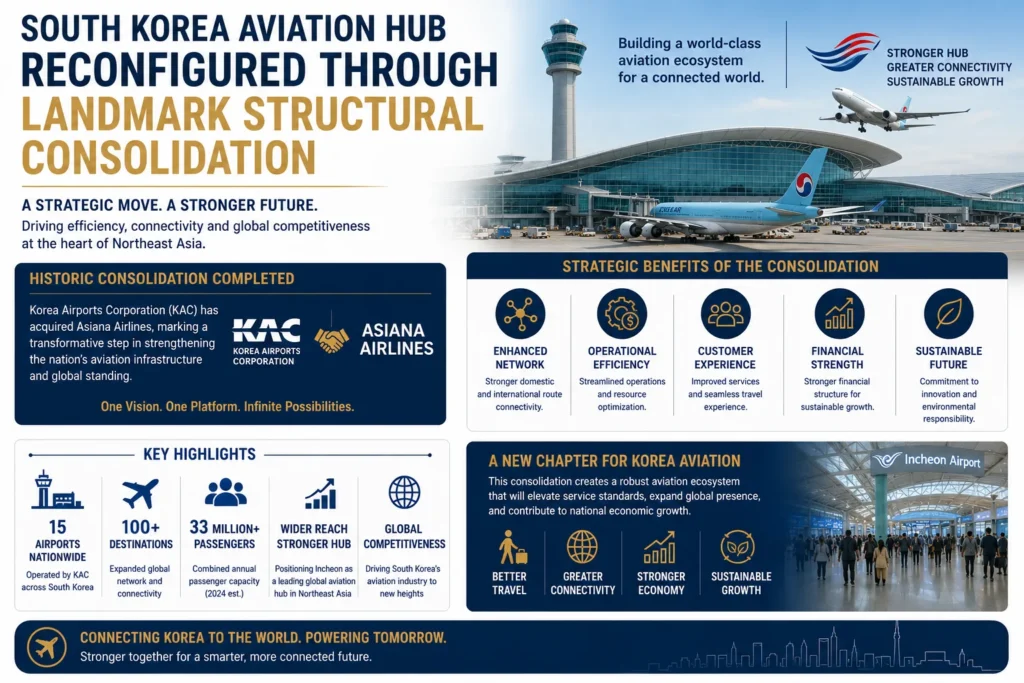
The operational parameters of East Asian commercial aviation are undergoing a massive transformation as South Korea moves to consolidate its market footprint and expand its primary transit infrastructure. Following final conditional approval from South Korea’s Ministry of Land, Infrastructure and Transport (MOLIT) under the Aviation Business Act, the long-scrutinized integration of Asiana Airlines into Korean Air has entered its final operational phase. This historic regulatory milestone sets a definitive timeline for the formal conclusion of independent operations under the legacy Asiana Airlines brand.
According to official state declarations and corporate merger frameworks, independent passenger flights and administrative processes operating under the Asiana identity are scheduled to permanently conclude. This mega-merger represents the largest structural reorganization within the country’s civil aviation history, bringing an end to decades of dual flag-carrier competition. Once the transition is executed, all underlying capital assets, international flight rights, operational obligations, and workforce personnel will be fully absorbed into the expanded corporate network.
Structural Realignment Alters Global Airline Alliance Matrices
The finalization of this historic consolidation triggers an immediate shift within international airline networks and frequent flyer loyalty structures. Operating schedules confirm that Asiana Airlines will officially terminate its long-standing membership with the Star Alliance network. Immediately following this departure, the carrier’s remaining flight operations will be integrated into the SkyTeam alliance architecture through Korean Air’s pre-existing alliance framework.
This major alliance migration presents significant routing adjustments for international code-share agreements and global transit connections. Passengers who historically relied on uniform Star Alliance connectivity via Seoul will transition into the SkyTeam operational ecosystem. State transport ministries note that while duplicate routes on highly dense international corridors will be systematically streamlined, strict capacity rules implemented by the Korea Fair Trade Commission require the combined entity to maintain a minimum of 90% of its historical seating capacity to protect consumer options and stabilize airfares across the Pacific.
Major Route Expansion Strengthens Strategic Air Corridors
In tandem with the internal corporate consolidation, South Korea is executing a targeted expansion of its regional flight frequencies following bilateral aviation updates. A revised cross-border allocation adds dozens of new weekly passenger services distributed among domestic carriers, pushing total weekly flight frequencies between South Korea and mainland China to a standardized baseline. High-density paths linking Seoul Incheon with primary commercial hubs, including Shanghai and Guangzhou, are receiving priority allocations to clear peak-season bottlenecks.
Furthermore, state development guidelines are intentionally utilizing regional airports to distribute international visitor arrivals more evenly across the nation. Up to 14 weekly services are actively connecting provincial gateways, such as Busan and Cheongju, with major regional commercial centers. In a parallel development within regional vacation corridors, low-cost carrier T’way Air is finalizing the resumption of its popular Seoul-to-Saipan route, restoring vital tourism connectivity following the temporary resolution of fuel-related scheduling suspensions.
Massive Capital Investments Upgrade Airport Capacity Thresholds
To prevent a sudden influx of international passenger traffic from causing terminal congestion, South Korea has officially brought online the Phase 4 infrastructure expansion of Incheon International Airport. This extensive infrastructure project, representing an investment of approximately 4.8 trillion South Korean won (equivalent to $3.6 billion), focused primarily on doubling the physical footprint of Terminal 2. The completion of this seven-year development project increases the facility’s annual passenger handling threshold to over 100 million travelers.
Official data from the Incheon International Airport Corporation (IIAC) indicates that this capacity surge places the gateway as the third-largest airport worldwide in terms of international passenger throughput capability, trailing only Hong Kong and Dubai. The modernized terminal layout incorporates advanced technology, including smart check-in systems, automated biometric security portals, and an automated baggage handling network designed to shorten average processing times. This high-capacity blueprint provides the essential infrastructure needed to process the combined airline groups without triggering aircraft delays.
Seamless Baggage Technology Protects International Transfers
Passenger processing is being further optimized through the expansion of cross-border automated logistics programs. The seamless transfer initiative, managed via joint venture frameworks between regional carriers and major North American operators, is utilizing advanced remote baggage screening systems. This technology enables international travelers connecting through premier West Coast gateways to route checked luggage directly to final domestic destinations without needing to manually clear and re-check bags at initial entry points.
The standardization of these digital luggage systems across multiple international gateways significantly limits transfer delays and helps mitigate connection friction. By matching physical infrastructure expansions with advanced tracking data, transport offices aim to insulate international itineraries from luggage mishandling errors, providing a reliable experience for global long-haul travelers.
Strategic Outlook for the East Asian Flight Grid
The synchronized execution of corporate airline mergers, regional route expansions, and multi-billion dollar airport modernizations reflects a highly calculated approach to securing long-term aerospace dominance. National development plans emphasize that establishing a highly efficient transport network is vital to achieving broader economic targets, including the government’s stated goal of attracting 30 million annual inbound international tourists.
By transitioning from a fractured multi-carrier model to a unified, high-capacity flagship architecture supported by world-class airport facilities, South Korea is establishing a highly resilient travel network. As global transit routes face ongoing capacity adjustments and structural resource limitations, the comprehensive updates across the South Korean aviation landscape ensure its continued positioning as a secure, efficient, and dominant gateway connecting the Pacific with the global travel marketplace.
For more travel news like this, keep reading Global Travel Wire