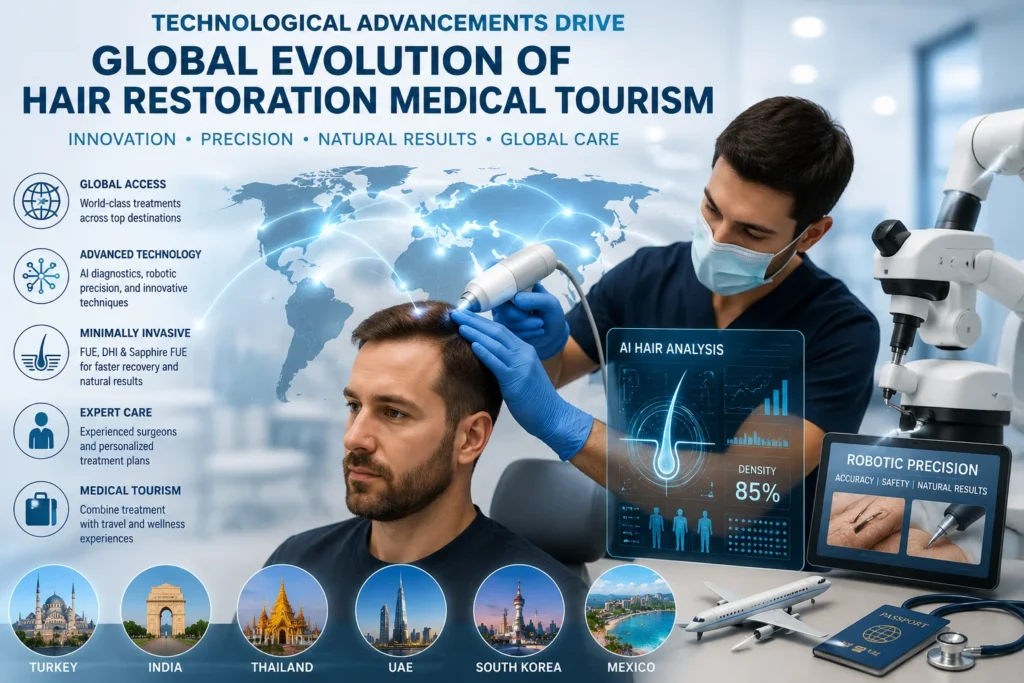
The global health travel sector is experiencing a structural shift, evolving from a market once driven primarily by low-cost procedure packages into an industry defined by technological specialization, digital integration, and comprehensive patient care. While cost considerations remain relevant, international travelers increasingly select healthcare destinations based on procedural precision, clinical credentials, and modern support systems.
Official figures from International Health Services (USHAŞ) and Ministry of Health datasets show that Türkiye welcomed over 1.5 million international health visitors in recent reporting years, generating over USD 3 billion in health tourism receipts. Specialty clinics account for a significant majority of this demand, with hair transplantation representing approximately half of all elective procedures sought by incoming international travelers. This rapid expansion highlights how specialized medical hubs like Istanbul rely on advanced digital workflows and technology-assisted care to meet rising global expectations.
Precision Micro-Surgical Techniques Redefine Patient Outcomes
A primary factor reshaping patient decisions is the technological refinement of minimally invasive hair restoration techniques. Earlier surgical methods often involved removing strips of donor tissue, which required longer recovery periods and could leave linear scars. Modern clinical approaches focus on individual follicle extraction and strategic placement.
Primary advanced extraction and implantation protocols include:
Follicular Unit Extraction (FUE): Individual follicular units are harvested using microscopic punch instruments, minimizing tissue trauma in donor areas and allowing faster healing.
Direct Hair Implantation (DHI): Specialized pen-like implantation devices allow clinical teams to control the depth, angle, and direction of each graft simultaneously without creating prior incision slits.
Sapphire Micro-Blades: Utilizing specialized sapphire crystal blades instead of traditional steel creates smaller micro-channels, reducing post-operative scabbing and supporting denser graft placement.
These refined instruments enable surgical teams to design natural-looking hairlines tailored precisely to a patient’s facial structure and existing hair density while protecting donor hair supply for future needs.
Digital Scalp Analysis and Virtual Treatment Planning
Technology has also transformed how treatments are planned well before a traveler boards a flight. Advanced diagnostic platforms allow clinics to evaluate patient candidacy remotely, minimizing uncertainty for cross-border travelers.
High-resolution trichoscopy, AI-assisted scalp analysis software, and digital imaging platforms provide detailed quantitative data regarding donor area hair density, shaft thickness, and scalp health. For international travelers, these capabilities enable accurate virtual consultations. Prospective patients can submit standardized photographs, review medical histories, discuss goals, and receive preliminary graft estimates remotely.
Integrated digital planning tools allow medical teams to set clear expectations and establish comprehensive treatment timelines before patients commit to travel expenses, hotel stays, and time off from work.
Comprehensive Infrastructure and Mandated Quality Standards
The evolution of health travel extends beyond procedural mechanics to encompass total logistics and patient coordination. International health travel requires seamless management of airport transfers, accommodation, multilingual translation services, appointment schedules, and administrative documentation.
To protect foreign travelers and enforce consistent quality controls, official regulatory frameworks, such as the mandatory HealthTürkiye portal overseen by health authorities, require accredited clinics to register foreign patient cases, maintain standardized digital records, and adhere to strict international patient protocols. Clinics that integrate these regulatory and logistical requirements into structured patient management platforms deliver a safer, transparent, and more reliable experience.
Additionally, digital record-keeping ensures that medical notes, graft distribution maps, and prescription details are archived securely, facilitating continuity of care regardless of where the patient resides.
Remote Digital Aftercare and Long-Term Recovery Tracking
Because full hair growth develops gradually over 12 to 18 months following a procedure, post-operative support is critical to long-term satisfaction. Digital health tools have transformed aftercare by allowing medical teams to monitor patient recovery across international borders.
Dedicated mobile applications, secure messaging platforms, and video consultation schedules enable clinical staff to track healing milestones, review periodic photo updates, and address questions promptly. Standardized photo-documentation schedules allow doctors to evaluate graft retention and scalp health at key recovery stages.
This continuous remote engagement provides international travelers with continuous reassurance, bridging the geographic gap between home countries and specialized medical centers abroad.
Raising Standards Across the Health Tourism Industry
The integration of advanced micro-surgical tools, virtual consultations, and structured remote aftercare illustrates how medical travel is maturing. Access to transparent information allows consumers to evaluate clinical credentials, physician involvement, and technology standards rather than selecting providers based solely on promotional package pricing.
As global demand for specialized elective procedures grows, destinations that prioritize technological precision, regulatory compliance, and continuous digital aftercare are establishing new benchmarks for global health travel. Hair restoration stands as a clear example of how modern medical technology transforms international healthcare into a coordinated, patient-centered experience from initial online inquiry to long-term recovery.
For more travel news like this, keep reading Global Travel Wire