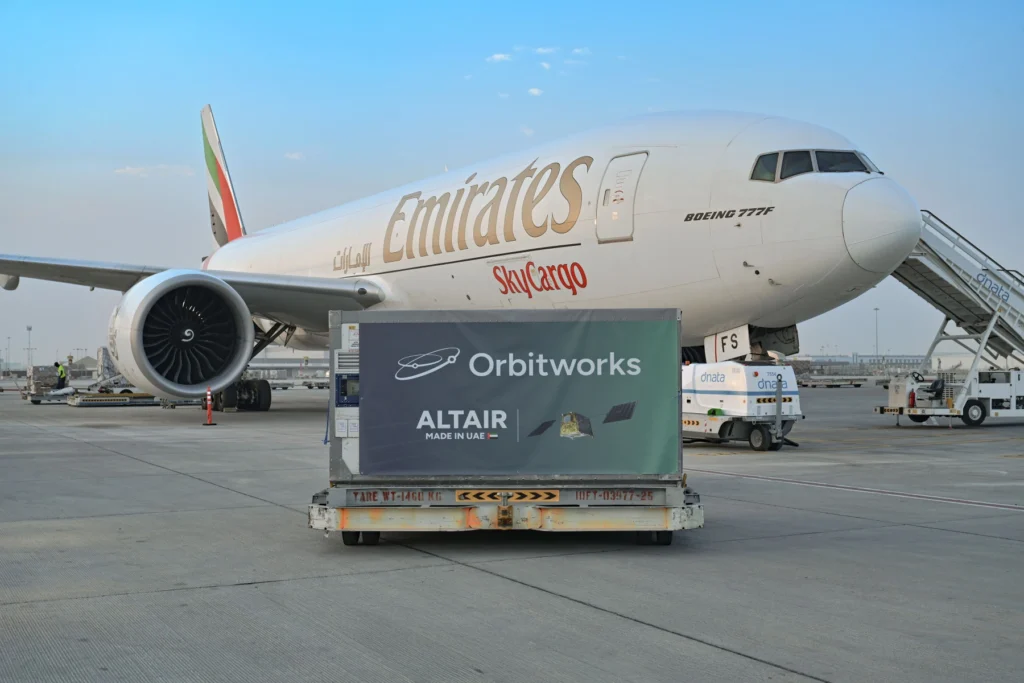
The UAE has reached another major aviation and space technology milestone after Emirates SkyCargo transported Altair-1, the country’s first commercial AI-enabled Earth observation satellite, from Dubai to the United States.
The satellite travelled aboard an Emirates SkyCargo Boeing 777 freighter from Dubai World Central, or DWC, to Los Angeles International Airport. Altair-1 is scheduled for launch in October 2026 and will become the first spacecraft in Orbitworks’ planned 10-satellite Altair constellation.
The operation demonstrates how Dubai’s aviation infrastructure is increasingly supporting industries beyond passenger travel and conventional freight. High-value aerospace movements now strengthen the UAE’s position at the intersection of aviation, technology, advanced manufacturing and commercial space development.
For the travel industry, the milestone further reinforces Dubai’s status as a global connectivity hub capable of supporting tourism, international business and highly specialized logistics.
Sensitive satellite requires specialized aviation logistics
Transporting a satellite requires significantly more control than moving standard commercial cargo.
Emirates SkyCargo managed the Altair-1 journey through its Aerospace and Engineering operation. A dedicated team handled the satellite throughout the end-to-end journey while maintaining strict environmental and safety controls required for sensitive aerospace equipment.
Satellites contain delicate electronic systems and scientific technology engineered to function in extreme conditions after launch. Therefore, precise handling during ground transportation, airport processing and air freight operations is essential.
Successfully moving Altair-1 between Dubai and Los Angeles highlights the increasing importance of specialized aviation expertise as the commercial space economy expands.
Altair constellation brings AI into Earth observation
Altair-1 represents a new generation of Earth observation technology developed and manufactured in the UAE by Orbitworks.
The wider Altair system combines optical, infrared, thermal and radio-frequency sensing capabilities. It also incorporates onboard artificial intelligence processing, allowing information collected in orbit to be analyzed more efficiently.
Potential applications include environmental monitoring, disaster response, maritime awareness, land and coastal analysis, infrastructure assessment and natural-resource monitoring.
Altair-1 will be the first of 10 satellites forming the planned constellation. Orbitworks has positioned the network as an important component of the UAE’s growing commercial space capability.
Such technologies could eventually support sectors connected with tourism as well. Environmental intelligence, coastal monitoring and disaster assessment can help destinations understand natural conditions and improve long-term infrastructure planning.
Dubai strengthens global aviation hub credentials
Although the operation does not affect passenger flights, its broader significance extends into the tourism economy.
Dubai already functions as one of the world’s most important aviation gateways. Specialized cargo operations strengthen that ecosystem by attracting technology companies, engineers, investors and international business activity.
That creates additional opportunities for hotels, meeting venues, transport providers and other businesses serving corporate and professional travelers.
Aviation hubs increasingly compete not only through passenger connectivity but also through their ability to support complex global supply chains and advanced industries.
Emirates SkyCargo currently connects cargo customers across more than 150 destinations through its global network. Its expanding freighter operation provides additional capacity for specialized movements requiring dedicated aircraft and handling capabilities.
Emirates builds deeper aerospace transport experience
Altair-1 is not the first satellite handled by Emirates SkyCargo.
The airline previously transported Arab Satellite 813 from Dubai toward its launch site near Shanghai. In 2018, it also carried KhalifaSat, the first satellite developed and built by UAE engineers, from Dubai to South Korea.
These missions have helped Emirates develop expertise in moving sensitive spacecraft and advanced engineering equipment.
Demand is also increasing. Emirates SkyCargo reported that more than 6,000 tonnes of aerospace and advanced engineering cargo had been transported worldwide during 2026.
The carrier has simultaneously expanded its freighter fleet and network, strengthening Dubai World Central’s role within international cargo flows.
No impact on UAE passenger travel
International visitors planning journeys through Dubai do not need to make any changes because of the Altair-1 operation.
The satellite movement was a specialized cargo mission. Passenger booking conditions, entry requirements and normal airline operations remain separate.
Travelers can therefore continue using Dubai as a tourism destination and international connection point under normal airline and government requirements.
However, visitors passing through the UAE are increasingly travelling through an aviation ecosystem supporting far more than tourism.
UAE aviation and space ambitions converge
Altair-1 illustrates how aviation logistics and commercial space development are becoming increasingly connected.
The satellite was manufactured in the UAE, transported through Dubai’s global air cargo infrastructure and moved internationally ahead of its planned October launch.
That journey reflects the expanding technological role of the UAE’s aviation sector.
For Dubai and the wider Emirates, advanced aerospace logistics can strengthen international business connections, attract specialist investment and reinforce the country’s reputation for technological innovation.
The Altair-1 mission therefore represents more than a cargo shipment. It demonstrates how aviation infrastructure is helping the UAE connect Earth-based industries with its growing ambitions in space.
For more travel news like this, keep reading Global Travel Wire