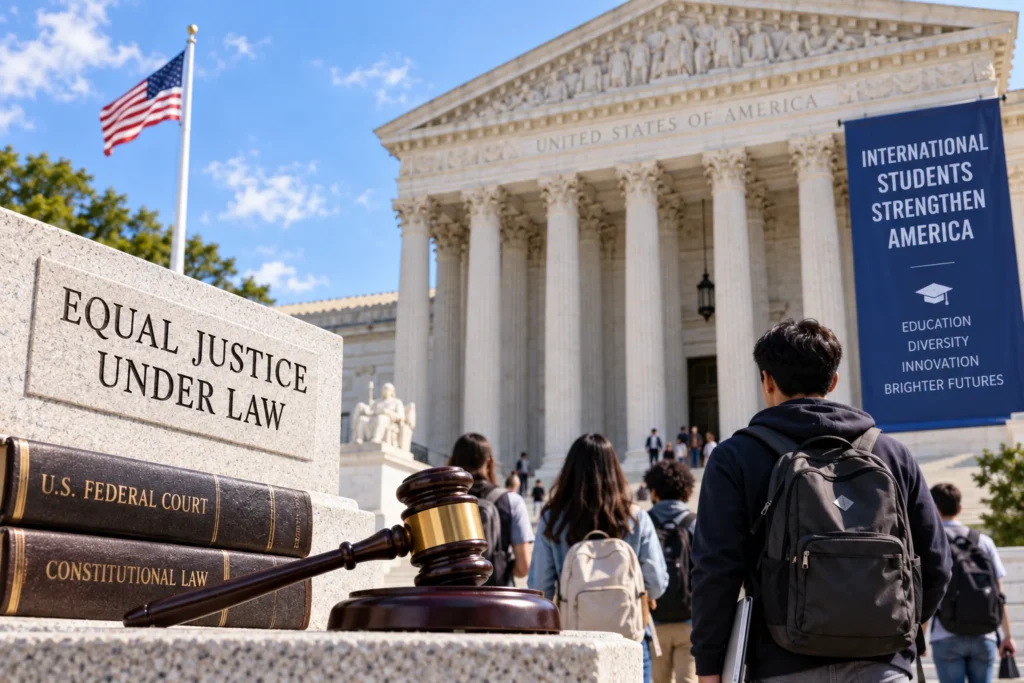
A judicial order issued by the U.S. District Court for the District of Massachusetts has formally blocked the implementation of restrictive Department of Homeland Security regulations targeting academic visitors, exchange participants, and media representatives. Chief U.S. District Judge F. Dennis Saylor IV issued a nationwide preliminary injunction halting the administrative framework one day before its planned implementation on September 15, 2026. The ruling ensures that the established “Duration of Status” framework governing international travel, higher education enrollment, and academic mobility remains in full effect.
The challenged Department of Homeland Security policy sought to eliminate the multi-decade policy that allows international academic participants to remain in the United States for the entire duration of their approved educational programs. By preserving current regulatory standards, the judicial stay provides immediate stability for higher education institutions, exchange visitor programs, and international tourism channels tied to academic mobility.
Institutional Impact and Visa Category Breakdown
The proposed regulatory update aimed to transition international nonimmigrant visas from status-based durations to rigid calendar-based limits. The injunction maintains current administrative standards across key visa classifications:
| Visa Classification | Historical Admission Standard | Proposed Rule Limitation | Post-Injunction Status | Primary Regulatory Authority |
| F-1 Academic Students | Duration of Status (Full study program) | Fixed 4-year maximum stay limit | Duration of Status preserved | Department of Homeland Security |
| J-1 Exchange Visitors | Duration of Status (Full program length) | Fixed 4-year maximum stay limit | Duration of Status preserved | Department of State / DHS |
| I-Visa Foreign Media | Duration of Employment | Fixed 240-day initial admission limit | Standard visa validity preserved | U.S. Citizenship and Immigration Services |
| Cultural & Educational Travel | Program-based entry period | Strict discretionary extension required | Baseline entry rules remain active | U.S. Customs and Border Protection |
Official filings in the case—brought by higher education coalitions, academic associations, and labor organizations—highlighted that imposing arbitrary cap limits would introduce severe administrative friction. Major research institutions noted that advanced degree programs routinely exceed four-year timelines, and eliminating status-based admission would discourage international talent from choosing American universities.
Economic Contributions of Academic Tourism and Higher Education
The preservation of existing entry frameworks safeguards a critical component of national travel and educational service exports. Open Doors data published by the Institute of International Education in coordination with the U.S. Department of State confirms that more than 1.1 million international scholars and exchange visitors reside in the United States annually.
International educational mobility drives significant economic activity, contributing tens of billions of dollars directly to local travel economies, regional housing markets, hospitality services, and municipal transportation systems. In his ruling, Judge Saylor noted that the traditional admissions model has supported groundbreaking academic research while serving as a vital driver of economic growth across urban and regional educational hubs.
The judicial order emphasized that substituting the established duration of status framework with an unappealable discretionary extension process raised serious compliance concerns. The opinion noted that the administrative rationale offered for the rule change was exceptionally weak and failed to justify the widespread economic and educational disruption it would cause.
Key Traveler and Higher Education Guidelines
Status Quo Maintained: International academic visitors traveling under F-1 and J-1 classifications continue to be admitted under standard Duration of Status guidelines.
University Operations: Higher education institutions may continue standard Form I-20 issuance and program extension recommendations without requiring supplemental Department of Homeland Security filings.
Continued Judicial Review: The nationwide preliminary injunction remains in force while the federal court conducts further proceedings regarding procedural compliance under the Administrative Procedure Act.
Official Verification: International scholars and academic travel coordinators are advised to monitor official guidance from Designated School Officials and official Department of State portals.
Frequently Asked Questions
What does the federal court order mean for current international students in the US?
The judicial injunction pauses the Department of Homeland Security rule. International students on F-1 visas remain under the Duration of Status framework, allowing them to complete their academic degree programs without applying for fixed four-year extensions.
Did the Department of Homeland Security visa changes take effect on September 15?
No. The preliminary injunction issued on September 14 temporarily blocked the rule nationwide before its scheduled effective date, keeping existing visa regulations active.
Where should international scholars check for verified US visa policy updates?
Travelers and academic visitors should reference official announcements from the U.S. Department of Homeland Security, U.S. Citizenship and Immigration Services, and official international student advisories published by host academic institutions.
For more travel news like this, keep reading Global Travel Wire