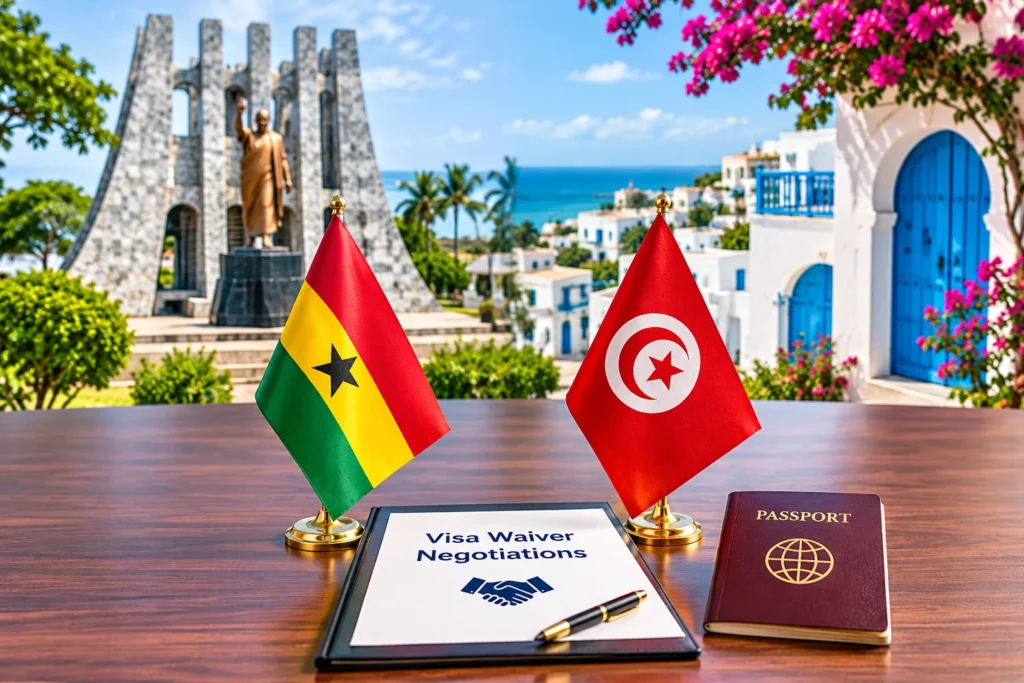
Cross-border travel across Africa is gaining fresh diplomatic momentum as the governments of Ghana and Tunisia officially initiate formal negotiations on a bilateral visa-waiver arrangement. The announcement followed high-level diplomatic talks held on November 15, 2026, between Ghana’s Minister for Foreign Affairs, Samuel Okudzeto Ablakwa, and Tunisia’s Minister of Foreign Affairs, Migration and Tunisians Abroad, Ali Nafti. Designed to simplify entry formalities between West and North Africa, the proposed agreement aims to strengthen tourism flows, commercial partnerships, and people-to-people exchanges between Accra and Tunis.
In an official ministerial statement released following the bilateral engagement, Minister Ablakwa confirmed that both governments agreed to immediately commence formal negotiations toward a visa-waiver framework. While specific timelines for concluding the treaty and the exact passport categories to be covered remain subject to ongoing diplomatic consultations, the announcement represents a concrete step toward removing administrative barriers to regional travel.
Reviving the Permanent Joint Commission for Cooperation
Beyond visa liberalization, the two foreign ministries agreed to revive the Ghana–Tunisia Permanent Joint Commission for Cooperation (PJCC) to establish a structured platform for regular intergovernmental dialogue. According to official ministerial disclosures, the revitalized commission will prioritize collaboration across six strategic sectors:
Tourism and Cultural Exchange: Facilitating two-way leisure travel, heritage tourism, and hospitality investment between North and West Africa.
Trade and Agribusiness: Expanding bilateral commerce, agricultural value chains, and private-sector market access.
Education and Sports: Strengthening academic exchanges, scholarship programmes, and athletic partnerships.
Maritime Cooperation: Enhancing port logistics, maritime security, and coastal trade connectivity.
To reinforce institutional presence and streamline consular support for travellers and businesses, both governments also confirmed they are actively considering the establishment of permanent resident diplomatic missions in Accra and Tunis as soon as practicable. During the meeting, Minister Nafti formally extended an official invitation to Minister Ablakwa to undertake a reciprocal diplomatic visit to Tunisia to advance these joint initiatives.
Expanding Ghana’s International Passport Diplomacy Toward 2027
The proposed Ghana Tunisia visa waiver forms a central component of Accra’s broader foreign policy strategy to elevate the global standing, security, and international acceptance of the Ghanaian passport. According to official updates from Ghana’s Ministry of Foreign Affairs, active diplomatic engagements are underway with multiple partner nations, with the government targeting the conclusion of several additional visa-waiver agreements before the end of 2027.
Recent ministerial records illustrate steady progress across both regional and intercontinental corridors:
Central European Outreach: Earlier in November 2026, following the presentation of credentials in Accra by Slovakia’s Ambassador-designate Martin Podstavek, Ghana and Slovakia agreed to launch negotiations on a visa-waiver arrangement for holders of diplomatic and service passports, alongside plans for a bilateral business forum focused on automotive, banking, and pharmaceutical investment.
Eurasian Diplomatic Agreements: In August 2026, during an official diplomatic mission to Moscow, Ghana and the Russian Federation signed a bilateral visa-waiver agreement covering holders of diplomatic and service passports to facilitate official travel and industrial cooperation.
Existing Mobility Baseline: Official consular data published by the Ministry of Foreign Affairs of the Republic of Ghana indicates that Ghanaian passport holders currently benefit from visa-free or simplified entry access across dozens of jurisdictions worldwide, including member states of the Economic Community of West African States (ECOWAS) and electronic travel authorization frameworks such as Morocco’s ETA system.
Implications for Intra-African Tourism and Regional Connectivity
Tourism ministries and continental institutions across Africa increasingly view visa openness as a primary catalyst for economic diversification and intra-regional leisure growth. By eliminating pre-departure visa hurdles between Ghana—a leading cultural, heritage, and business gateway in West Africa—and Tunisia—one of North Africa’s established Mediterranean coastal and historical destinations—a finalized waiver arrangement would encourage multi-destination itineraries, conference travel, and diaspora tourism.
Until formal negotiations are finalized and the bilateral treaty is ratified and signed by both governments, existing entry and visa regulations remain in effect for travellers moving between Ghana and Tunisia. Nevertheless, the immediate launch of talks, the revival of the Permanent Joint Commission for Cooperation, and plans for permanent embassies in both capitals signal a determined commitment by Accra and Tunis to deepen diplomatic cooperation and make travel between their nations substantially more accessible.
For more travel news like this, keep reading Global Travel Wire