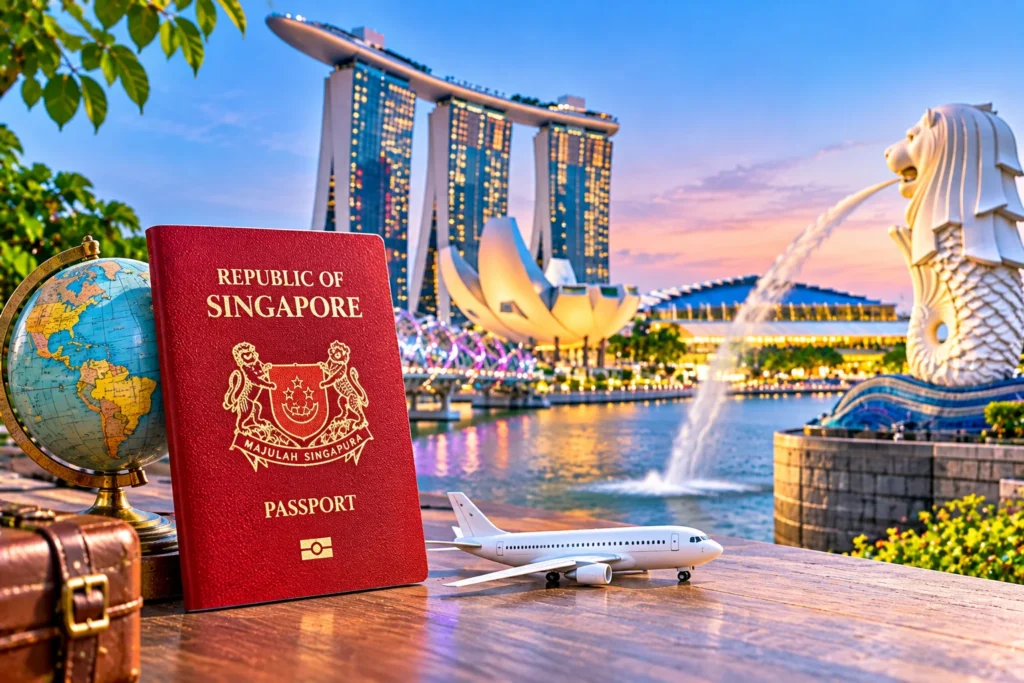
International passenger mobility and outbound tourism dynamics are experiencing renewed expansion as multilateral diplomatic accords, streamlined border procedures, and reciprocal entry frameworks facilitate cross-border travel. Recent comparative documentation compiled from international civil aviation registries and official consular mobility records confirms that Singapore has maintained its standing at the pinnacle of global travel access. With simplified, visa-exempt, or on-arrival entry privileges across 193 global destinations, the Southeast Asian island nation outpaces fellow Commonwealth member states and prominent global travel powerhouses, establishing a benchmark for international transit ease and outbound leisure potential.
Official mobility evaluations that track entry regulations across more than two hundred sovereign territories emphasize that international travel freedom is intrinsically tied to proactive diplomatic engagement, high border integrity, and robust bilateral trade frameworks. Within the fifty-six member countries comprising the Commonwealth, Singapore leads all peers, followed closely by Malta with access to 185 destinations. Malaysia and the United Kingdom share the third position with access to 184 destinations each, while Canada, Australia, and New Zealand maintain reciprocal access across 183 global destinations. Farther along the spectrum, Cyprus provides access to 175 jurisdictions, Barbados connects citizens to 164 destinations, and Brunei rounds out the top tier with access to 163 destinations.
The practical implications of these agreements for international holiday planning and tourism growth are profound. For outbound holidaymakers, spontaneous leisure travelers, and executive delegates, visa exemptions eliminate lengthy administrative consular delays, processing fees, and mandatory pre-departure interviews. Tourism boards and civil aviation directorates consistently observe that passport holders with wide-ranging visa exemptions demonstrate higher outbound departure frequencies, greater average trip duration, and increased holiday spending abroad. The expanded mobility of Singaporean travelers, who enjoy simplified access to ten more destinations than their counterparts from Canada, Australia, or New Zealand, has energized outbound tourism spend across key markets in Europe, the Americas, and the Asia-Pacific region.
A major driver of Singapore’s preeminent standing is its strategic positioning as an international aviation nexus and business gateway. Public announcements from national immigration and checkpoint directorates, paired with diplomatic updates from the Ministry of Foreign Affairs, demonstrate how steady consular negotiations have steadily broadened destination access. Over the course of recent bilateral updates, reciprocal thirty-day mutual visa exemption agreements with key regional economic centers have come into effect, alongside expanded electronic travel facilitation arrangements across emerging tourist regions in Central Asia, Latin America, and the Middle East. These developments have elevated total accessible visa-free or visa-on-arrival destinations from 192 earlier in the period to 193 destinations today.
The global mobility landscape also illustrates contrasting dynamics across fellow Commonwealth economies. While larger continental nations such as Canada, Australia, and the United Kingdom command extensive international flight networks and world-renowned tourist hubs, individual destination requirements vary significantly. For instance, European Union member state Malta benefits from the Schengen Area’s total freedom of movement, giving its citizens statutory residency and employment rights across Europe that extend well beyond standard tourist allowances. Meanwhile, Malaysia’s advancement to 184 destinations highlights expanding diplomatic engagement across Southeast Asia, the Middle East, and the African continent, making its travel document the second most versatile within the Commonwealth’s Asian membership.
Government tourism bureaus in recipient destinations monitor these international mobility indices closely to shape source market marketing campaigns. National destination management agencies recognize that travelers possessing high-mobility travel documents require lower promotional friction to convert interest into confirmed bookings. When simplified electronic travel authorizations or border arrival passes replace traditional advance visas, destination tour operators, hotel chains, and cultural attractions experience accelerated bookings for shoulder-season city breaks and long-haul discovery tours.
Simultaneously, international aviation and immigration authorities emphasize that elevated visa-free counts do not imply an absence of border entry oversight. International civil aviation guidelines and national border agencies remind prospective travelers that visa-free privileges remain subject to established sovereign immigration controls. International travelers must continue to satisfy mandatory pre-boarding clearances, electronic health and immigration declarations, return ticket verifications, financial solvency thresholds, and minimum six-month passport validity rules prior to embarkation.
As international air connectivity continues to rebuild toward long-term developmental milestones, the relationship between diplomatic agility and tourism competitiveness becomes increasingly apparent. Nations that cultivate open consular relationships while upholding modern biometric security standards empower their citizens to explore the world with minimal bureaucratic impediment. By securing broad visa-exempt travel across 193 destinations, Singapore exemplifies how administrative efficiency, border integrity, and strategic foreign diplomacy can create a modern ecosystem of unrestricted global discovery and international cultural exchange.
For more travel news like this, keep reading Global Travel Wire