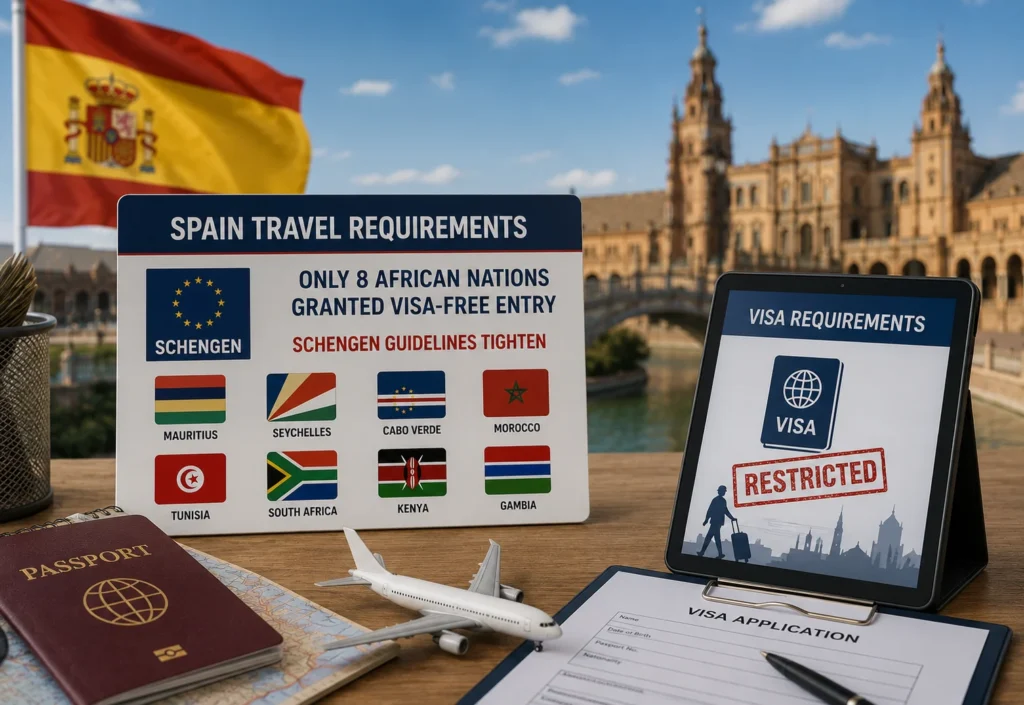
The administration of international border policies is seeing significant updates as Spain clarifies its entry protocols for the year. According to updated consular entry guidelines, Spain has formalized its list of international jurisdictions permitted to bypass standard pre-travel visa applications for short-term stays. Within this updated framework, which coordinates with broader European Union migration policies, only eight African nations have secured visa-free status for ordinary passport holders entering Spain.
This policy update highlights a targeted approach to bilateral travel relations, emphasizing streamlined security cooperation, economic ties, and diplomatic agreements. While travelers from over sixty nations worldwide can enter Spain for leisure or short business trips without submitting administrative applications in advance, the vast majority of passport holders from the African continent will still need to navigate the formal Schengen application process.
The Exemption List: Eight African Nations Granted Streamlined Access
For citizens of the selected eight African nations, the updated travel rules bring a major sigh of relief, eliminating a layer of administrative friction. Starting in the first half of 2026, ordinary passport holders from these specified countries can board flights directly to Spanish airports with only their valid travel documents:
Botswana
Namibia
Eswatini
Lesotho
Mauritius
Seychelles
Cape Verde
Rwanda
This select group of nations represents a mix of regional economic leaders, prominent island tourism hubs, and countries that have made notable progress in international security alignments. By allowing travelers from these markets to enter without prior visa approval, Spain aims to foster stronger cultural exchange, boost commercial ties, and support mutual tourism development. Visitors from these approved countries are permitted to stay in Spain and across the wider Schengen Area for a maximum of 90 days within any 180-day window, provided their visits are strictly for tourism, family visits, or short-term business consultations.
Standard Visa Requirements Stand for Most of the Continent
Despite the streamlined process for the exempt nations, travelers from most other African countries face the same requirements as before. Citizens of major regional economies—including Nigeria, Ghana, Kenya, Morocco, Algeria, Egypt, and Tunisia—must still secure a standard Schengen visa before traveling to Spain.
Spanish consular services emphasize that the application process is designed to ensure orderly border management and verify traveler safety. Because Spain belongs to the Schengen Zone, a visa approved by a Spanish embassy or consulate grants the holder access to explore any of the 29 European countries in the visa-free travel area. However, applicants must apply through the diplomatic mission of the country that serves as their primary destination or their initial point of entry.
Essential Documentation and Application Protocols
For those who must apply for a visa, consular authorities recommend beginning the application process well in advance of the planned departure date. Applications can generally be submitted up to six months before the travel date, giving consular officers plenty of time to process the paperwork.
Applicants must compile a comprehensive dossier of supporting documents to verify their travel intent and financial stability. The standard requirements include:
A Valid Passport: The travel document must have at least two blank pages and remain valid for a minimum of three months beyond the traveler’s planned exit date from the Schengen territory.
Biometric Identification: Recent, high-resolution passport-sized photographs that meet strict European civil standards, along with fingerprint scans taken at an authorized application center.
Proof of Sustenance: Recent bank statements showing sufficient funds to cover daily expenses throughout the stay.
Travel and Medical Insurance: A comprehensive policy with a minimum coverage limit of €30,000, valid for medical emergencies and repatriation across the entire Schengen Zone.
Itinerary Specifics: Confirmed round-trip flight reservations and documented proof of accommodation, such as a certified hotel booking or an official letter of invitation from a host in Spain.
The standard processing fee for adult applicants is set at €90. Consular representatives advise travelers to double-check their application details before submitting, as incomplete forms or unverified bookings are the primary reasons applications face delays or denials.
Fostering Tourism and Managing Border Security
The new framework aims to balance open global tourism with robust border security. Spanish tourism boards project that the ease of entry for the eight exempt nations will spark a notable increase in inbound arrivals from these markets. Eliminating upfront visa costs and wait times allows travelers to plan spontaneous holidays, attend international trade fairs, and book luxury getaways with greater flexibility.
At the same time, Spain remains dedicated to managing its borders in close coordination with European partners. The gradual rollout of new electronic entry systems ensures that even visa-exempt travelers are pre-screened to maintain high standards of public safety. By combining efficient screening with simplified entry rules for select partners, Spain is reinforcing its position as a highly accessible and welcoming global travel destination.
For more travel news like this, keep reading Global Travel Wire