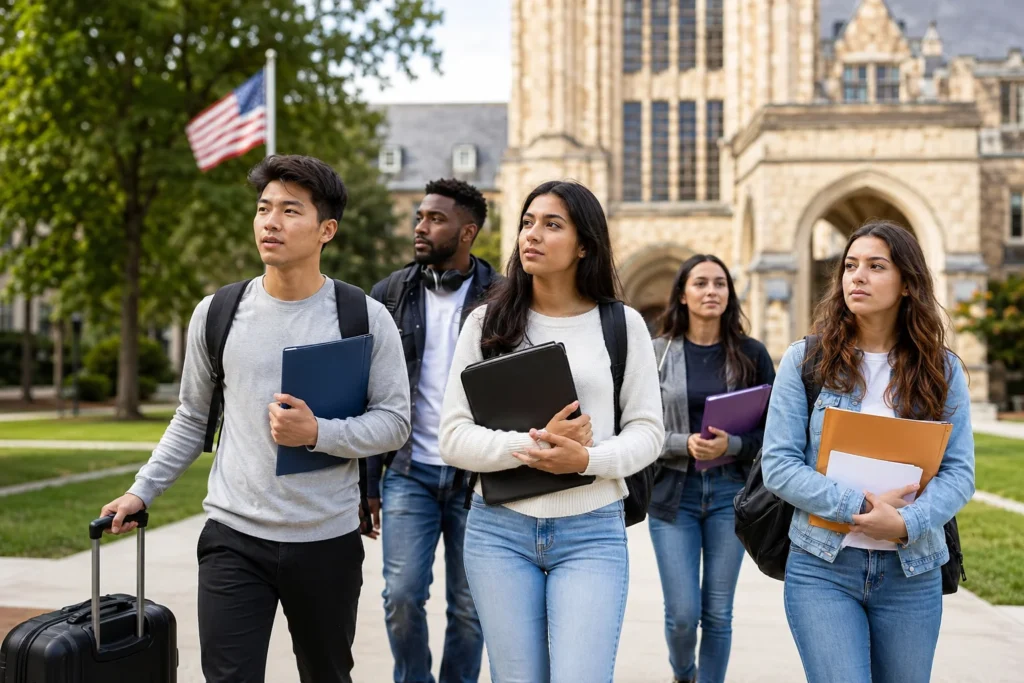
Educational travel to the United States is facing its most significant policy shift in decades. The U.S. Department of Homeland Security has finalized a sweeping regulatory change that completely overhauls how international students, exchange visitors, and foreign media representatives are admitted into the country. By eliminating a long-standing immigration framework, federal authorities are moving toward strict oversight, fundamentally changing the landscape for global students planning their academic journeys in the United States.
For nearly half a century, international students traveling to American universities enjoyed a flexible entry system. Under the new regulations published in the Federal Register, that era has officially come to an end. Understanding these changes is critical for anyone planning a long-term educational stay in the country.
The Shift from Open-Ended Stays to Fixed Admission Caps
Historically, most nonimmigrant students under F-1 classifications and exchange visitors under J-1 classifications entered the country under a policy known as Duration of Status. This framework allowed travelers to legally reside in the United States for as long as they maintained their full-time student status and complied with their educational programs. The system did not enforce a specific, pre-determined departure date on their arrival forms.
The newly finalized framework completely replaces the Duration of Status model with a fixed period of admission. Moving forward, the Department of Homeland Security will admit international travelers for the precise length of their academic or exchange program, capped at a maximum ceiling of four years. Even if a specialized degree or doctorate takes longer to complete, the initial admission period will not cross this four-year threshold.
Mandatory Federal Extensions and New Adjudication Rules
The introduction of a four-year limit does not mean that every international student must immediately leave the country upon reaching the cap. However, it does add an extra layer of bureaucracy. Under the new rules, any visa holder who requires additional time to finish their degree program, complete a residency, or advance their studies must formally apply for an Extension of Stay directly through U.S. Citizenship and Immigration Services.
This shift transitions the primary oversight of student stay durations away from local university staff and brings it back under direct federal supervision. Students seeking extensions will be required to submit formal documentation, undergo biometric vetting, and clear background checks. Because federal processing times can vary, educational travelers will need to plan their schedules months in advance to avoid unintentionally accumulating unlawful presence.
Departure Grace Period Cut in Half
Beyond the initial length of stay, the new rule significantly alters the timeline for students wrapping up their studies. Under the previous guidelines, F-1 students were granted a 60-day grace period after graduation to prepare for departure, apply for a new academic program, or transition to a different visa status.
The updated policy slashes this grace period down to 30 days. This reduction leaves international students with half the time to finalize their post-graduation plans, pack their belongings, or complete mandatory immigration filings. Consequently, early planning becomes an absolute necessity for anyone looking to transition smoothly out of their academic program without violating immigration law.
What the Updates Mean for Optional Practical Training
A major point of discussion for international students involves the future of post-completion work opportunities. Optional Practical Training and the specialized Science, Technology, Engineering, and Math extensions remain available under the new framework. The core mechanism of these training benefits has not been abolished.
The key change lies in how the timeline is managed. If a student’s authorized training period extends past their initial fixed admission date, they will need to file a formal extension application alongside their training request. Students should not assume that the four-year cap automatically disqualifies them from practical training opportunities; rather, it introduces a separate requirement to synchronize their physical authorized stay dates with their work authorizations.
Transition Provisions for Current Students in the United States
For international students who are already enrolled in American institutions under the older framework, the Department of Homeland Security has outlined specific transition measures. Current F-1 and J-1 visa holders will automatically transition into the new system, with their authorized stays remaining valid through their current program end date or up to a maximum of four additional years from the rule’s effective date.
However, international travel introduces a vital caveat to this transition window. If an active student departs the United States and attempts to re-enter after the new regulations take effect, they will be admitted under the new fixed-period framework. Their new arrival documentation will display a specific expiration date aligned with their program parameters and the four-year ceiling.
Timeline and Next Steps for International Travelers
The Department of Homeland Security officially announced the final rule on July 16, 2026, with publication in the Federal Register following on July 17, 2026. The new fixed-term admission system is scheduled to take full effect on September 15, 2026. Until that formal implementation date arrives, the traditional Duration of Status rules remain active for incoming travelers.
Prospective and current students do not need to alter their immediate travel plans, but staying proactive is vital. Reviewing the exact dates listed on educational forms, maintaining continuous contact with university international student offices, and monitoring direct updates from official federal channels will ensure a seamless experience under the changing U.S. immigration landscape.
For more travel news like this, keep reading Global Travel Wire