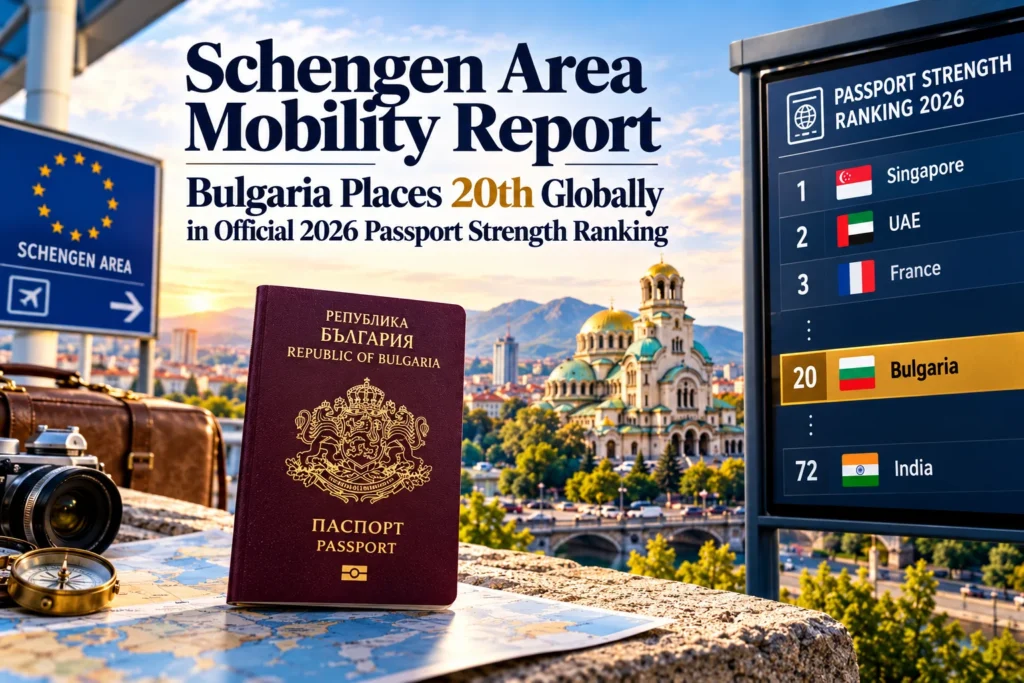
Official global travel data published on October 13, 2026, reveals updated international mobility benchmarks across European nations. In the comprehensive evaluation released by Passport Reports, Bulgaria holds 20th position worldwide in overall global passport power while placing 21st among the 29 member states of the border-free Schengen Area.
The published rankings evaluate international access privileges, cross-border travel efficiency, and visa mobility standards across 199 countries and territories. The comparative study provides essential guidance for international travelers, diplomatic bodies, and aviation hubs managing European transit networks.
How European and Schengen Area Nations Compare
Regional metrics within the Schengen Area showcase tight competition among Central and Eastern European nations regarding international travel access.
Leading Schengen Nations: Croatia ranks 19th among Schengen member states, while Romania holds the 20th position, placing just ahead of Bulgaria.
Following European States: Immediately following Bulgaria’s 21st position in the Schengen area lineup, the Czech Republic places 22nd, followed by Latvia in 23rd place.
Broader European Standings: Slovakia ranks 24th, Slovenia 25th, Estonia 26th, Lithuania 27th, Liechtenstein 28th, and Iceland occupies the 29th position among Schengen states.
The overall index is led by Luxembourg in first place, with Spain and Switzerland securing second and third positions globally. Belgium claims fourth place, followed by France in fifth, Denmark in sixth, Finland in seventh, Germany in eighth, Italy in ninth, and the Netherlands in tenth place.
Within the top twenty rankings, Sweden holds 11th position, followed by Norway in 12th, Malta in 13th, Greece in 14th, Portugal in 15th, Austria in 16th, Hungary in 17th, and Poland in 18th place worldwide.
Standardized Evaluation Methodology and Criteria
Passport Reports operates as an independent global research platform producing comparative passport reports across 199 countries in 34 distinct languages. Assessment rules apply standardized, publicly transparent criteria to establish consistent travel mobility scores for every national document.
The overall mobility score measures destinations that citizens can access under three core entry categories:
Visa-Free Access: Destinations allowing immediate border entry without prior entry authorizations or visa fees.
Electronic Travel Authorization (eTA): Border control jurisdictions requiring pre-departure digital registration.
Visa on Arrival: Destinations issuing entry permissions directly at border checkpoints or international arrival terminals.
When national passports achieve identical aggregate mobility scores, the evaluation platform applies a standardized tie-breaking process. The platform first compares the total count of completely visa-free destinations. If scores remain identical, it compares destinations requiring electronic travel authorization, followed by locations permitting visas on arrival. Passports sharing identical totals across all three comparative tiers receive equal global rankings.
Essential Guidance for International Travelers
Because bilateral entry policies, visa exemptions, and border regulation frameworks undergo regular updates, travelers are officially advised to verify destination-specific entry rules with relevant diplomatic missions or government immigration portals prior to booking international transit.
For more travel news like this, keep reading Global Travel Wire