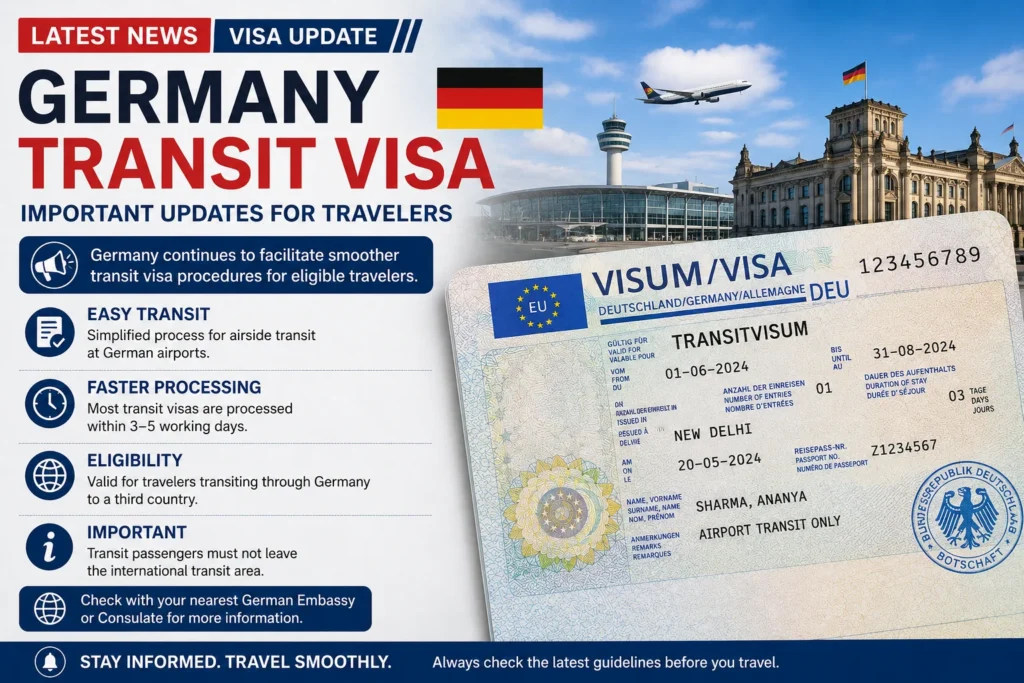
The landscape of international aviation has become significantly easier to navigate for travelers from South Asia. In a major policy shift aimed at fostering global mobility, the Federal Republic of Germany has officially removed the requirement for Indian nationals to hold an airport transit visa when transiting through its international gateways. This landmark directive scales back a long-standing travel restriction, streamlining connections for thousands of passengers utilizing European hubs on their way to final destinations across North America, non-Schengen Europe, and Latin America.
The official implementation was formalized through an executive announcement published in Germany’s Federal Law Gazette, the Bundesgesetzblatt. Following its publication, the new travel rules took effect immediately. In a joint diplomatic acknowledgement, representatives from both the German Embassy in New Delhi and India’s Ministry of External Affairs confirmed that the updated protocols have been integrated into international immigration systems, marking a historic turning point in bilateral connectivity.
Strategic Geopolitical Cooperation and Diplomatic Framework
The swift operationalization of this policy stems directly from high-level geopolitical discussions held earlier this year. The initial agreement was negotiated during a state visit to India by German Chancellor Friedrich Merz, where he met with Indian Prime Minister Narendra Modi. The leaders focused heavily on eliminating administrative bottlenecks, modernizing economic frameworks, and accelerating people-to-people exchanges between the two nations.
Statements released by the Ministry of External Affairs emphasized that India warmly welcomes the completion of this arrangement. According to official diplomatic briefings, the move reflects deep bilateral trust and aligns with Germany’s overarching strategy to attract global talent, boost international commerce, and position its primary airports as world-class transit zones. This development follows a similar decision enacted by France, making the two largest economies in Western Europe key corridors for hassle-free Indian transit.
Key Conditions and Border Security Protocols
While the updated guidelines represent an enormous step forward in traveler convenience, immigration departments have stressed that passengers must understand the strict operational boundaries of this waiver. The transit visa exemption is structured around definitive border security rules to ensure secure airside-only routing:
Strict Airside Limitations: The waiver applies exclusively to Type A airport transit scenarios. Passengers must remain entirely within the secure, designated international transit area of the German airport. Leaving the terminal to enter domestic territory remains strictly forbidden without proper entry visas.
Single-Point European Layovers: The rule applies solely to travelers transiting through a single German airport on their way to a non-Schengen destination. If an itinerary requires connecting through two or more airports within the Schengen zone, standard Schengen visa requirements apply.
Checked Baggage and Through-Ticketing: Travelers must be booked on a single, continuous through-ticket where checked luggage is tagged directly to the final destination. The exemption does not cover split tickets or itineraries that require checking in again or retrieving baggage at a German terminal.
Valid Destination Documents: Passengers bear full legal responsibility for presenting valid ordinary passports along with all required entry visas, transit permits, or health clearances mandated by their ultimate destination country.
Boosting Global Aviation Infrastructure and Commercial Travel
The elimination of the transit visa bottleneck is poised to drastically alter international flight booking trends. Major German air gateways, such as Frankfurt Airport and Munich Airport, stand as some of the busiest connecting facilities in the global aviation industry. By removing the stress of advance visa appointments, additional fees, and administrative backlogs, Germany instantly elevates its competitive position as a preferred transit hub for long-haul passenger traffic originating from the Indian subcontinent.
The structural change has been met with praise from major commercial aviation groups. Major European carriers, which maintain extensive flight schedules connecting major Indian metropolises like New Delhi, Mumbai, Bengaluru, and Hyderabad to mainland Europe, have recognized the policy as a vital catalyst for passenger growth. To leverage the simplified border regulations, airlines are actively rolling out targeted operational upgrades, including the deployment of modernized long-haul aircraft cabins and optimized layover schedules to accommodate rising numbers of business executives, international students, and leisure tourists.
Furthermore, these adjustments coincide with enhanced commercial passenger perks. International airlines operating through German hubs have recently extended premium frequent flyer incentives, including flexible youth and student fare categories that accommodate higher checked baggage caps and zero-penalty booking modifications. Combined with state-of-the-art transit lounges featuring premium work centers, relaxation zones, and digital checking facilities, the new framework promises a fundamentally elevated end-to-end journey for travelers exploring the world via Germany.
For more travel news like this, keep reading Global Travel Wire