Government immigration authorities and statutory tourism bodies in South Africa have enacted significant enhancements to the national digital border architecture, modernising the entry framework for international holidaymakers and corporate visitors. According to official announcements issued by the Department of Home Affairs and South African Tourism, the Electronic Travel Authorisation platform has been upgraded to accommodate family units, tour groups, and traveling minors. This technological enhancement marks a decisive step toward eliminating administrative friction for inbound visitors, particularly from high-priority outbound regions such as India.
The upgraded digital ecosystem allows eligible passport holders to complete pre-travel clearance entirely through a remote, web-enabled interface. By removing the conventional requirement to visit physical visa application centers, submit physical passports for paper visa stickers, or navigate fragmented single-entry paperwork, authorities are aligning border control systems with global best practices in digital visitor facilitation.
Advanced Group Portals and Streamlined Verification for Young Travellers
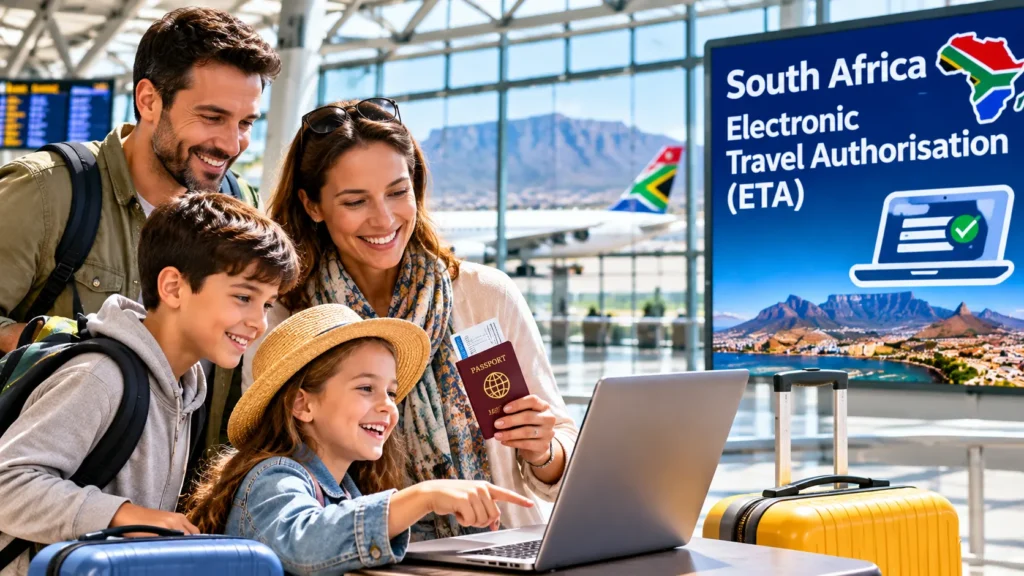
A central component of the latest functional update is the introduction of a dedicated multi-applicant facility. Under this integrated feature, heads of households, family representatives, and organized tour operators can compile and submit entries for multiple travellers under a consolidated administrative dashboard. This unified mechanism eliminates the historic burden of managing disparate credentials and individual transaction steps, providing an organized approach for multi-generational parties.
Parallel to group processing, immigration authorities have established explicit, child-focused provisions within the digital infrastructure. The platform now supports dedicated applications for minors, integrating biometric data capture and identity validation. Children aged seven years and older are formally enrolled through the Home Affairs National Identification System. By integrating modern identity verification standards directly into the digital clearance framework, border officials can uphold stringent child safeguarding protocols and verify parental custody documentation while avoiding airport terminal bottlenecks.
Comprehensive Transition from Traditional eVisa to Digital Pre-Authorisation
The expansion builds upon a phased implementation strategy initiated by public authorities across August and September. The electronic travel authorisation framework now encompasses fifty-three nations globally, absorbing all sovereign jurisdictions that previously operated under the Department of Home Affairs legacy eVisa program.
To complete the institutional shift toward a unified, automated immigration border architecture, official directives confirm that the legacy eVisa portal will be permanently decommissioned on 1 December 2026. Authorities are actively conducting comprehensive stress testing to verify system scalability, server stability, and network throughput ahead of the shutdown deadline.
In coordination with regional diplomatic missions and overseas trade offices, ongoing stakeholder onboarding programmes are underway. These operational briefings aim to familiarise international carriers, aviation ground staff, registered tour planners, and commercial travel agents with the revised pre-travel clearance protocols. Transport operators are being trained to verify digital authorization barcodes and validation records prior to issuing passenger boarding passes for flights bound for South African international gateways.
Strengthening Visitor Inflows Ahead of Global Sporting Spectacles
The strategic modernization of cross-border travel procedures directly supports national economic development goals, with immigration adjustments specifically tailored to accommodate rising passenger traffic ahead of premier global sporting tournaments, most notably the ICC Men’s Cricket World Cup 2027.
South African Tourism officials note that international travelers, especially from key growth corridors like India, increasingly prioritize holiday destinations that combine world-class recreation with administrative convenience. Streamlining travel authorization is anticipated to encourage sports enthusiasts attending international matches to extend their stays, dispersing economic benefits into regional hospitality, culinary, wildlife conservation, and eco-safari sectors across all nine provinces.
Tourism authorities emphasize that visitors traveling for sports fixtures frequently seek comprehensive itineraries that encompass Big Five game drives in national parks, marine excursions along coastal corridors, scenic exploration across the Western Cape winelands, and heritage tours within vibrant urban hubs such as Johannesburg and Durban. By lowering bureaucratic barriers, public tourism agencies aim to convert brief tournament attendance into extended leisure vacations.
Legal Pre-Clearance Guidelines and Border Entry Protocols
Immigration authorities reiterate that an approved electronic travel authorisation functions as an advance pre-travel permission, designed to verify eligibility and enhance security screening before departure. The electronic credential grants permission to travel to a designated port of entry, while final legal authority regarding port-of-entry admission remains under the sovereign jurisdiction of the Border Management Authority upon passenger arrival.
International voyagers planning itineraries to South Africa are advised to confirm individual nationality eligibility directly on the official Department of Home Affairs online portal prior to booking transport. Applicants must ensure their passports meet statutory validity standards and submit documentation well in advance of departure schedules to avoid unexpected disruptions to their travel plans.
Through coordinated administrative digitization, expanded group processing capabilities, and a commitment to modern border management, South Africa is reinforcing its standing as a welcoming, accessible, and forward-thinking destination on the global tourism stage.
For more travel news like this, keep reading Global Travel Wire