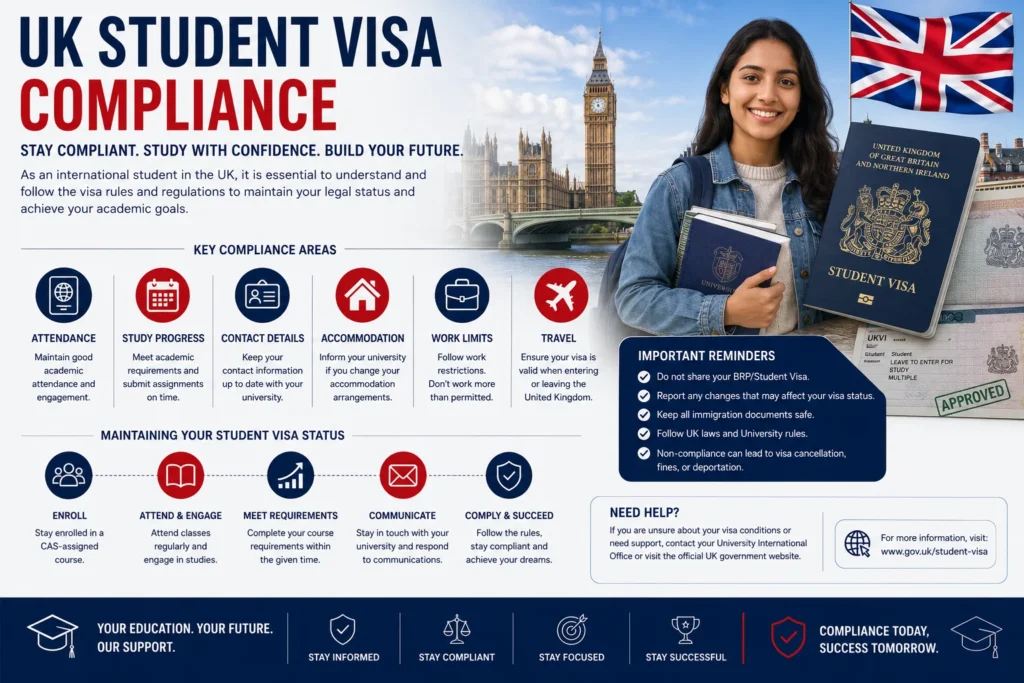
The Home Office of the United Kingdom has formally enacted an extensive restructuring of its student visa compliance framework, detailing strict new international recruitment standards for higher education institutions. Under the newly configured mandate, universities and independent colleges face the immediate suspension of their foreign student recruitment rights if they fail to meet elevated performance thresholds. The regulatory intervention is engineered to address persistent gaps in system integrity, particularly surrounding localized visa non-compliance and unverified course withdrawals.
According to statistical performance metrics published directly by the Home Office, the aggressive joint enforcement strategies deployed across the higher education sector have already yielded significant progress. Official data confirms that student-linked asylum claims have experienced a notable 30 percent contraction over the past twelve months. This positive shift follows an intense period of cross-departmental collaboration aimed at eliminating the exploitation of academic entry paths for alternative economic motivations. Additionally, the Home Office has instituted a first-of-its-kind visa brake restricting student entry from specific nations—including Afghanistan, Cameroon, Myanmar, and Sudan—following sharp upturns in localized protection applications originating from those jurisdictions.
Tightening the Metrics: The Advanced Annual Sponsor Compliance Matrix
The core structural adjustment introduced by the updated policy rests on a substantial elevation of the pass marks utilized during annual sponsor license assessments. The government has systematically modified all three key metrics that determine whether an educational institution retains its legal status as a trusted visa sponsor. Higher education providers must now realign their internal application screening processes to meet these revised minimum compliance targets:
Maximum Permissible Visa Refusal Rate: Reduced to less than 5 percent, tightening the previous limit of 10 percent to ensure institutions conduct extensive due diligence prior to issuing compliance certificates.
Minimum Course Enrolment Rate: Elevated to at least 95 percent, an increase from the historical baseline of 90 percent, to verify that arriving individuals successfully matriculate into their intended programs.
Minimum Academic Course Completion Rate: Raised to a strict 90 percent threshold from the previous 85 percent, directly penalizing institutions that experience excessive student dropout frequencies.
Speaking during an official structural review at Manchester Metropolitan University, Parliamentary Under-Secretary of State for Migration and Citizenship Mike Tapp emphasized that while the United Kingdom remains proud of its world-class academic institutions, the student visa pipeline must never function as a secondary mechanism for unauthorized labor markets. The migration department noted that exceptionally high drop-out numbers frequently provide a strong statistical warning that individuals have drifted away from formal education to enter the unregulated local workforce.
Launching the Digital Traffic Light Framework for Academic Sponsors
To provide absolute operational transparency for both the public and independent regulators, the Home Office is finalizing the development of a automated traffic light rating system, scheduled for full implementation by the summer of 2027. This public dashboard will separate institutional recruitment networks into distinct categories based on their real-time adherence to the new student visa compliance guidelines.
Sponsors designated with a red rating will instantly face severe caps on the total volume of international students they are permitted to register for upcoming academic terms. Furthermore, non-compliant institutions will be legally required to finance and execute a comprehensive 12-month administrative action plan under direct Home Office supervision to remedy flawed screening methods. Educational facilities that fail to achieve measurable improvement across the core completion and enrollment targets by the end of this probationary window will face the permanent revocation of their international sponsor licenses.
Balancing National Export Income and Strict Regulatory Oversight
The structural shift comes at a delicate economic moment for the United Kingdom’s wider international education infrastructure, which remains an important driver of national service exports. Analytical reports compiled by Universities UK highlight that international students generate approximately £37 billion in vital export earnings annually, injecting significant capital into regional municipal economies, hospitality networks, and localized infrastructure projects.
University administrators note that recent contractions in international registrations have already forced selected campuses to implement wide-ranging cost-cutting operations and workforce reductions. While fully endorsing the government’s drive to maintain system integrity, academic boards are calling for enhanced data-sharing channels. In response, immigration enforcement agencies are establishing secure data transmission systems to supply university admissions offices with real-time feedback regarding global visa patterns, allowing sponsors to intercept suspicious recruitment networks before applications reach official border clearance points.
Concurrently, border agencies have utilized targeted communication channels to contact roughly 306,000 international students whose authorized stay permits are nearing expiration. The formal alerts explicitly warn that meritless or tactical applications designed to delay departure will be processed and refused swiftly, requiring individuals without valid leave to remain to vacate sovereign territory or face compulsory administrative removal. By combining strict data tracking with clear institutional boundaries, the revised civil aviation and immigration framework aims to preserve the global prestige of the nation’s academic infrastructure while re-establishing absolute control over net migration levels.
For more travel news like this, keep reading Global Travel Wire